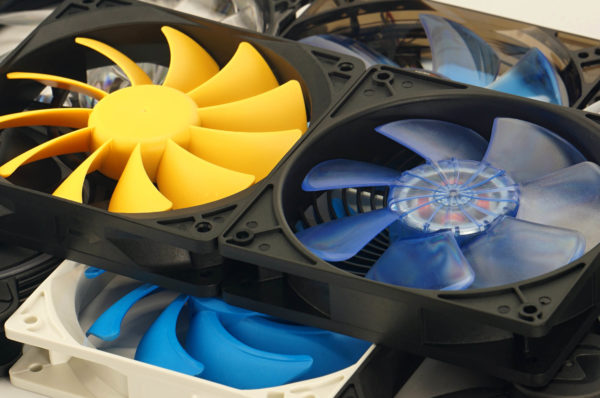
You know the feeling: moderate expectations, and then a surprise. With the MaxFlow fan, a fairly positive one. It delivers excellent results not only at its maximum speed, but also in quieter operation. However, it is weaker with obstacles, where it has to overcome higher resistance from the surrounding environment, and it should also be noted that, as with the Phanteks T30 and Sudokoo Mach120, its thicker profile means poorer compatibility. Read more “Seasonic MaxFlow fan: Still “water” runs deep”
Category: Fans
Fan frame daisy-chaining trend. When is it (not) helpful
Easier installation? Yes, that’s why it’s done. Daisy-chaining fans using contacts in their frames is great, but it often also comes with pitfalls that reduce “cooling efficiency”. Manufacturers deal with this in different ways. One does it technically one way, another differently. In any case, they know that a frame that is too thick means less space for the blades. And that does not improve airflow per unit of noise. Read more “Fan frame daisy-chaining trend. When is it (not) helpful”
Arctic BioniX P14 A-RGB: Elegant daisy chaining is just the beginning
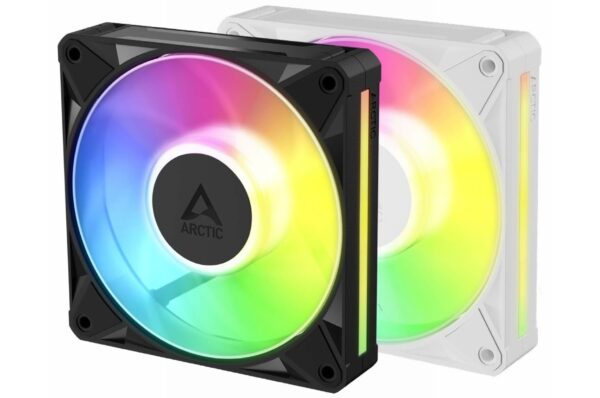
High cooling efficiency is the foundation, but with the BioniX P14 A-RGB fans, Arctic has also made efforts on other fronts. In addition to the clever daisy-chaining method (with the aim of reducing cabling to a minimum), this includes, for example, illumination as intense as possible. The light is guided not only through the entire impeller, but also through the surface of the frame, from the side. There are light guides in these areas as well. Read more “Arctic BioniX P14 A-RGB: Elegant daisy chaining is just the beginning”
Arctic BioniX P12 A-RGB: Efficient, inexpensive, illuminated and…
And with very clever daisy‑chaining from one fan to the next. This is what can fill in the ellipsis in the headline. The aerodynamic efficiency remains top‑tier, built on a design that Arctic revised some time ago (with the P12 Pro fans), but which can still be considered “new.” The BioniX P12 A‑RGB fans certainly are (new), and in this in‑depth analysis we focus on how they work. Read more “Arctic BioniX P12 A-RGB: Efficient, inexpensive, illuminated and…”
ID-Cooling AM-120-K: Bet on an Elegant Geometry
It has exactly the elements that make an inexpensive fan aerodynamically efficient and acoustically unobtrusive. Or rather, not too obtrusive—at least at lower, non‑high speeds. At higher speeds, every fan is “noisy,” but making a low‑cost fan that can still be described as pleasant to the ear is already something of a feat. We can, however, state that ID‑Cooling has achieved this with the AM‑120‑K model. Read more “ID-Cooling AM-120-K: Bet on an Elegant Geometry”
BioniX (P) now with seven blades, smarter daisy-chaining
Arctic’s new BioniX fans, which adopt a seven-blade geometry, just like the “base” P1x A-RGB models, are nearing release. Based on the results of the older BioniX “P” fans, it can be assumed that aerodynamic efficiency will be higher this time. Alongside the fans, Arctic is also preparing a fan hub to which they can be connected. The method of daisy-chaining one fan to the next is innovative as well. Read more “BioniX (P) now with seven blades, smarter daisy-chaining”
ASRock at Computex: 3200W PSU, unique AIOs and LCP fans
One company out of the big four has been missing from our coverage of Computex 2026: ASRock. This year’s Computex 2026 is tied to an anniversary for ASRock as well, as the company is celebrating the 10 years of its Taichi hardware lineup. The occasion is being marked with new hardware too: ASRock has unveiled new motherboards, graphics cards, power supplies with protection against cable melting, as well as coolers and fans. Read more “ASRock at Computex: 3200W PSU, unique AIOs and LCP fans”
FD Dynamic 3: Efficient design (from Momentums) cheaper
They’re built on an exceptionally efficient aerodynamic design, but come at a lower price point. Using more flexible blades reduces manufacturing costs, and the bearings in the Dynamic 3 fans are also “simpler” compared to the Momentum series. For the user, this doesn’t necessarily mean any major drawback—on the contrary, you can look forward to more pronounced lighting, enabled in part by a larger area of light‑conducting material. Read more “FD Dynamic 3: Efficient design (from Momentums) cheaper”
If aluminium fans, then fully aluminium (including the impeller)
For it to be possible to speak of a fully metallic construction, the basic prerequisite is that the blades are also made of such material. This applies to Cooler Master’s “A” series fans, whereas the lower-end—or cheaper, interpret that however you prefer—model uses aluminium only for the frame. Yes, this can still be described as a metal fan, but it is somewhat of a… “hybrid” design, although one equipped with RGB lighting as well. Read more “If aluminium fans, then fully aluminium (including the impeller)”
Primarily quieter operation: Arctic P12 Pro (A-RGB) LN fans
Arctic has expanded its fan portfolio with new P12 Pro (A-RGB) models carrying the “LN” suffix in their designation. This stands for “low-noise” and in practice mainly means that maximum speeds are capped lower than on the original (P12 Pro/A-RGB) fans. However, the aerodynamic design itself remains unchanged, with the primary difference being the motor. At the same time, these are still affordable fans. Read more “Primarily quieter operation: Arctic P12 Pro (A-RGB) LN fans”
Which fan to choose—and when? From premium to budget models
Too inaccessible for “ordinary” readers? That is how our fan testing is sometimes described, and we understand why. That is exactly why the following initiative exists—we will try to ensure everyone can quickly orient themselves around which of the many available fans makes the most sense under specific circumstances. More expensive, cheaper—there is room for everything. And of course, you can also ask questions. Read more “Which fan to choose—and when? From premium to budget models”
Why is Gamers Nexus “stringing” its audience? Possible reasons
They promised, collected money from people, and it has now actually been nearly five years since the Gamers Nexus team announced uncompromising fan testing. Yet those tests still have not materialized, and public questions on the subject are often ignored by the creators. As always, there are multiple possible scenarios as to what may have happened. In the following article, all that remains is speculation about how things may be unfolding. Read more “Why is Gamers Nexus “stringing” its audience? Possible reasons”
Noctua NF-A12x25 G2 PWM fans now also available in black
For users who do not like the original brown-and-beige color scheme, Noctua is releasing NF-A12x25 G2 fans in the chromax.black variant. This combines more visually attractive styling with the exceptional aerodynamic properties associated with top-tier positions in charts measuring relative airflow per unit of noise. Yes, the foundation remains the highest possible cooling performance at the lowest possible noise level. Read more “Noctua NF-A12x25 G2 PWM fans now also available in black”
Endorfy Corona 120 Reverse: Attractive mainly visually
You’ve already seen the tests of the Endorfy Corona 120 fans, and now we’re adding results for the “reverse” variants. The aerodynamic design is essentially the same—just… reversed. The emphasis on visual appeal is therefore even stronger. The colorful lighting is complemented by an element intended to make the result even more striking. You won’t see the stator struts interfering with the appearance. Read more “Endorfy Corona 120 Reverse: Attractive mainly visually”
Analysis: Which PC fans vibrate the least?
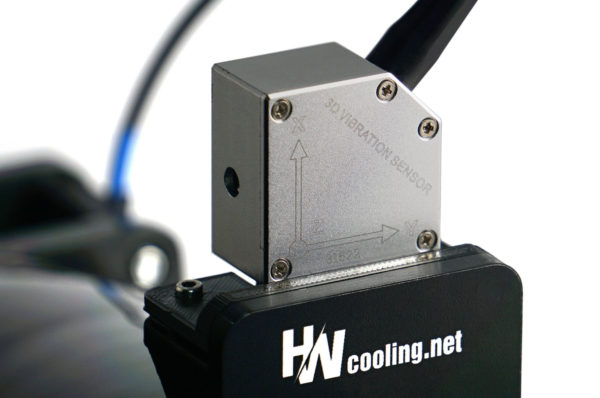
So which ones? Vibrations of more than a hundred PC fans collected in one place, in both 120 mm and 140 mm formats—the ones most widely used among PC builders. Some models vibrate more, others less, or not at all. The scenarios vary, as is natural. The task is to make sense of it all based on exact measurements. These are compiled into clear graphs. Yes, you’ve seen them before. Read more “Analysis: Which PC fans vibrate the least?”


Latest comments