Intel’s new Arc “Battlemage” gaming GPUs coming out next month

No new GPUs from Nvidia are expected to hit the market this year with the new products will be revealed in January (at CES 2025). But one possibly important premiere in the world of gaming GPUs is still slated to happen this year – Intel’s new Arc desktop GPUs, the Battlemage architecture, will be released. It looks surprisingly good in the mobile Lunar Lake processors, so Arc “Battlemage” desktop graphics cards might finally be worth it. Read more “Intel’s new Arc “Battlemage” gaming GPUs coming out next month” »

Added Value of the Nvidia App: Quick Latency Insights via HUD

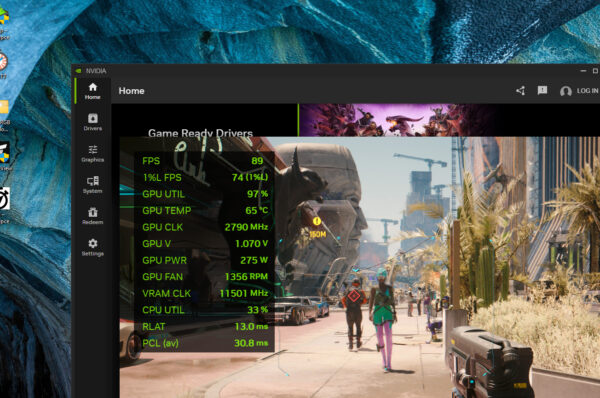
Questions about when will Nvidia modernize the control panel for graphics cards have been around since a decade ago. They were only answered this year when Nvidia unveiled a beta version of the successor to the control panel and the GeForce experience. We take a look at one of the new features it offers – OSD, HUD, in short an overlay window that, alongside the usual monitoring values, can display real-time PC latencies. Read more “Added Value of the Nvidia App: Quick Latency Insights via HUD” »

Introduction to input lag testing with AMD Frame Latency Meter

Frame rate has been the only metric for comparing performance in games. Even at smooth frame rates, however, gaming can be uncomfortable if there is a significant amount of input lag – the game responds to controls with noticeable lag. There are countless tools for measuring frame rates, but unfortunately not for testing responsiveness. Here we introduce the specialized Frame Latency Meter recently made available by AMD. Read more “Introduction to input lag testing with AMD Frame Latency Meter” »

3DMark Steel Nomad and three generations of graphics cards in test

UL Solutions’ 3DMark suite of performance tests recently added a new multi-platform test, Steel Nomad. With it, UL aims to replace the popular Time Spy in DirectX 12 for Windows while offering cross-platform performance measurement on other modern gaming platforms using other APIs such as Vulkan for Windows on Arm and Android and Metal for Apple iOS. Read more “3DMark Steel Nomad and three generations of graphics cards in test” »

Intel catching up with Radeons? Battlemage GPUs will clock high

Intel is expected to launch the second generation Arc gaming graphics cards late this year, or early 2025. Their Alchemist generation suffered from various flaws (high idle power consumption, for example) and a less mature ecosystem but it’s still the most successful (and the only usable yet) attempt to produce an alternative to GeForce and Radeon graphics cards. The next generation, Battlemage, could hopefully take it further. Read more “Intel catching up with Radeons? Battlemage GPUs will clock high” »

New Nvidia GPUs: GeForce RTX 5080 and RTX 5090 specs

It looks like the release of the next generation of Nvidia graphics cards got closer again. Major news about its Blackwell architecture GPUs was leaked on the web, or more accurately on (former) Twitter, yesterday – the specs of the two highest performance models that are due out first: the GeForce RTX 5080 and the new high-end, GeForce RTX 5090. And there’s a surprise: the specs of the high-end have improved compared to previous reports. Read more “New Nvidia GPUs: GeForce RTX 5080 and RTX 5090 specs” »

UDNA: Next-gen architecture will unite AMD’s gaming and AI GPUs

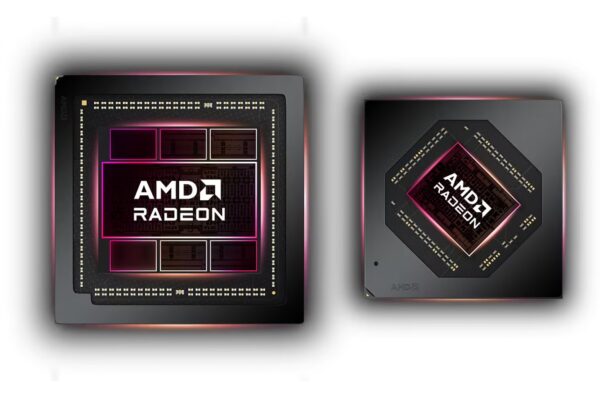
The next generation AMD GPUs with RDNA 4 architecture should be coming soon. The company has now confirmed the rumors that high-end models will not be released in this generation and it will cover only part of the performance and price range. But the company also discussed their long-term roadmaps for the Radeon and Instinct GPU architectures. It seems we could be in for a change as significant as the transition from GCN to RDNA. Read more “UDNA: Next-gen architecture will unite AMD’s gaming and AI GPUs” »

AMD prepares three Radeons with Navi 48, we have memory specs

This week, the first leak of a Radeon RX 8000 in the Geekbench database appeared online. It could have been an ES sample of this GPU or a similar early prototype, so it’s unclear how close these GPUs are to launch. But this seems to have kicked off leaks for this new generation of AMD graphics cards. A bit more detail has now surfaced on the web about what to expect from these GPUs, especially the more powerful mainstream Navi 48 GPU. Read more “AMD prepares three Radeons with Navi 48, we have memory specs” »

AFMF 2: Universal frame generation has better quality, performance

It’s been almost a year since the release of AMD Fluid Motion Frames (AFMF) for Radeon GPU users, which is an alternative solution to generating interpolated frames as provided by DLSS 3 or FSR 3, but for games that don’t offer those features. In fact, AFMF works at the driver level and generates frames without any game integration. A second improved version of AFMF 2 is now out with higher quality and better compatibility. Read more “AFMF 2: Universal frame generation has better quality, performance” »

“All” graphics cards in in-depth coil whine analysis

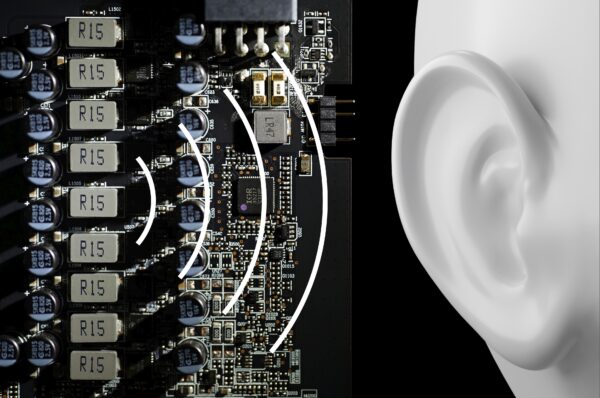
The number of graphics cards tested over the recent period has reached a number after which we can pause a bit and specifically focus on the noise level of their coils. The latter has always been recorded in standard measurements, but in large tests with lots of other information, this unique data was getting lost. That is why it will now, within the scope of this article, be limited to these only. So which of the modern graphics cards has the quieter coils? Read more ““All” graphics cards in in-depth coil whine analysis” »

Intel Arc Battlemage discrete GPUs use TSMC’s 4nm node

Intel should finally release a generation of its discrete “Battlemage” graphics cards with Xe2 HPG architecture later this year, but it will be competing with AMD’s Radeon RX 8000 and Nvidia’s GeForce RTX 5000 cards for most of its lifetime. It does look like Intel will have one advantage on its side, though – Battlemage will be on the same manufacturing node, and at least that way it won’t be disadvantaged right off the bat. Read more “Intel Arc Battlemage discrete GPUs use TSMC’s 4nm node” »

Gigabyte RX 7900 GRE Gaming OC 16G in test of 30 graphics cards

The most “lightweight” AMD Navi 31 (XL) GPU, the slowest memory subsystem, but also the lowest price. That’s the RX 7900 GRE compared to the RX 7900 XT. This Radeon is also noticeably cheaper compared to the RTX 4070 Super, although the GeForce’s power efficiency is more favorable. The gaming performance of the RX 7900 GRE (RTX 4070S), meanwhile, is comparable. That is, as long as you won’t miss ray-tracing graphics. Read more “Gigabyte RX 7900 GRE Gaming OC 16G in test of 30 graphics cards” »

RDNA 4 said to mostly be patched RDNA 3, RDNA 5 completely new

AMD hasn’t yet released the next-gen Radeon RX 8000 graphics cards, which will use the RDNA 4 architecture, so it’s probably a long time to the arrival of the following generation, which could be called RDNA 5 – but maybe also totally differently. Still, the first unofficial rumors have now surfaced about what RDNA 5 could mean in Radeon GPUs. This architecture could be a significant leap forward, unlike RDNA 3 and the upcoming RDNA 4. Read more “RDNA 4 said to mostly be patched RDNA 3, RDNA 5 completely new” »

New Nvidia GPUs this year? The cheaper RTX 5080 to be the first

We got news on next-gen graphics cards, which should be out in the second half of the year (or early next year). This time, they pertain to Nvidia’s upcoming cards, GeForce RTX 5000s with Blackwell GPUs. Two rumors arrived shortly after each other, initially claiming that Nvidia would release only the most expensive model this year, but this was almost immediately corrected to more affordable model actually being the first out. Read more “New Nvidia GPUs this year? The cheaper RTX 5080 to be the first” »

Caveat: RGB LEDs can damage graphics cards and other hardware

A curious “scandal” has now surfaced on the Internet: it seems that decorative RGB LEDs in your computer may not be a purely cosmetic feature that has no effect on the hardware. Users on social media have noticed that the illumination can leave an irreversible mark on your hardware, so to speak, such as on a graphics card that you have next to your RGB memory. Whether this can also have adverse effects on users is hard to say. Read more “Caveat: RGB LEDs can damage graphics cards and other hardware” »

1 … 8 9 10 11 12 … 21