You may soon start seeing Micron SSDs in laptops. The company, which manufactures its own NAND memory, sells products under the Crucial brand in retail, but uses its own name for OEM products. The latest offering, branded as the Micron 2600, is built on QLC NAND memory, but it promises performance matching even exceeding TLC modules. This is supposed to be achieved through a special write approach—though we shouldn’t expect miracles.
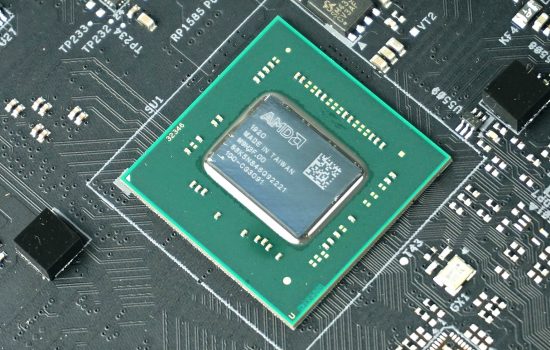
The Micron 2600 is a basic SSD designed for OEM computers and laptops, using a PCIe 4.0 ×4 interface, and available in 512 GB, 1 TB, and 2 TB capacities. Micron built it using the Phison E29T controller, which is a DRAMless design, and its latest 9th-generation 3D NAND chips with 276 layers. It’s offered in standard M.2 2280 form, as well as shorter 2230 and 2242 variants, commonly used in handheld gaming devices.

The SSD uses QLC NAND chips, which are inherently associated with lower performance and especially reduced write endurance. However, Micron claims it has managed to eliminate (or more likely, mitigate) these drawbacks through a special feature called Adaptive Write Technology.
Adaptive Write Technology
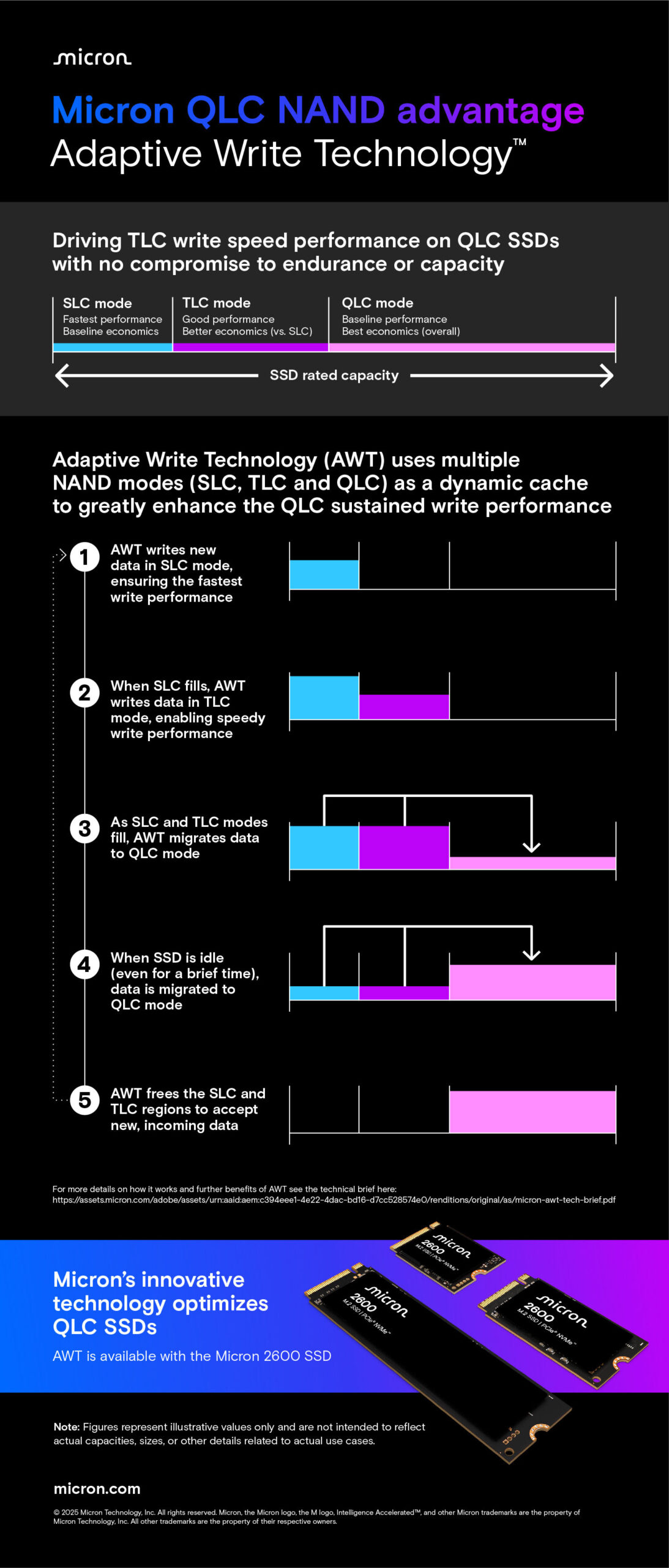
Adaptive Write Technology appears to be an enhancement of the pseudo-SLC cache or write buffer approach long used in pretty much all SSDs based on TLC or QLC NAND (which record 3 or 4 bits per cell, requiring 8 or 16 voltage levels, respectively), which typically means all writes are initially made to a part of the memory where only one bit is written per cell (as if it were SLC). That means the NAND cells provide only a fraction of the total capacity but allow for much faster programming (writing). Later, during idle times, the SSD re-writes the data in its native QLC format.
What sets Adaptive Write Technology apart is that it doesn’t rely on a limited buffer using this method, nor does it only distinguish between SLC and final storage mode. Micron 2600 modules first store data as SLC and keep it in this form permanently—though naturally, this can only be done until a certain level of capacity is filled. That’s because in SLC mode, NAND memory has only a quarter of the capacity compared to QLC.
As the SSD approaches a certain data fill threshold, it starts storing data in TLC mode instead, likely including background conversion of data previously stored as SLC. In TLC mode, the drive could theoretically use up to 75% of its capacity, though the actual limit will be lower. Only when nearing the next threshold level of data occupancy does the SSD really begin writing new data in QLC mode and starts converting older data to QLC. If a significant portion of the drive is freed up, the device would likely revert to writing in TLC mode again.
The main benefit of Adaptive Write Technology is that it allows a QLC module to (at least temporarily) operate in TLC mode, provided it isn’t too full with user data. Micron claims the drive can sustain high sequential write speeds up to about 40% of capacity before performance drops due to switching to QLC mode. The company offers an example: the 2TB model can sustain high-speed writing for up to 800 GB of data at once—though this depends on the current occupancy, the 800GB value likely assumes the drive is nearly empty.
Micron claims this innovation makes the 2600’s performance superior to “competing low-cost TLC SSDs” or similar QLC-based drives, boasting up to 63% faster sequential writing and 49% faster random writes. But it’s unclear exactly what is the new module being compared to—Micron likely chose a particularly slow TLC SSD for the benchmark, possibly even one without PCIe 4.0 support or a drive using the older crop of controllers that only reached speeds around 4000 to 5000 MB/s. It’s also likely these figures reflect performance while the Micron 2600 is still operating in TLC or even SLC mode.
Full PCIe 4.0 ×4 Performance (Under Ideal Conditions)?
On paper, the Micron 2600 delivers sequential read speeds up to 7200 MB/s and write speeds up to 6500 MB/s, matching high-performance PCIe 4.0 modules. It’s rated for up to 1,000,000 IOPS in random reads and up to 1,100,000 IOPS in random writes—though these write figures apply to pseudo-SLC mode, as usual. These performance numbers are for the 2TB version; smaller capacities offer lower specifications, as shown in the spec table:

The modules have a peak power consumption under 5 W and idle power consumption below 0.1 W. In Sleep / PS4 mode, power usage drops even further to below 2.5 mW. This makes them a good fit for laptops—though installing an operating system on QLC drive (as opposed to using it just for data) is never ideal.
While Adaptive Write Technology can help ease QLC SSD performance shortcomings, it unfortunately doesn’t solve the more critical issue of reduced write endurance. Micron promises the modules can handle around 400 write cycles per cell—translating to a total of 200 TB written for the 512 GB model, 400 TB for the 1TB model, and 800 TB for the 2TB model.
The Adaptive Write Technology design is arguably a positive step for QLC SSDs. Still, the fact that your drive performs significantly better only when it’s half-empty (or less) is kind of frustrating. Since SSD capacities in PCs have generally remained limited, expecting users to leave large portions of storage unused isn’t very realistic.
So despite improvements like these, we would still generally recommend avoiding QLC SSDs and opting for TLC NAND modules instead. But when buying a laptop, you often won’t know what type—or even what brand—of SSD is inside. In such cases, it’s wise to seek out reviews that identify the installed SSD and alert you if a QLC model is used.
Sources: Micron, techPowerUp, Tom’s Hardware
English translation and edit by Jozef Dudáš
⠀⠀