


We were very excited to see the results of the Grand Tornado 120. It looks good geometrically and is also one of the cheapest LCP models out there. Scythe has also informed us that the Grand Tornado 120 is set to outperform the legendary Gentle Typhoon (D1225C). And it’s true, it does outperform it, though perhaps in different ways than you’d expect. But the LCP fan from Scythe gets along really well with radiators.
Everything changes with obstacles
So far, we have described how static pressure and airflow measurements are made under conditions where the fan has no obstacles in its path. In practice, however, fans do not usually blow into an empty space, but have a filter, grille or radiator in front of or behind them, the fins of which need to be pushed through as efficiently as possible.
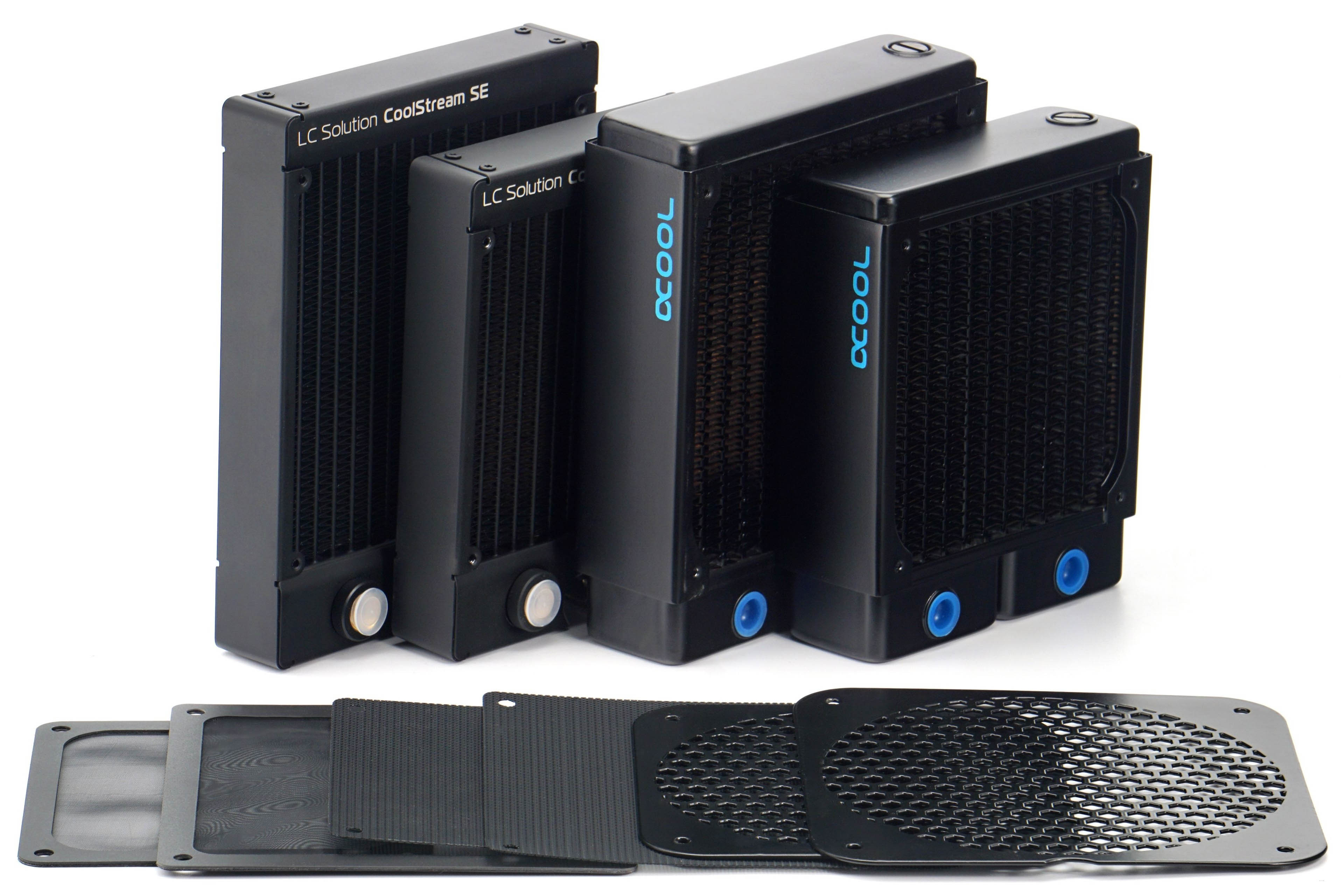
We will also measure both airflow and pressure through practical obstacles for the reasons stated above. These include two types of filters that are usually used in PC cases. One fine – nylon and the other plastic with a thinner mesh. One other obstacle is the hexagonal grille perforated at 50%, on which the vast majority of fans – intake and exhaust – are installed. In some cases, we measure the effect of the obstacles on the results at positions (behind or in front of the impeller) that are used in practice. All obstacles are both pushed through to detect pressure drops, but also pulled through, which in turn speaks to the impact on airflow.

We use two radiators that differ in thickness and fin density. The EK CoolStream SE120/140 is 28 mm thick and the FPI is 22, the Alphacool NexXxoS XT45 v2 is thicker (45 mm) but with less FPI. CoolStream’s fin disposition is also similar in parameters to AIOs. The results on the NexXxoS will again be attractive for those who build their own water cooling loops, where the fans should work well even at low speeds – hence the lower fin density.
These obstacles and especially the radiators, but also the grilles, increase the mechanical resistance in front of the fan, resulting in higher noise levels. However, we will still tune the fan speeds to the specified noise levels of 31 to 45 dBA. Naturally, the speeds will always be lower than when testing without obstructions, but we will maintain the noise levels for clarity. The different noise levels with and without obstacles will only be at maximum power. In this mode it will also be nice to see how the fan design works with the obstacle and in which case the noise level increases more and in which less.


DNF at the very high target of 31dB(A) means it isn’t cheap, it means no matter the price it’s too expensive
additionally knowing it starts at around 680RPM and it still doesn’t pass that target means it’s just bad acoustically
it may find a niche, people are frequently mentioning this or that dethroning Noctua while the performance is only slightly higher at one very specific and extremely high noise target so at some point it may be a decent option, but I just wouldn’t bother, no reason to stand that noise when I can just set A12x25 a tiny bit below this ones starting speed and have it perform better and stay silent
This is subjective. It depends on who is looking for what. If the priority is the highest possible airflow regardless of noise level, while also weighing low vibration or extra durability, then the Grand Tornado 120 can be a great choice. In the context of that potentially high durability (if Scythe doesn’t exaggerate the MTBF value…), we also discussed the server concept of the Scythe Grand Tornado 120 fan in the discussion below the text in another language…
for separate-room-home-server I’d likely go with Noctua PPC or T30 (or NH-P1 due to superior reliability if the heat load was lower, though AC has the advantage of providing a decent heatsink that will prevent your system from shutting down even if fans stop, LC on the other hand…), for regular server room with regular server fans like Delta
for living/working space silence is a requirement impossible to give up on so the silent performance is all that matters
I really love its name (GT), indicating the intention for it to succeed Gentle Typhoon. Unfortunately, I don’t think it’s worthy of that title. Even if the argument is that it’s better in peak performance, remember there’s the GT-HI (https://www.e-jpc.com/wp-content/uploads/gentle-typhoon-d1225cen-2.pdf) that goes up to 5400 RPM!