


We were very excited to see the results of the Grand Tornado 120. It looks good geometrically and is also one of the cheapest LCP models out there. Scythe has also informed us that the Grand Tornado 120 is set to outperform the legendary Gentle Typhoon (D1225C). And it’s true, it does outperform it, though perhaps in different ways than you’d expect. But the LCP fan from Scythe gets along really well with radiators.
Evaluation
On radiators, the Grand Tornado is one of the most efficient 120mm fans. At comparable noise levels to competing models, its achieved airflow is among the highest across the board.
It’s usually not enough for the absolute peak in the form of the BeQuiet! Silent Wings Pro 4 (BL098) or Noctua NF-A12x25 PWM, but you have to take into account that the Scythe fan (Grand Tornado 120) is cheaper and has a more attractive price/performance ratio on radiators. From the established graphs of airflow per euro, it doesn’t look like it, but those do account for results from a non-restrictive environment. And in such conditions, the Grand Tornado 120 fan is merely average. The Scythe fan benefits from a higher static pressure, which makes the drop in airflow due to obstacle resistance relatively small.
With dust filters (with a nylon one and a plastic one), it’s efficiency is above average, but for system cooling in the given price range, there are more attractive options than the Grand Tornado 120, even from the ranks of cheaper fans. In cooling down radiators, however, the Scythe fan excels, here it has high efficiency. And this even on a thicker radiator with less FPI.
If you focus on the comparison with the Gentle Typhoon D1225C, you’ll find that yes, the Grand Tornado 120 outperforms it. But that’s only in terms of top speed at the cost of higher noise, and it should also be noted that this statement only applies to the faster variant (GT1225FD30-P) with 3000 rpm. Or, actually, with only 2900 rpm, and in a restrictive environment the max speed can be even lower.
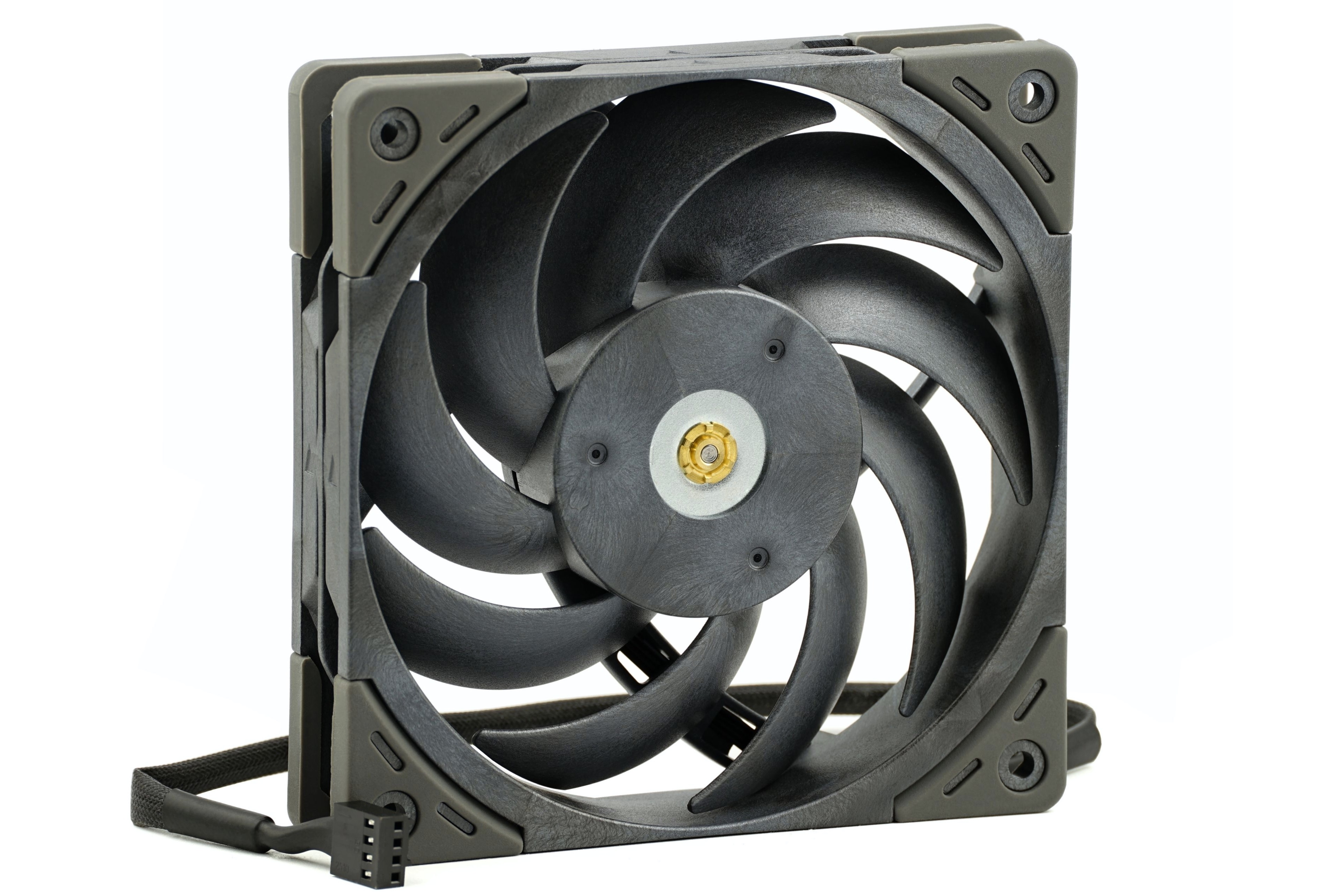
Rather than the maximum speeds, however, many users will struggle with the minimum speeds. These are quite high, around 680 rpm. We couldn’t even regulate the Grand Tornado 120’s fan to the quietest “31 dBA” modes because of it. Compared to more expensive fans, the Grand Tornado 120 also lacks something that is commonly referred to as “passive operation”. In other words, at low PWM duty cycle the motor doesn’t turn off and keeps spinning, which may bother some people. Especially in situations where only very low cooling performance is enough and noiseless cooling operation would be optimal. You won’t get to that with Scythe Grand Tornado 120 fans.
One thing has improved significantly over the Gentle Typhoon D1225C though, and that’s the vibrations. These can be said to be negligible even at very high speeds. Even at the latter, the vibrations that reach the fan frame are very low. Therefore, secondary noise by vibration transmission to a case (or cooler) is not too much of a threat. Of course, some secondary noise can be generated due to extremely intense airflow, but that is something different (than vibrations on the fan frame).
The acoustic response can also be quite pleasing, especially at lower (around 900 rpm) or medium speeds (around 1500 rpm), where the sound doesn’t contain significant tonal peaks. These do appear in the Grand Tornado, but primarily only in combination with selected obstacles, such as on a hexagonal grille with more pronounced frequencies around 330 Hz. Overall, however, the Scythe fan cannot be criticized in this respect either. As one of the most affordable LCP fans, it has stood the test well.
We don’t think it’s worthy of any special award for an extremely attractive price/performance ratio (there are other contenders for that… ), but we can definitely recommend the Grand Tornado 120. As long as you’re aware of all its features and know what you want, then why not.
English translation and edit by Jozef Dudáš
| Parametre | MSI MPG Z890 Carbon WiFi | |
| Pätica | Intel LGA 1851 | |
| Čipová súprava | Intel Z890 | |
| Formát | ATX (305 × 244 mm) | |
| Napájacia kaskáda procesora | 23-fázová | |
| Typ podporovaných pamätí (a maximálna frekvencia) | DDR5 (9200 MHz) | |
| Sloty PCIe ×16 (+ PCIe ×1) | 3× (+ 0×) | |
| Od stredu pätice k prvému PCIe ×16 | 94 mm | |
| Od stredu pätice k prvému slotu DIMM | 56 mm | |
| Diskové konektory | 4× SATA III, 1× PCIe 5.0 ×4 (60–80 mm) + 1× M.2 PCIe 4.0 ×4 (60–80 mm) + 1× PCIe 4.0 ×4 (60–80 mm) + 1× PCIe 4.0 ×4 (60–110 mm) + 1× PCIe 4.0 ×4/SATA (60–80 mm) | |
| PWM konektory na ventilátory alebo pumpu kvapalinového chladiča | 7× | |
| Interné porty USB | 1× 3.2 gen. 2×2 typ C, 4× 3.2 gen. 1 typ A, 4× 2.0 typ A | |
| Ďalšie interné konektory | 1× TPM, 3× ARGB LED (5 V), 1× RGB LED (12 V), 1× jumper Clear CMOS | |
| Displej POST | áno | |
| Tlačidlá | Flash BIOS, Clear CMOS, Smart | |
| Externé porty USB | 2× 4 typ C (Thunderbolt), 10× 3.2 gen. 2 typ A, 1× 3.2 gen. 2 typ C | |
| Videovýstupy | 1× HDMI 2.1, 1× DisplayPort 2.1 | |
| Sieť | 2× RJ-45: 2,5 GbE – Intel I226-V + 5 GbE Intel Killer E5000B, bezdrôtový modul Intel Killer BE1750x: WiFi 7 (802.11 a/b/g/n/ac/ax/be) + Bluetooth 5.4 | |
| Zvuk | Realtek ALC1220P (7.1) | |
| Ďalšie externé konektory | – | |
| Orientačná koncová cena | 543 eur/13 590 Kč |


DNF at the very high target of 31dB(A) means it isn’t cheap, it means no matter the price it’s too expensive
additionally knowing it starts at around 680RPM and it still doesn’t pass that target means it’s just bad acoustically
it may find a niche, people are frequently mentioning this or that dethroning Noctua while the performance is only slightly higher at one very specific and extremely high noise target so at some point it may be a decent option, but I just wouldn’t bother, no reason to stand that noise when I can just set A12x25 a tiny bit below this ones starting speed and have it perform better and stay silent
This is subjective. It depends on who is looking for what. If the priority is the highest possible airflow regardless of noise level, while also weighing low vibration or extra durability, then the Grand Tornado 120 can be a great choice. In the context of that potentially high durability (if Scythe doesn’t exaggerate the MTBF value…), we also discussed the server concept of the Scythe Grand Tornado 120 fan in the discussion below the text in another language…
for separate-room-home-server I’d likely go with Noctua PPC or T30 (or NH-P1 due to superior reliability if the heat load was lower, though AC has the advantage of providing a decent heatsink that will prevent your system from shutting down even if fans stop, LC on the other hand…), for regular server room with regular server fans like Delta
for living/working space silence is a requirement impossible to give up on so the silent performance is all that matters
I really love its name (GT), indicating the intention for it to succeed Gentle Typhoon. Unfortunately, I don’t think it’s worthy of that title. Even if the argument is that it’s better in peak performance, remember there’s the GT-HI (https://www.e-jpc.com/wp-content/uploads/gentle-typhoon-d1225cen-2.pdf) that goes up to 5400 RPM!