Something for Asus fans: a complete ROG build in the Z11 case

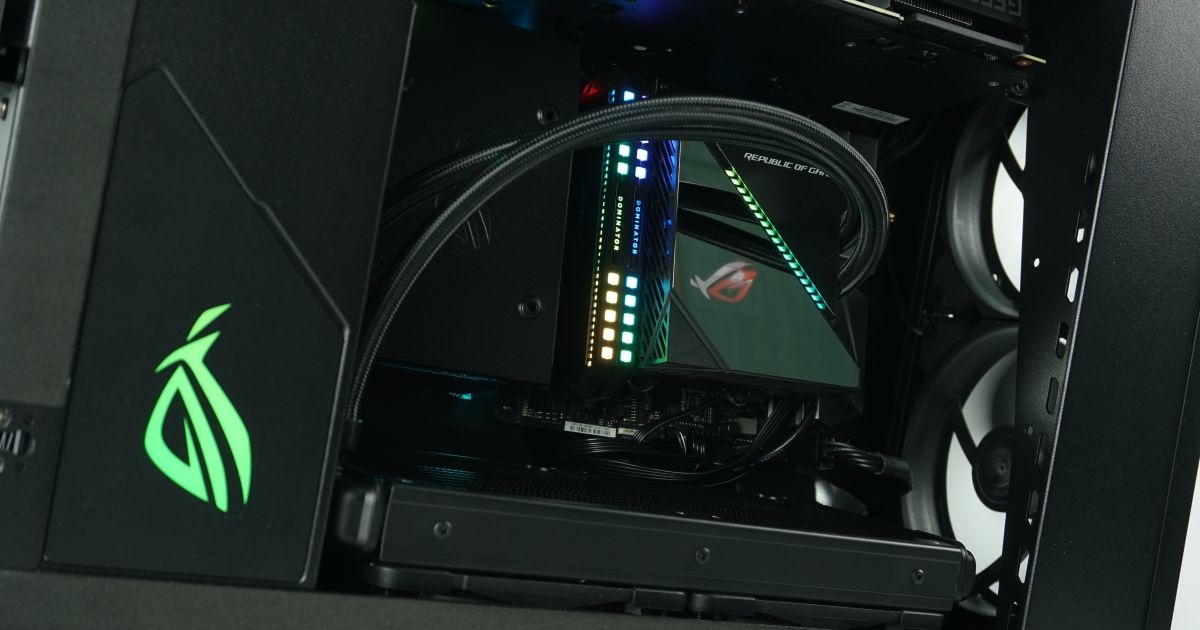
A very untraditional and relatively unique case has come to our editorial office. It is the ROG Z11, which the manufacturer introduced at the beginning of the year at CES 2020. The case hides several specialties, such as the possibility of vertical and horizontal positioning or a slightly curved motherboard tray. To make matters better, we fitted the case more or less exclusively with ROG components, thus creating a kind of full-on Asus build.

Blender –a look at the CPU

First glance at the course of performance, we use our traditional BMW Blender (v2.9) test. We monitor the clock speed, power draw and temperature of the processor when using air and water cooling in both vertical and horizontal positions of the case.

In the first graph, you’re looking at the progress of processor clock speed during the render. Air cooling has lower clock than water cooling. Although the results are tight, it looks like the lowest clock speed is with air in horizontal position and the best with water vertically.
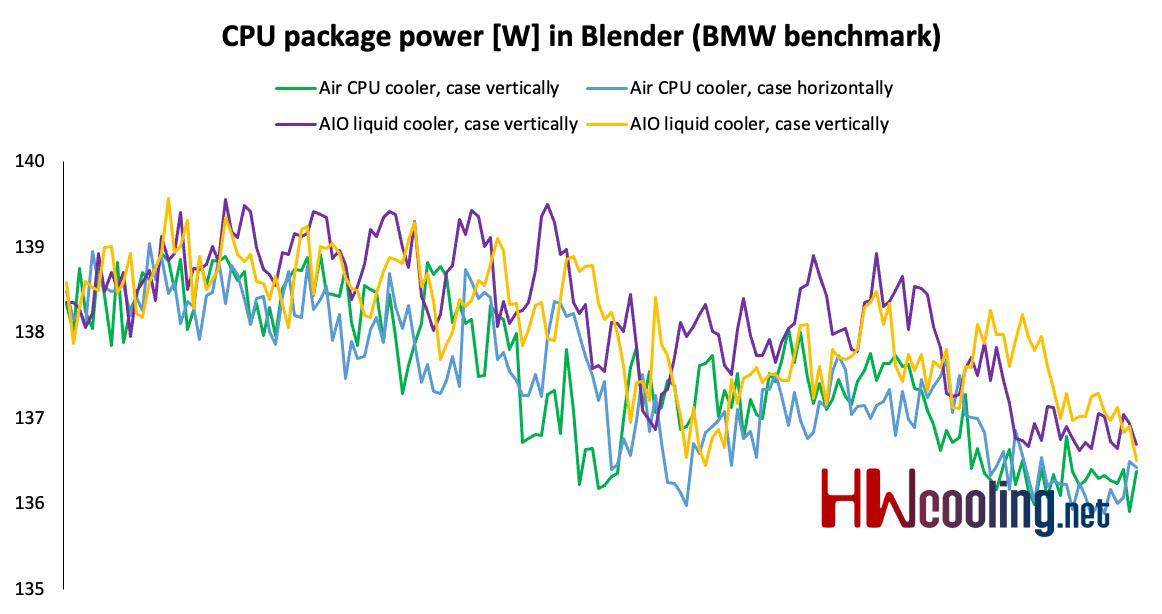
The situation is similar with power consumption, where again the air shows the lowest value, which is caused by lower clock. On the contrary, water vertically has the highest consumption, thanks to the highest clock.
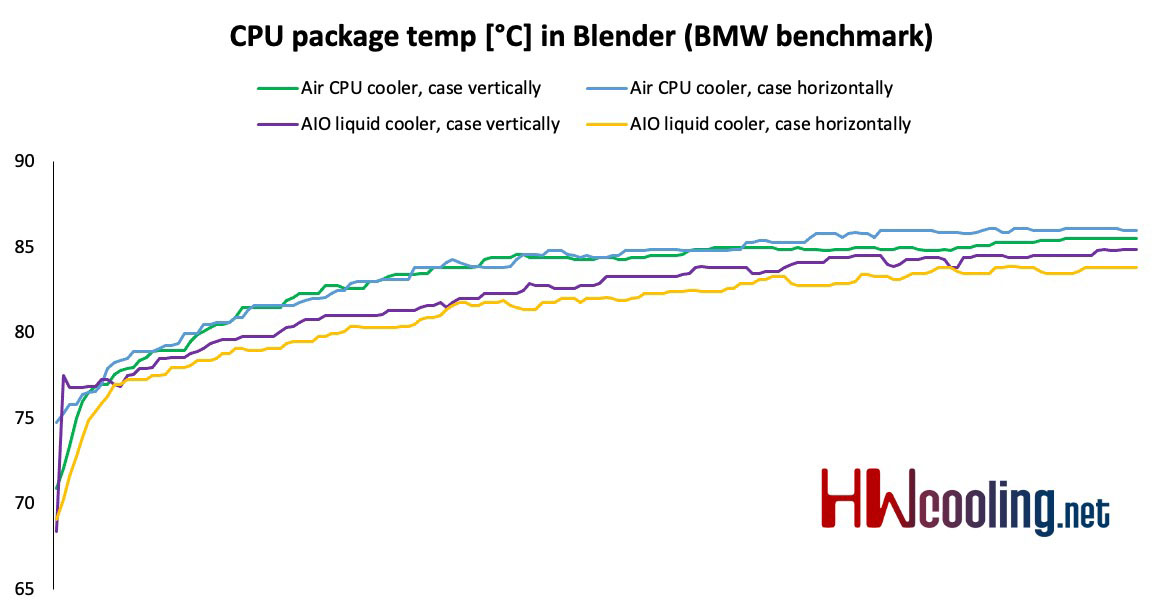
Processor temperatures more or less confirm the assumptions from the previous graphs and are therefore higher than air, although only by 2–3 degrees Celsius. The horizontal position with air proved to be the worst, the water in the same position is the best. However, you can see that higher clock is achieved with water vertically and the difference in temperature is not high, so this seems to be the most optimal solution.

Practical results show only a minimal difference. The rendering time with air was 2:50 minutes, with water 1–2 seconds slower.

The most interesting (and craziest) Asus hardware at Computex

The Computex tradeshow this year seems to involve various anniversaries for many companies. In the case of Asus, the company is celebrating 20 years of its “premium” gaming brand, ROG. We visited the booth Asus has at the trade show as well and will show you some of the new hardware the company brought to its booth—because of this anniversary, much of it is quite extraordinary and forms a celebratory lineup called ROG Edition 20. Read more “The most interesting (and craziest) Asus hardware at Computex” »

Asus ROG Equalizer: Robust 12+4pin connectors that don’t burn?

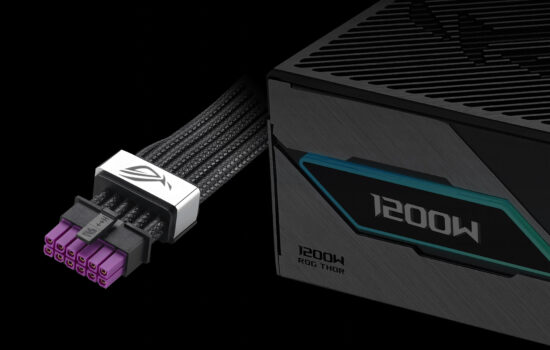
Failures of the 12V‑2×6 power cable (formerly 12VHPWR) have become the scourge of recent GPU generations. Especially for Nvidia cards pushing this power standard, but also for a few Radeon models using these connectors. Various attempts to work around or mitigate the risks have popped up; this time, Asus is introducing the Equalizer special‑purpose cable for its power supplies, that aim to prevent connector melting in several ways. Read more “Asus ROG Equalizer: Robust 12+4pin connectors that don’t burn?” »

Asus ProArt PF120: The most efficient fan at low noise level

It wants to go head‑to‑head with the Phanteks T30-120 fan, while also having a slight edge in every respect. That’s Asus’s marketing—and now comes reality in HWCooling’s in‑depth analysis. The ProArt PF120 fans are truly something exceptional and worth paying attention to. High cooling efficiency and elegant daisy‑chaining are just the beginning. The overall design of Asus’s fans is impressive. Read more “Asus ProArt PF120: The most efficient fan at low noise level” »

Leave a Reply

Your email address will not be published. Required fields are marked *