Sapphire Pulse AMD Radeon RX 9060 XT 16 GB Review: Value Pick

The information embargo on Radeon RX 9060 XT test results has been lifted. Let’s take a look at how the new Radeon stacks up against the competing GeForce RTX 5060 and RTX 5060 Ti. The 16GB variant is priced closer to Nvidia’s 8GB models and offers a better price-to-performance ratio than the 16GB RTX 5060 Ti. The more affordable Sapphire Pulse RX 9060 XT model adds great thermal and acoustic performance on top of that.

Clocks, Temperatures & Fan Speeds – F1 24

The next tests are from the F1 24 benchmark at 3840 × 2160 resolution using Ultra settings. This benchmark runs five laps on the Singapore map in wet conditions. Unlike other benchmarks, the load is continuous, with no relief between loops, so the card remains warm throughout.
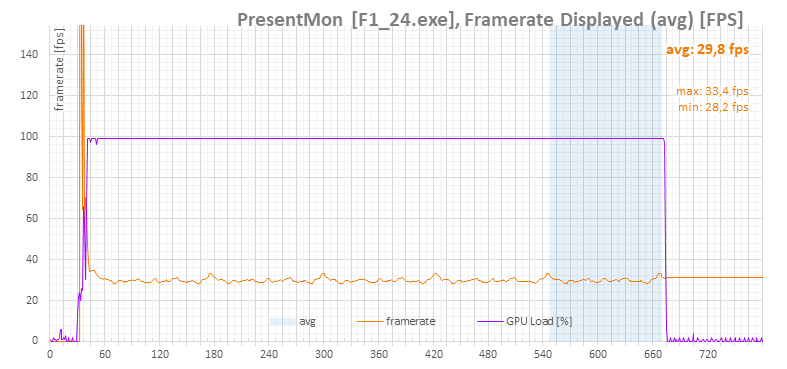
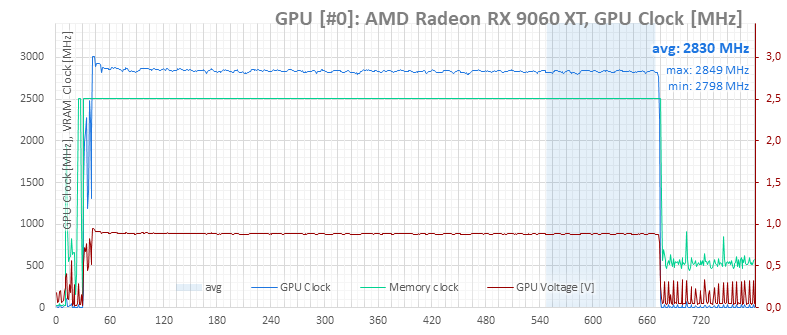
Clock speeds differ from those in Cyberpunk only by a few dozen MHz. During testing, the heated card maintained a clock speed between 2798 and 2849 MHz, with an average of 2830 MHz.
Power consumption monitoring again shows the card staying close to the 170W limit (light green line), with the rest of the system adding just under 100 W, bringing total system power consumption to 278.8 W.

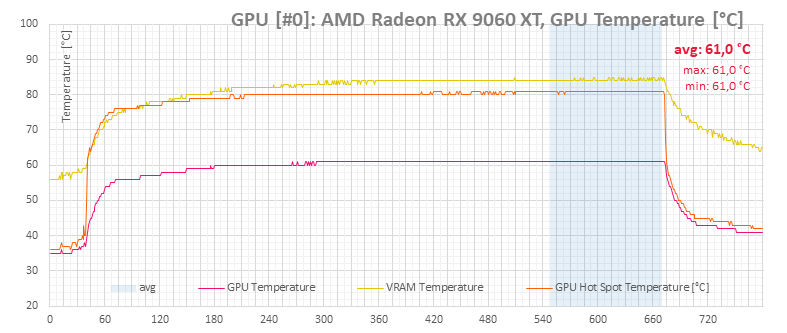
The GPU’s average temperature during this phase reached 61 °C, memory hit 85 °C, and the hotspot maxed at 81 °C.
Fan speeds topped out at about 1940 RPM.


HWiNFO Now Shows Temps of Individual Video Memory Chips

Not long ago, HWiNFO gained the ability to monitor GPU hotspot temperatures—local hotspots with significantly higher temps than the average having been reported by Nvidia chips. This has been followed by another improvement in graphics card temperature monitoring. You will now be able to look at the temperatures of all memory chips on the card, which can reveal cooling problems in much the same way as the GPU hotspot temperature. Read more “HWiNFO Now Shows Temps of Individual Video Memory Chips” »

Instinct MI455X and the Helios Rack: Can AMD beat Nvidia in AI?

AMD unveiled Zen 6-based server processors at the Advancing AI 2026 event, dubbing them the best generation it has ever released. The company is focusing on complete solutions including its own Helios server racks, though, which incorporate a new generation of GPUs: the Instinct MI455X, the first GPU based on an architecture derived from the RDNA gaming GPU family and a product that is intended to take AMD to a new level in the AI market. Read more “Instinct MI455X and the Helios Rack: Can AMD beat Nvidia in AI?” »

Multi-frame generation coming to Radeon GPUs, drivers show

Last year, Nvidia introduced multi-frame generation that inserts 2, 3, or even 5 AI-interpolated “fake” frames between real frames (though only for GeForce RTX 5000-series cards—with users of older GPUs out of luck). Since then, Intel has also introduced multi-frame generation, but it has never been available on Radeon graphics cards. That now appears to be changing, as AMD seems to be preparing the feature for an upcoming driver release. Read more “Multi-frame generation coming to Radeon GPUs, drivers show” »

Leave a Reply

Your email address will not be published. Required fields are marked *