


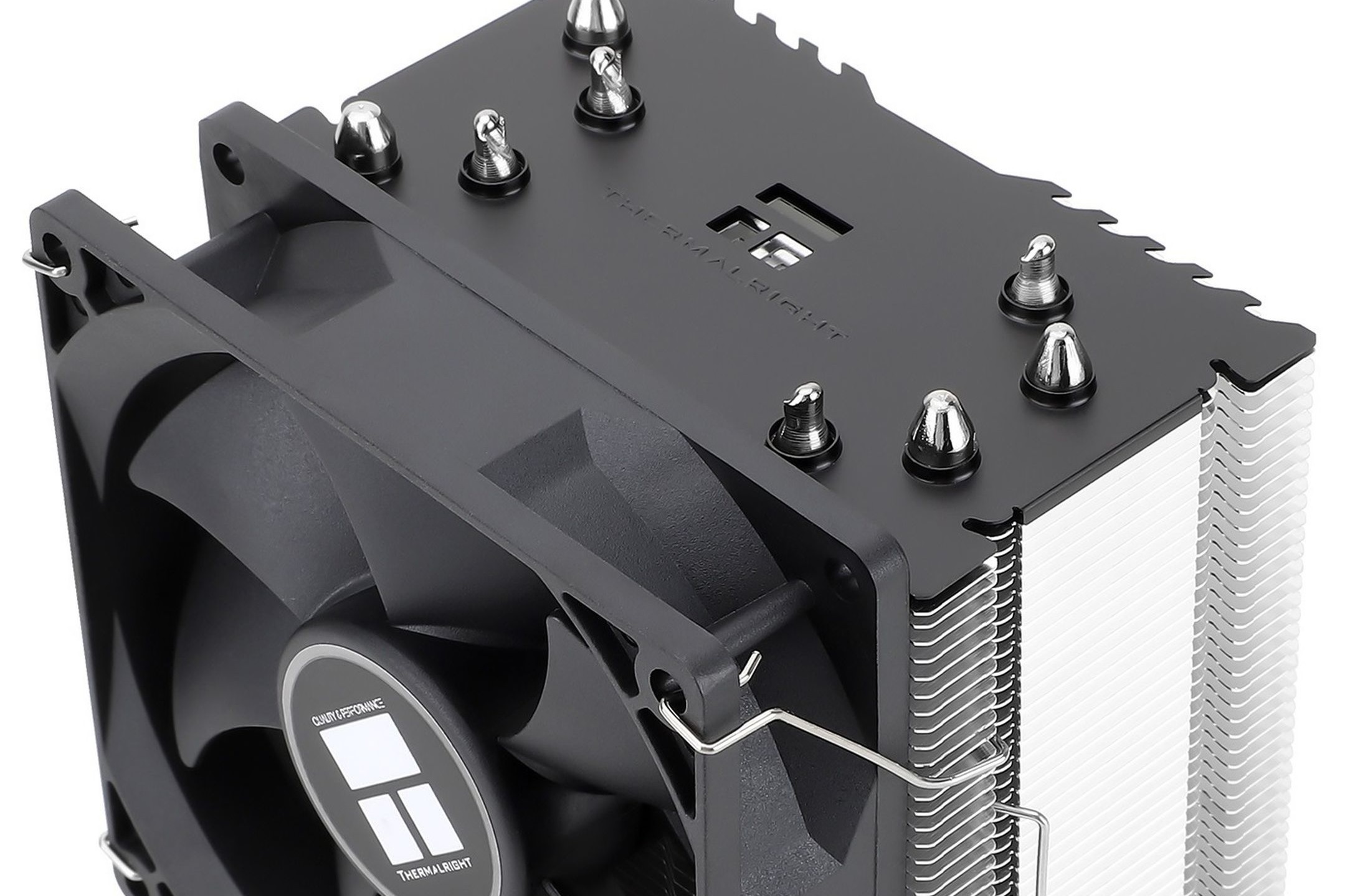
There used to be no shortage of them, but now they’re quite rare – CPU coolers with smaller, 92-millimeter fans that are also compatible with slimmer cases. One such new product has been released by Thermalright. The Assassin X 90 SE cooler will soon come in handy when selecting a suitable solution for more low-power variants of desktop processors from both Intel (Raptor Lake) and AMD (Raphael) with a TDP of 65 W and lower.
Thermaltake has expanded its range of CPU coolers with the Assassin X 90 SE. It is a lower-profile tower design with a vertically mounted fan. The orientation of the airflow is thus in the direction of the fan on the case’s exhaust. In height, this cooler is only 118 mm.
Old-timers may remember the dimensionally similar Xigmatek Loki (II) or the current Noctua NH-U9S coolers. But these are already quite expensive and although Thermalright hasn’t disclosed the recommended price of the Assassin X 90 SE yet, we reckon it will be significantly lower (than the Noctua cooler mentioned above). But at the same time, it will probably be a more expensive cooler than the Spartan 5 from SilentiumPC. However, the Assassin X 90 SE, which is significantly lower, doesn’t compete there in terms of compatibility anymore.
Design-wise, it is not a cheap cooler, Thermalright does not make such products, and it keeps to a certain standard. This includes, for example, a nickel-plated surface of the part of the heatpipe that is not in contact with the CPU IHS. In these places, for better heat transfer from the CPU to the cooler, the heatpipe shroud has been left unplated. However, the surface of the fins no longer seems to be missing a layer of nickel.
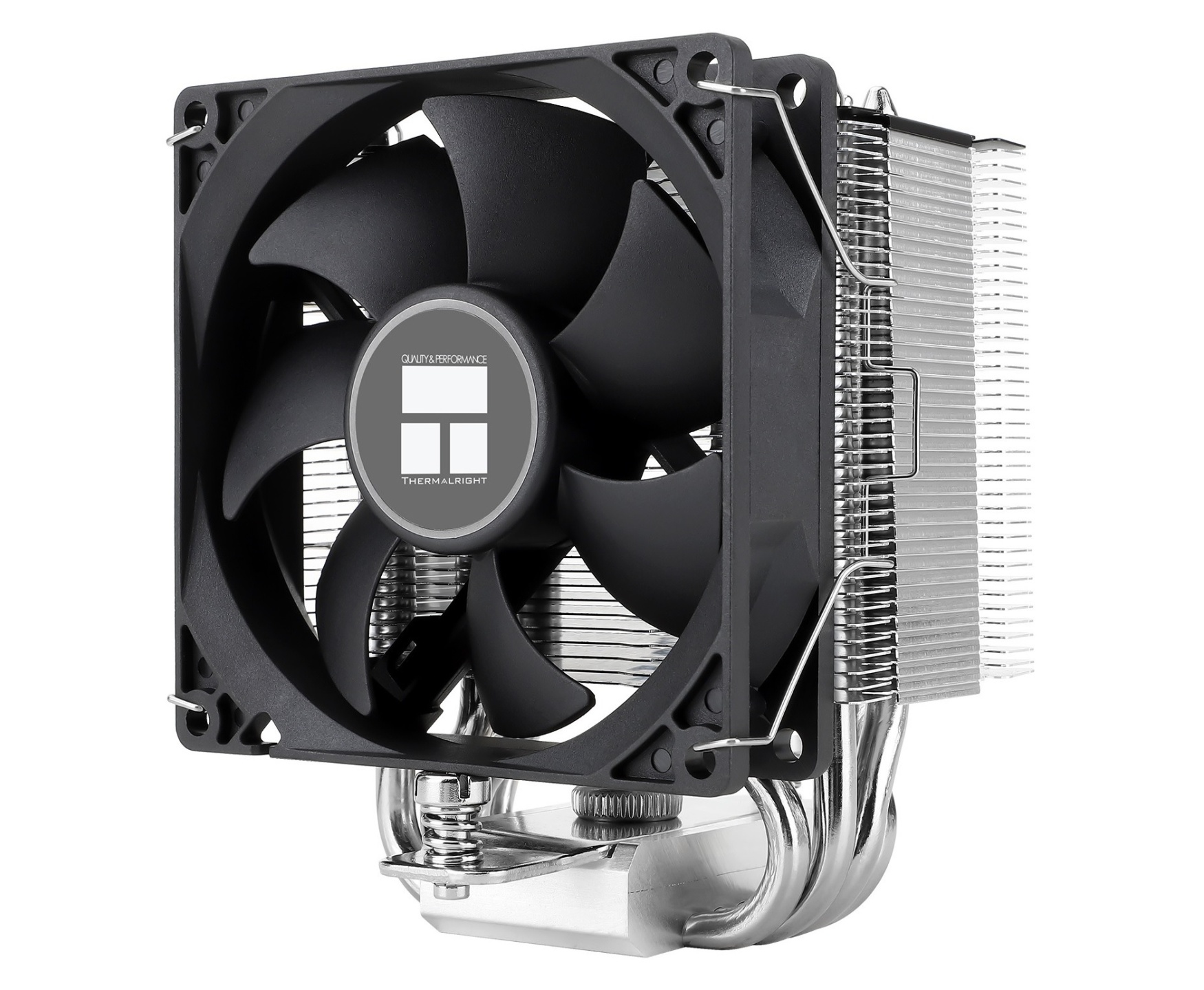
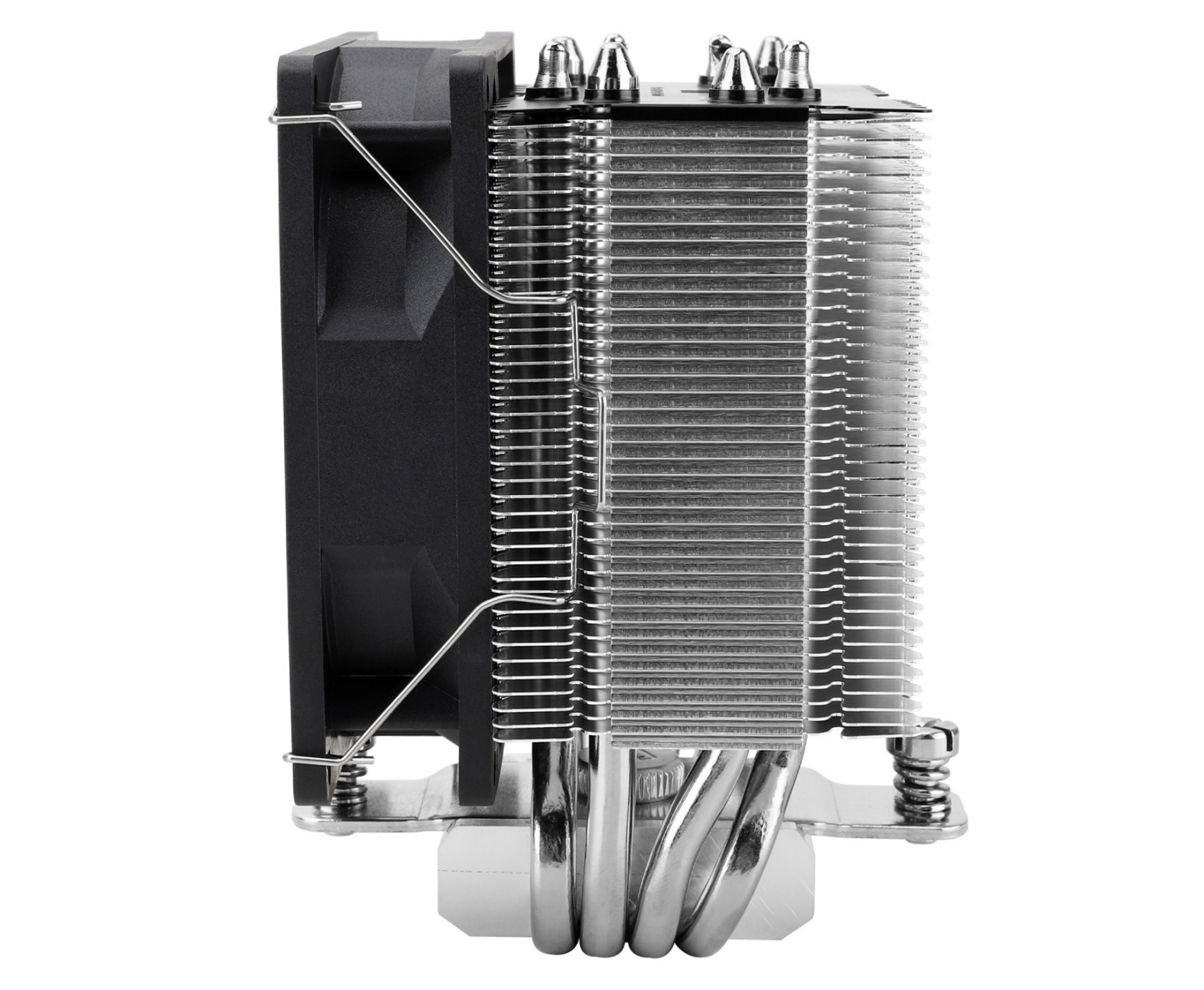
For better memory (RAM) compatibility, the heatsink is turned away from the DIMM slots, thus avoiding this space. Tall memory modules are thus compatible. You already know the height of the Assassin X 90 SE cooler (118 mm), its thickness with the fan is 77 mm and it is 94 mm in the axis along the motherboard. All this at a total weight of 445 g.
The fan used to cool the heatsink is the Thermalright TL-G9B with a maximum speed of approximately 2400 rpm. According to the parameters, this corresponds to an airflow rate of 73.06 m3/h and a static pressure of 1,51 mm H2O. Bearings are fluid (S-FDB), mean time between failures (MTBF) is not specified by Thermalright.
The Assassin X 90 SE supports both current AMD (AM5 and AM4) and Intel (LGA 1700 and LGA 1200) platforms. Mounting to the motherboard is via a backplate, but apparently made of plastic (we can’t make out the material used for manufacturing from the available illustrations), and a larger tube of Thermalright TF4 multi-use thermal paste is included in the package.
Thermalright doesn’t list the cooler’s thermal performance, but it won’t be for use with processors with TDP higher than 65 W. Even those often have power draw in excess of a hundred watts without power limits. But for such a load, the Assassin X 90 SE will probably be enough, even taking into account the used DHT type base (i.e. with direct contact of heatpipes with the heat spreader of the processor), where two of the four pipes will have lower yield on both AMD and Intel processors. When paired with more low-power processors with power draw below 120 W, this should be just enough, as is the design of the SilentiumPC Spartan 5 cooler, which only has two heatpipes.

The price of the Thermalright Assassin X 90 SE, as well as its availability in stores, is yet unknown.
English translation and edit by Jozef Dudáš





Okay. Is this a review or is this a press release?
Actually, neither. However, this is not a review, we put the label “extra tests” on those and they contain a lot of measurement results. In this case, however, it’s a news article, which is partly based on a press release, but it’s conceived in a more unique way in terms of the text, so that it’s not a copy and paste of what you’ll read in other places.