


Last time, we tested a pair of low-profile 140 mm fans on the TUF RTX 5070 Ti. They noticeably reduced noise, but they didn’t offer nearly as much cooling headroom as the stock fans, which can spin at over 3000 RPM. The top-tier Noctua NF-A14x25 G2 fans with the standard 25 mm thickness are much quieter than the originals at the same temperatures, and at full speed they also narrow the temperature gap significantly.
In the previous test, I compared the original cooler with a trio of Asus’s proprietary Axial-tech fans against a deshroud mod using three large 140mm low-profile Arctic P14 Slim PWM PST fans, which are only 16 mm tall. We examined the cooler’s temperatures and noise levels across the entire operational range of fan speeds.
The cooler with the pair of 140mm fans managed to cool the card to the same temperatures more quietly than the original trio of Asus 9,8 cm fans, but it didn’t have as much performance headroom. With the pair of Arctic P14 Slim fans at their maximum 1750 RPM, the card was unable to achieve temperatures as low as with the original Axial-tech fans, which can run at up to 3100 RPM.

So today, we will try replacing them with a pair of 140mm fans with the standard 25 mm thickness. And we won’t hold back—we’ll go straight for the top-tier NF-A14x25 G2 fans. Noctua sent us a pair of fans in a kit for testing.
We have already thoroughly covered the NF-A14x25 G2 PWM fan in a dedicated review on HWCooling Noctua NF-A14x25 G2 PWM: Finally a First-Class 140mm Fan. We’ll quickly look at what you get in the kit, how they can be mounted on the Asus TUF RTX 5070 Ti, and dive into testing how the new fans change the card’s operational characteristics.
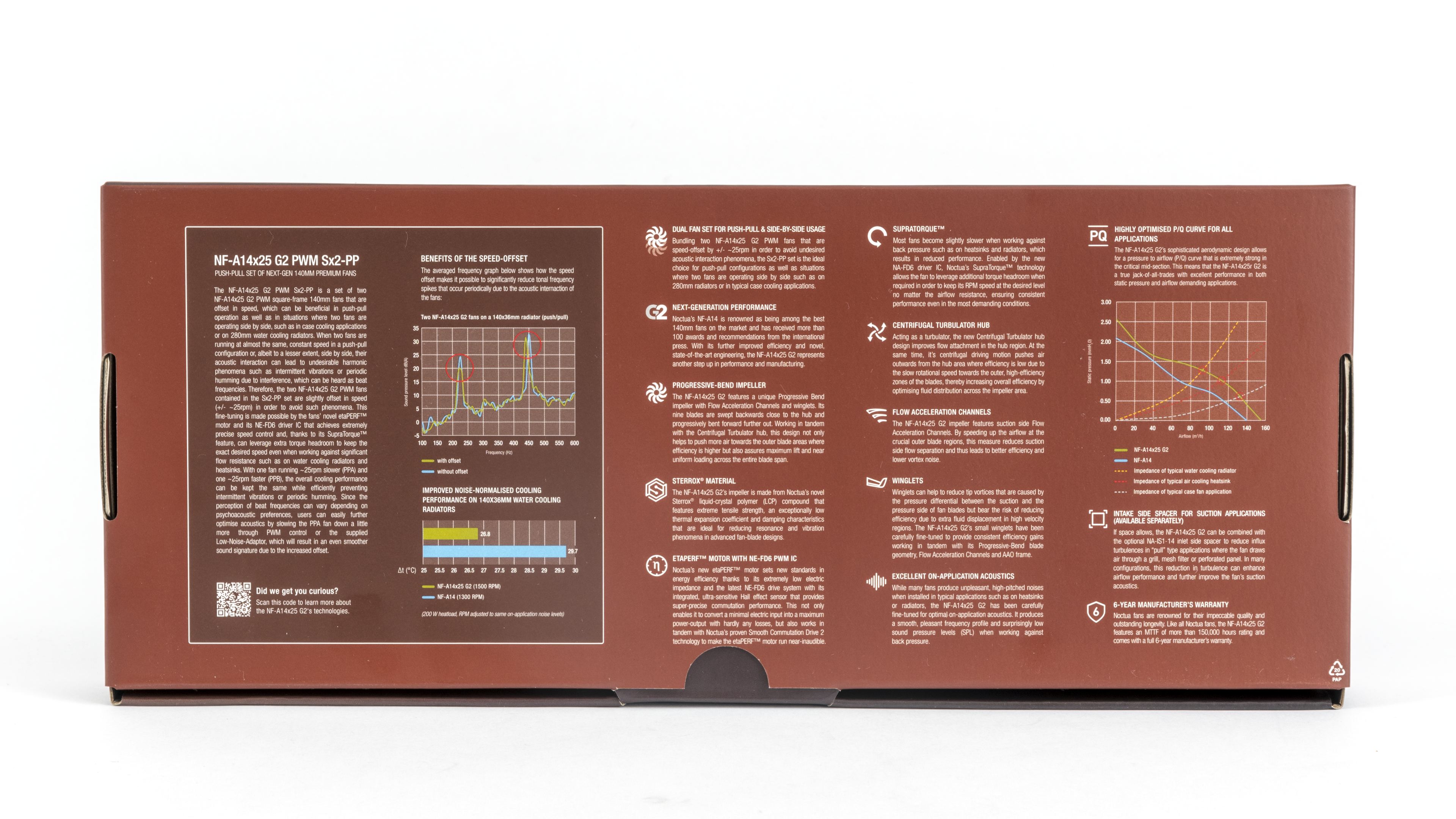
Noctua NF-A14x25 G2 PWM Sx2-PP
The kit consists of a pair of fans labeled NF-A14x25 G2 PWM PPA and NF-A14x25 G2 PWM PPB. They differ in that they have slightly offset speeds from each other. The reason for this is discussed in the review of the Noctua NH-D15 G2 cooler. In my case, the faster fan connected to the Corsair Commander Pro ran at approx. 1540 RPM at 100% PWM, and the slower one at 1480 RPM.
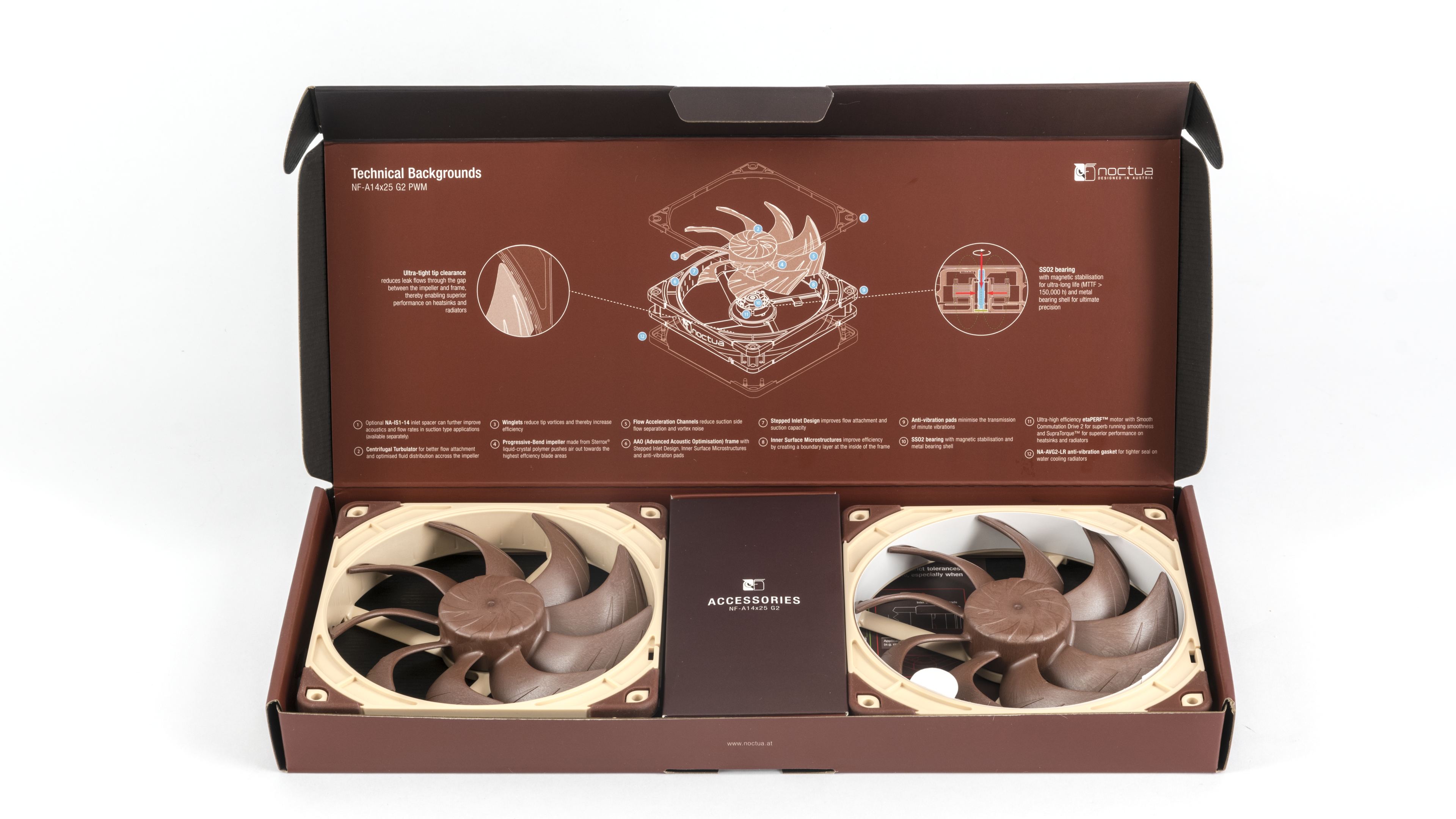

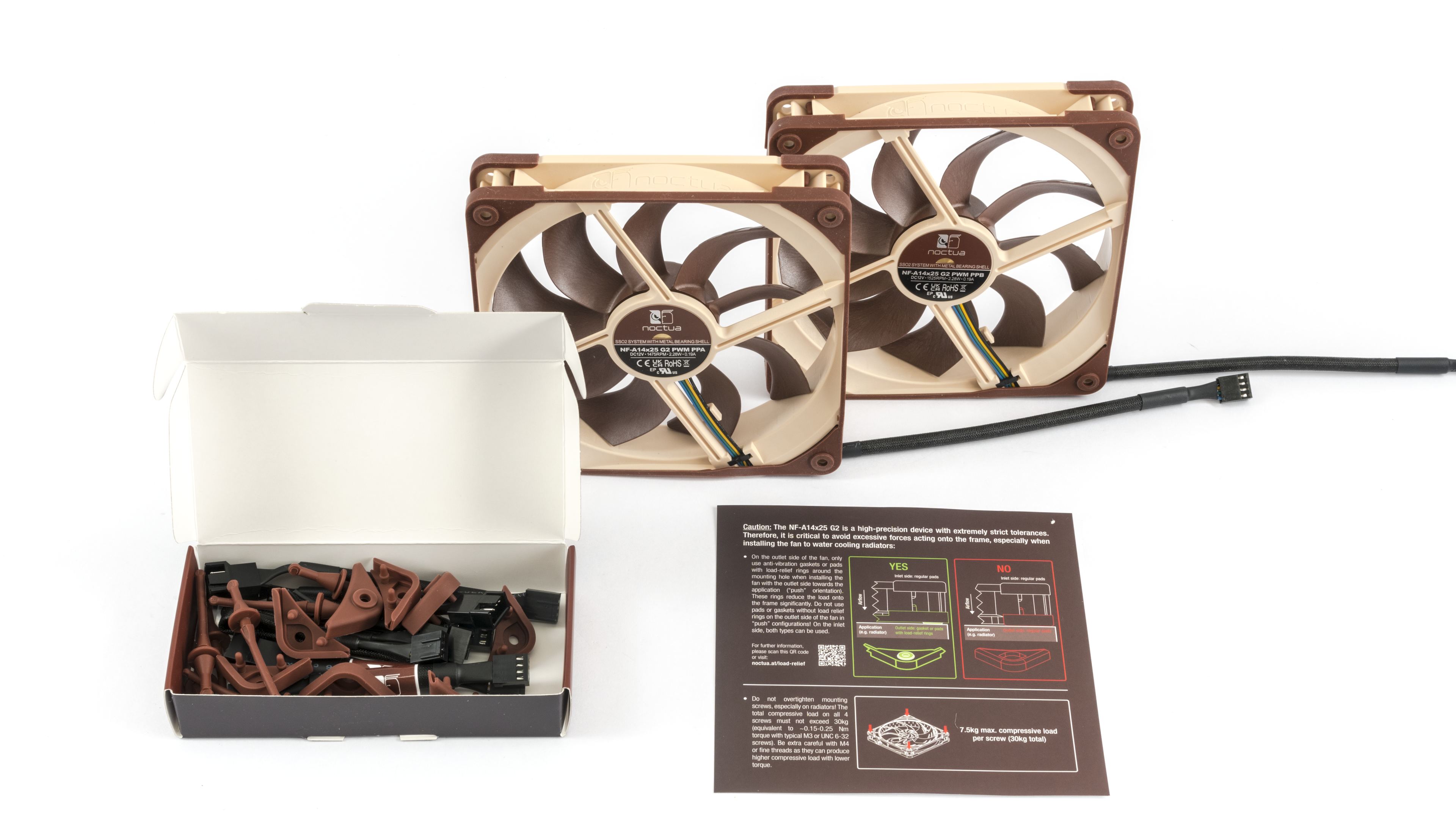
The list of package contents is considerably longer than with most fans; you will find:
- NF-A14x25 G2 PWM PPA
- NF-A14x25 G2 PWM PPB
- 2× NA-RC16 Low-Noise Adaptor (L.N.A.)
- NA-YC1 4-pin PWM splitter cable
- 2× NA-EC1 30cm extension cable
- 8× NA-AV2 anti-vibration mounts
- 2× NA-AVG2-LR anti-vibration gasket for water cooling radiators
- 8× NA-AVP1-LR load-relief anti-vibration pads
- Fan screws

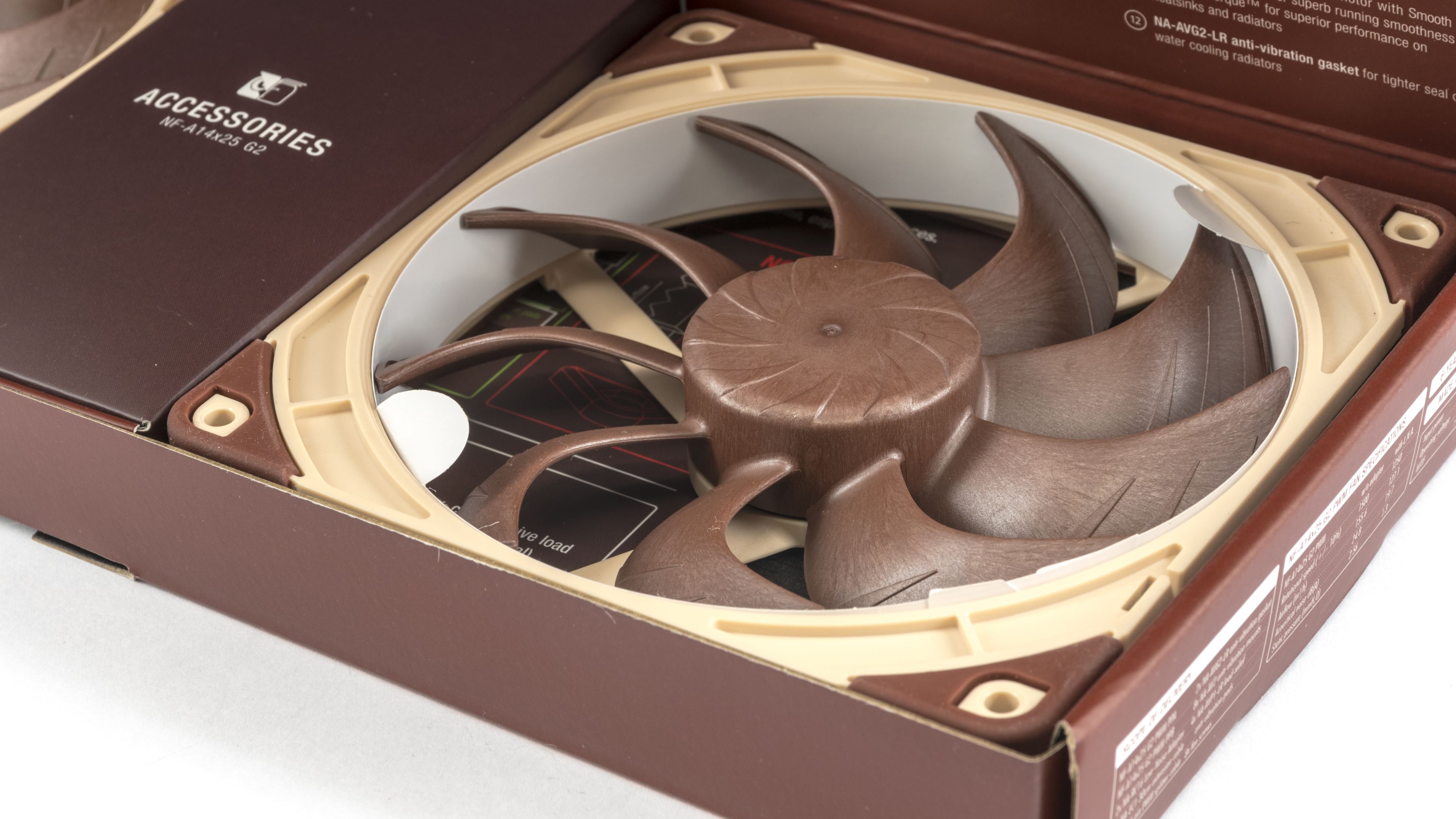
Inside the box, a paper insert between the frame and the fan impeller catches the eye. I’m genuinely curious if this significantly helps with safety during shipping, or if it’s more of a manufacturer flex to make it immediately obvious that the gap between the frame and the impeller blades is so narrow that nothing more than a strip of paper can fit.
The TUF RTX 5070 Ti is already too short for three 120mm fans, so attempting three 140mm fans is pointless. When you opt for two 140mm fans, each one covers a larger portion of the heatsink fin stack.


However, you must account for the fact that with 140mm fans, the card will overhang the slot bracket edge by about 5 cm. With a height of 8 cm, the card already occupies four slots, and the fifth slot should leave enough space for the fans to intake air.


Again, we will test just the bare frame without covering the fin stack. As usual, we will connect the fans to the Corsair Commander Pro controller and regulate them via the Fan Control application.


Noctua also supplies anti-vibration mounts with the fans. However, the included ones are double-sided and intended for case mounting. But if, like me, you want to mount the fan flush against the fin stack, the mount needs to be flat on one end. Therefore, I used a different type from Noctua’s range, labeled NA-SAV4.
These have another advantage. Most similar products on the market are only designed for standard 25 mm fans and would be loose on lower-profile fans. In a previous test with low-profile fans, I worked around this by using standoffs above the fans. However, the NA-SAV4, thanks to their stepped tabs, are “compatible” with lower-profile fans of all common heights up to 25 mm.


In the following chapters, we will recap how the card performed in terms of cooling across the entire operational speed range with the stock fans, and then we’ll look at the results with the NF-A14x25 G2.
⠀


