


Last time, we tested a pair of low-profile 140mm fans on the TUF RTX 5070 Ti. They helped noticeably reduce noise but didn’t offer nearly as much performance headroom as the stock fans with a maximum over 3000 RPM. The top-tier Noctua NF-A14x25 G2 fans with the standard 25 mm thickness are significantly quieter than the original fans at the same temperatures, and at maximum performance, they significantly close the gap in temperatures too.
Before we get to the summary measurement graph, just a reminder that the card used for testing has been repasted and has a few degrees higher temperatures on the chip than the second tested unit with the original phase-change thermal interface material. Because of this, the card is slightly louder under load than it could be.
What will probably interest us most is how the card’s noise level changed at the same temperatures. This can be seen in the following graph. In it, the horizontal axis shows noise level and the vertical axis shows temperatures. The further left a fan’s curve is, the quieter it is at the same temperatures.
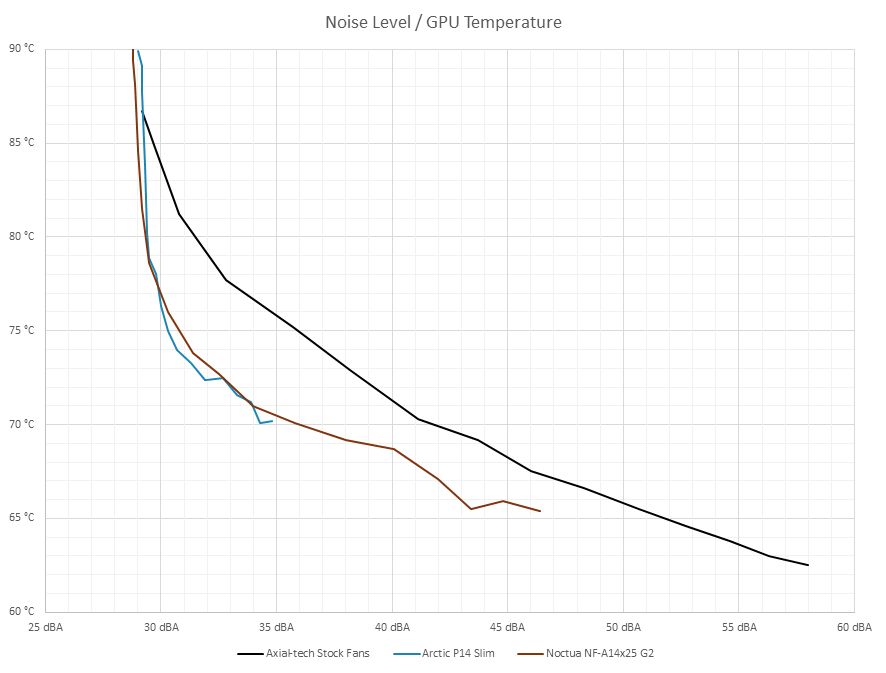
Unfortunately, at low speeds, I hit the limits of the sound level meter’s capabilities with both the Arctic P14 and the Noctua NF-A14x25. Within the operational range of the Arctic P14 Slim fans, the difference in noise isn’t dramatic. However, at the maximum performance of the Arctic low-profile fans, the maximum GPU temperatures did not drop below 70 °C. Compared to the stock fans, which can get below 63 °C, they therefore have significantly less headroom.
With the Noctua NF-A14x25 fans with standard thickness, you can get noticeably lower—just above 65 °C. That’s only a few degrees worse than the result with the stock Axial-tech fans at 3100 RPM. And the card’s noise level will still be noticeably lower.
So, the card’s behavior with the larger fans is certainly pleasing; even at a solid 75 °C on the GPU die, the cooler can be exceptionally quiet, and it still has plenty of headroom if you want to push temperatures lower. It’s a shame the heatsink isn’t a bit larger.
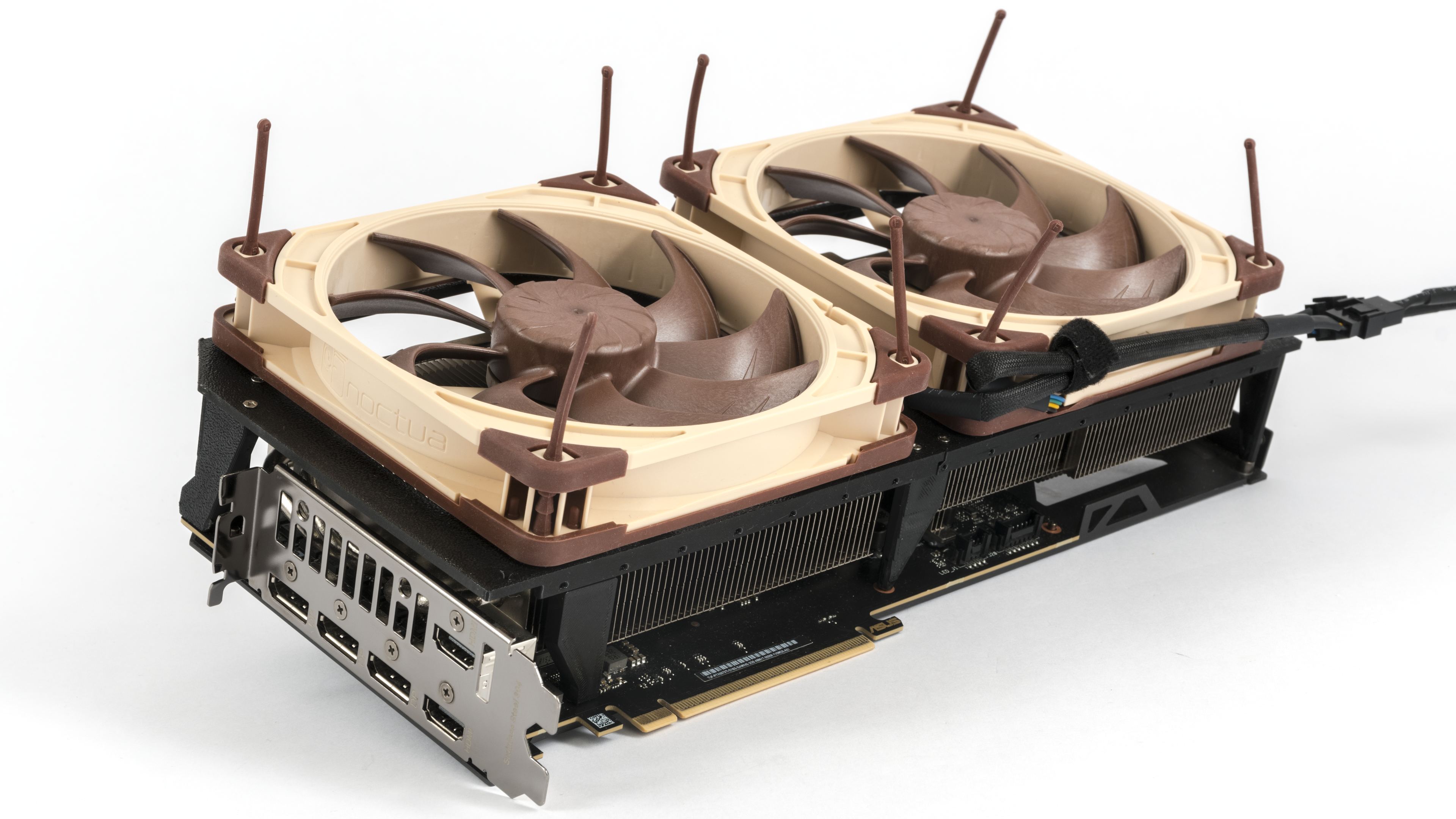
The disadvantage, of course, is the significantly larger dimensions of the card—you will need more space below the PCIe x16 slot and a wider case. However, cases that can fit a 140mm fan in the rear position should suffice.
It probably won’t surprise anyone that this isn’t the cheapest card upgrade either. The Noctua NF-A14x25 G2 PWM Sx2-PP kit with accessories will cost you around 80 EUR. But it’s still cheaper than buying two individual NF-A14x25 G2 units. Some compensation might be that the fans will likely outlive the card itself, and you also get a lot of extra accessories that often come in handy when building a PC.
⠀


