The top model of the RTX 5060 Ti currently available from Asus is the TUF Gaming GeForce RTX 5060 Ti 16GB OC Edition. Although its power consumption isn’t particularly high, it comes with a large triple-slot cooler (30 cm) that easily manages the 180W load, keeping GPU and memory temperatures at 70 °C with fans running at just 1000 RPM and staying whisper-quiet. It also offers a dual BIOS and other premium features, but these come at a steep price.
Fan behavior, noise levels
Just like with almost all graphics cards of recent generations, this card operates passively under low load. The minimum speed at which the fans can run is set at 30%.
At the lower threshold, the fan speeds slightly diverged at the same power setting; for the tested sample, the fans spun at roughly 830 RPM on fan connector 1 and 796 RPM on fan connector 2, with a measured noise level of 29.7 dBA—below the lower limit of the sound meter’s measuring range. From 34% performance and 850 RPM upwards, the fan speeds were synchronized.
In Quiet mode, after heating up, the fans ramped up to 980–1000 RPM, at which a noise level of 30.2–30.4 dBA was measured. The fans are practically inaudible, and instead of aerodynamic noise, you’re more likely to hear the coils of the power delivery system. They are slightly quieter compared to more powerful cards, but in a passively cooled setup during nighttime silence, you may still notice them.
In Performance mode, fan speeds during load reached between 1520–1600 RPM. Correspondingly, noise levels measured between 35.9 and 37 dBA. These are values where the cooler becomes audible even from a few meters away, but it remains noticeably quieter than average graphics cards noise-wise.
The fans can spin up to 3400 RPM, providing ample headroom for further overclocking and cooling experiments. However, it’s unlikely anyone would want to operate the card long-term at fan speeds where the noise meter climbed to 58.6 dBA.

Cyberpunk 2077, RT Medium, 3840 × 2160 (P mode)
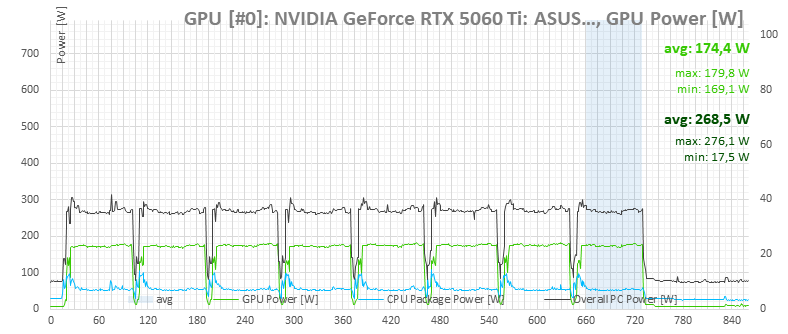
The first set of measurements is from the Cyberpunk 2077 benchmark with RT Medium settings at a resolution of 3840 × 2160 pixels. With this setup, the GPU is under full load. The test consists of eight consecutive benchmark runs.
The graph always shows the final run, from which the average value for the warmed-up card is calculated.

The GPU clock speeds range between 2782 and 2797 MHz, with an average of 2793 MHz.

Based on power consumption, stable GPU clocks, and limits, it’s clear that the card during testing did not operate at the 180W power limit. According to monitoring data, the card’s own power consumption (light green data line) remained within the 170–180W range. Thus, clock speeds are likely limited by the maximum set voltage of the chip.
The darker line in the chart shows the overall system power consumption, measured with a UT71E multimeter. The system’s load power consumption was remarkably low compared to what is typically seen with high-end models. This is primarily due to the lower power draw of the card, but also because the processor is not as heavily taxed with a less powerful GPU.
Average GPU temperatures during testing topped out at an excellent 65 °C, with memory temperatures at similar levels. Hotspot monitoring is not displayed on the new generation of GeForce cards.
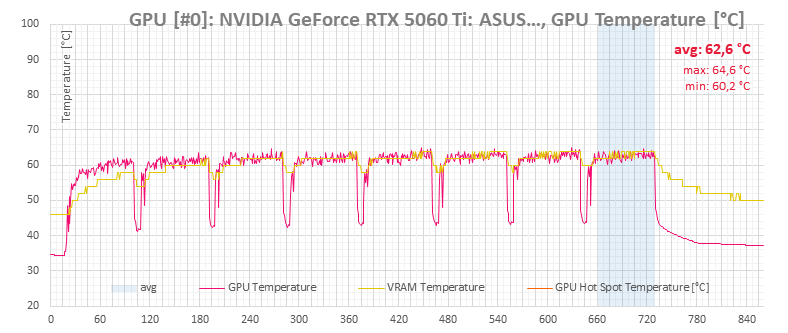
However, you pay for the low temperatures with higher fan noise. They are not truly loud, but unlike in Quiet mode, it’s very noticeable when the card is under load.


⠀