

Gigabyte has added new Radeon models to its lineup. That’s good news for anyone tired of all-black components. Alongside the budget-friendly Radeon RX 9060 XT Gaming OC and RX 9070 XT Gaming OC, the company is introducing “Ice” variants that pair a white shroud with gray and silver accents. As long as pricing doesn’t stray far from the standard black versions, they should rank among the best-value white cards on the market.
Fan behavior, noise level
Fan speeds can be set in the range of 20–100%. In Q (Silent) mode, this corresponds to fan speeds ranging from approximately 910–4280 rpm(29.3–63.2 dBA). Even at minimum speeds, the fans weren’t perfectly silent, but you’d only hear that at night with your ear right against the card.
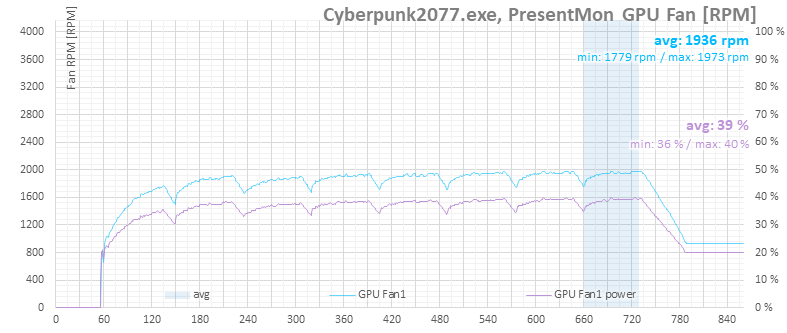
Even though their speeds under load are relatively high, values between 1770–2010 rpm still place us in the lower part of their operational speed range.
The noise level corresponds to this being a more compact, budget model. In silent mode, the card is quieter than the average noisy card. After warming up, fan speeds across tests ranged from 1770–1850 rpm, corresponding to a measured noise level of 37.2–38.4 dBA. The card is no longer silent, but it can’t be called loud either.
In Performance mode, fan speeds ranged from 1970–2010 rpmwith noise levels between 40.1 and 40.7 dBA.
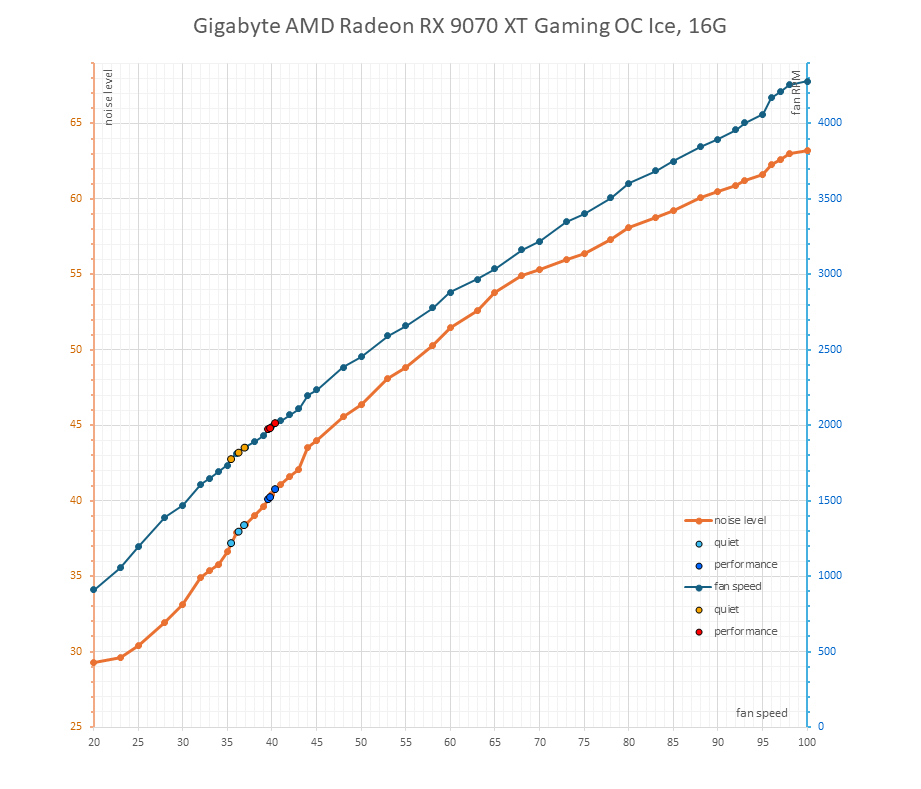
In terms of tolerances of measurement accuracy and sample variation, the results are similar to the black variant of the RX 9070 XT Gaming OC tested in March.
Cyberpunk 2077, RT Medium, 3840 × 2160 (Performance)
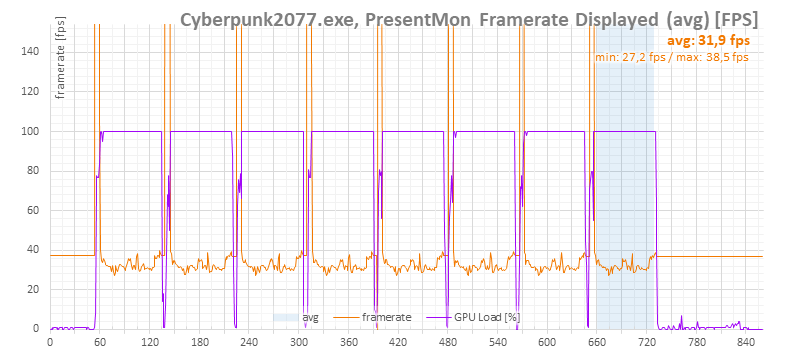
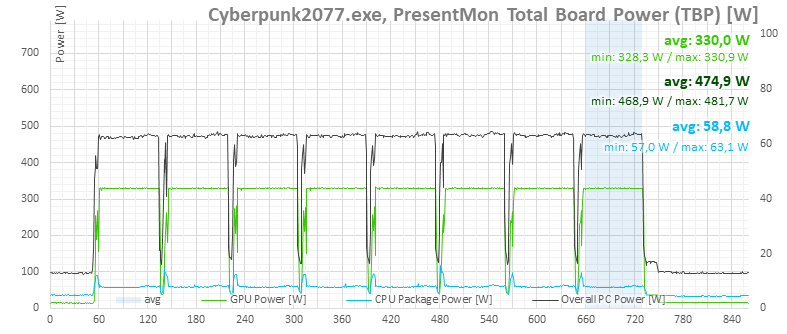
The first set of results comes from the Cyberpunk 2077 benchmark with the RT Medium setting at a resolution of 3840 × 2160 pixels. It includes eight consecutive benchmark runs. The graph always shows the final run, from which the average value for the warmed-up card is calculated.
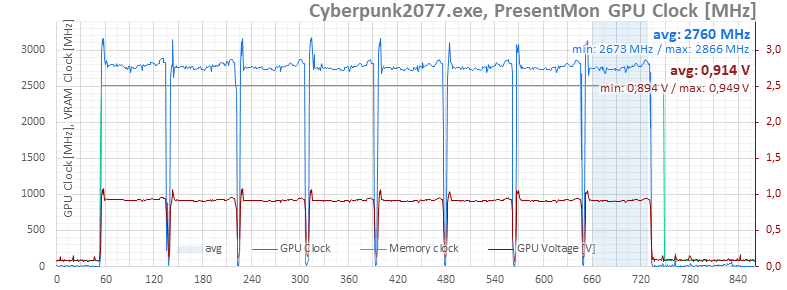
The warmed-up GPU core clock ranges from 2673 to 2866 MHz, averaging 2760 MHz. On the black version of Gaming OC, the average clock differed by only a few megahertz.
HWiNFO monitoring shows the card’s power draw (light-green series) stayed right at the 330 W limit; the average is exactly 330 W.
The entire system’s average power draw is 474.9 W.
The GPU’s average temperature peaked at 68 °C, and the memory reached 94 °C. The hotspot topped out at 90 °C. That leaves roughly 25 °C of headroom to the threshold that triggers overheat protection.

The fans top out around 1,970 rpm.
⠀