


Nitro+ AMD Radeon RX 9060 XT OC is Sapphire’s top-tier 16GB RX 9060 XT model. Alongside powerful cooling and excellent operating characteristics, the manufacturer also bets on stylish looks and prominent ARGB lighting—elements that help it fit right into popular PC design cases. If you’re building a PC for gaming at the lower 1080p and 1440p resolutions and care about aesthetics, it’s certainly worth considering.
Fan behavior, noise level
Fan speeds can be adjusted within a range of 15–100%. This corresponds to fan speeds ranging from approximately 540–3900 RPM (29.2–55.3 dBA). At minimum speeds, the fans were inaudible. Under load, after temperatures stabilized, the speeds hovered around 1600–1800 RPM. The card exhibits the behavior typical of Radeon fan control, where upon an increase in load, the fans ramp up to higher speeds and then gradually slow down. Paradoxically, this makes the card quieter under a steady load than when the load varies. This is clearly visible in the graph from the Metro benchmark, where with each loop start, the fans ramp up to 1860 RPM and gradually decrease to around 1560 RPM, at which point the noise level is only about 32.2 dBA and the card is very quiet.

In Cyberpunk, the fan speeds after stabilization were higher, reaching values around 1750 RPM, at which the card’s total noise level reaches about 33.4 dBA.
Occasional ‘teeth’ are visible in the fan speed graphs below. These are most likely due to the speed monitoring, as even though the noise level and fan tone changed slightly with a one-percent increase in their power, the RPM value displayed by the monitoring software increased in jumps, and at times remained the same even after the power was increased.
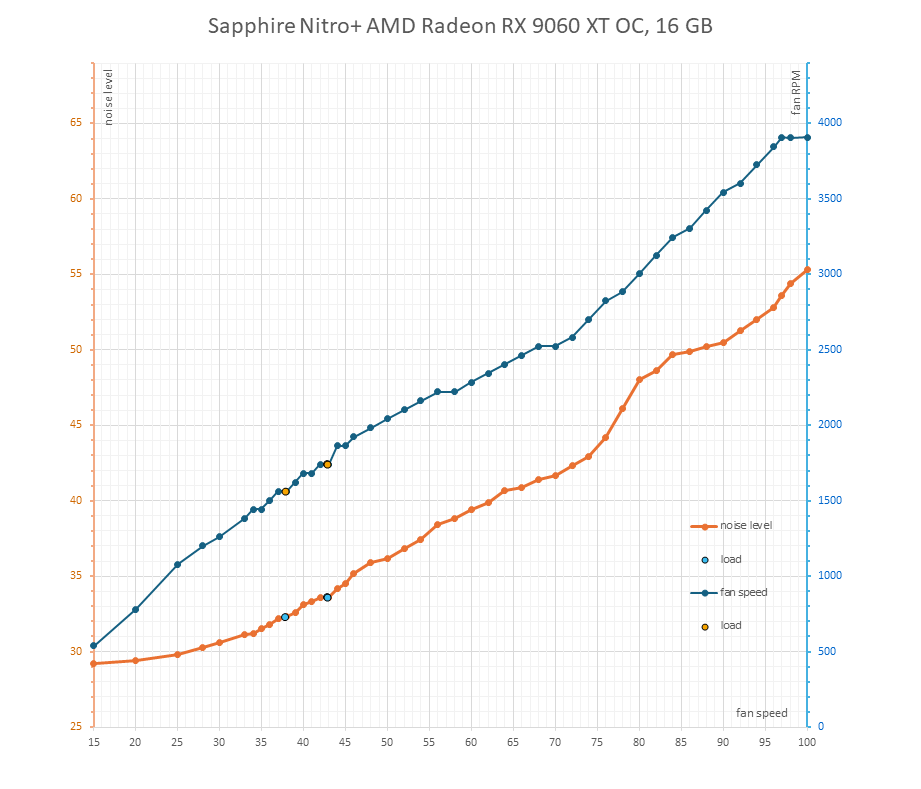
Although a noise level of 33.4 dBA is a devilishly low value—with other cards, you’d only hear a faint and indistinct hum—the Nitro+ couldn’t be called completely inaudible. At speeds around 1800 RPM, a lower-pitched tone from the fans was more distinctly audible.
I therefore tried using a UMIK-1, and the measurement confirmed a pronounced peak appearing around 200–220 Hz. Below are graphs from measurements at approximately 1740 and 1860 RPM. The microphone distance from the card is similar to that used for the noise measurement, i.e., about 20 cm. The overall noise level it measured was about 1 dBA higher compared to the sound level meter.
The black curve represents average values, red represents peaks.
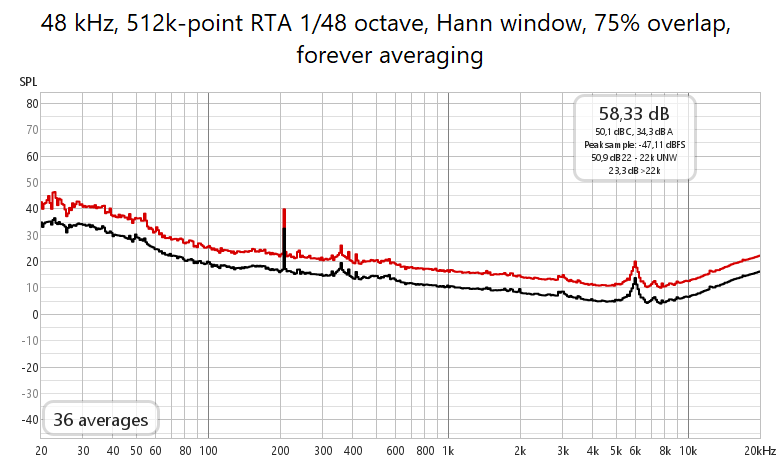
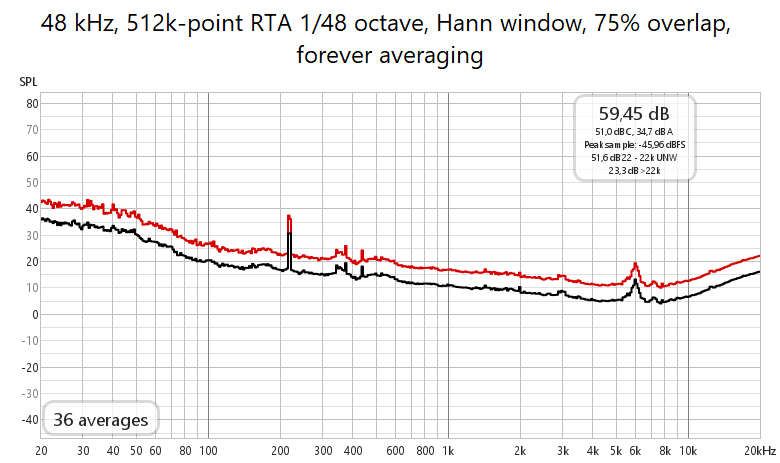
So, with the default fan control settings, you will likely hear the fans, but the cooler has enough headroom for you to lower the fan speeds for a better result.
⠀



Honeslty, with how slow advancement in this tier is, there’s a very good argument for getting the Nitro on build so the thing will live as long as possible.