


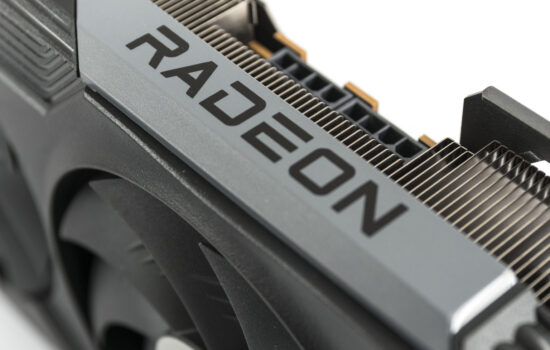
Nitro+ AMD Radeon RX 9060 XT OC is Sapphire’s top-tier 16GB RX 9060 XT model. Alongside powerful cooling and excellent operating characteristics, the manufacturer also bets on stylish looks and prominent ARGB lighting—elements that help it fit right into popular PC design cases. If you’re building a PC for gaming at the lower 1080p and 1440p resolutions and care about aesthetics, it’s certainly worth considering.
Radeon RX 9060 XT cards are designed for gaming at 1440p and 1080p resolutions. They will be available in two variants with 8 GB and 16 GB of memory. The 8 GB version is suitable for titles and settings that aren’t demanding on video memory and for lower 1080p resolution. It’s ideal for players focused on achieving high frame rates at lower graphic settings—typically how esports games are played. The more expensive 16 GB version is better suited for 1080p and 1440p gaming with high-quality graphics, including ray tracing.
The key innovations and changes that the new generation of Radeons, including the RX 9060 XT, bring compared to the RX 7000 series include:
- Improved ray tracing: The third generation of RT accelerators offers double the performance compared to the previous generation.
- Enhanced AI acceleration: Second-generation AI accelerators with significantly higher performance per unit and support for new data types such as FP8.
- FidelityFX Super Resolution 4 (FSR 4): Advanced supersampling and frame generation using AI.
These new technologies and improvements introduced with the latest Radeons are discussed in more detail in our article dedicated to the RDNA4 architecture, which we published alongside the release of the Radeon RX 9070 XT and RX 9070.
We also already covered the basic specs of the Navi 44 and the RX 9060 XT at the cards’ unveiling. You’ll find the specifications in the table below, so here’s a quick summary—the new Navi 44 chip in the Radeon RX 9060 XT features 2048 stream processors, 128 texture units, and 64 raster units. The memory bus is 128 bits wide and connects the chip to either 8 or 16 GB of GDDR6 memory running at 20 Gb/s.
There likely won’t be many stock-clocked models available; that’s why the table includes specs for factory-overclocked models. Keep in mind that with higher clocks, the power limit also goes up—in the middle column is an example from XFX, whose listed power draw increases from 160 to 180 W. The specs of the 8GB variant are similar to the base 16GB version, but the listed power draw is 10 W lower.

Sapphire offers the Radeon RX 9060 XT in its Pulse, Pure, and Nitro+ model lines. In the higher-end Nitro+ and Pure lines, it has only one 16GB model each with factory overclocking.
The Pulse RX 9060 XT is offered in three variants: an 8GB version with a stated game clock of up to 2530 MHz, a boost clock of up to 3130 MHz, and a power limit of 150 W; an OC version with a game clock of up to 2700 MHz, a boost of up to 3290 MHz, and a power limit of 170 W; and a 16GB version, the Pulse AMD Radeon RX 9060 XT OC, with a game clock of up to 2700 MHz, a boost of up to 3290 MHz, and a 170 W limit, which I tested around the RX 9060 XT launch.
The Pure AMD Radeon RX 9060 XT differs mainly in its color scheme and the ARGB lighting on the side of the shroud. Otherwise, in terms of cooler construction, specifications, and clock speeds, it is the same as the overclocked 16GB Pulse version.
The most powerful and best-equipped RX 9060 XT model, which we’ll look at today, is the Nitro+ AMD Radeon RX 9060 XT OC.
Testing the Sapphire NITRO+ AMD Radeon RX 9060 XT OC
(11350-01-20G)
The card has a factory-increased stated game clock of up to 2780 MHz and a boost clock of up to 3320 MHz. The memory runs at the reference 20 Gb/s. Due to the higher clocks, the power limit is also increased to 182 W. You can lower it by 30% to 127.4 W or increase it by 10% to 200.2 W. The card does not have a dual BIOS, so a single set of images will suffice.

You can monitor basic parameters and sensors. The monitoring software displays only one fan connector header, so fan speeds can only be monitored for that one header.


The HWiNFO application can retrieve the most information from the monitoring systems of most cards. The list of sensors available for the tested card in the latest version of the application is shown in the image below. It confirms the power limit of 182 W.

However, the card itself evidently can distinguish between individual fans. This is apparent in the fan health test within the TriXX utility, which can measure the speed of each fan separately (but likely cannot control them individually). In the card’s diagnostics, the displayed fan speed value is probably that of the slowest fan. This is because the displayed RPM value decreased whenever I manually braked the left, middle, or right fan with my finger.

Other manufacturers usually list their proprietary technologies on the back of the box. Sapphire limits itself to listing AMD technologies common to all Radeons. However, on its product page, it highlights the metal backplate for card reinforcement and better heat dissipation, the ARGB-lit strip, cooling utilizing Honeywell PTM7950 thermal interface material pads, the robust FrameDefense shroud for card reinforcement, optimized composite heat pipes, AeroCurve blade fans with dual ball bearings and a Fan Quick Connect connector for easy replacement, the Tri-X cooler responsible for cooling the GPU, memory, and power delivery, a design allowing free exhaust of heated air from the side of the card, an ARGB connector for controlling the lighting from external devices, fuses on the power connector, and the included TriXX utility for monitoring, switching performance profiles, and setting the lighting.


Auxiliary power is provided via a classic 8-pin connector, so the card does not require power adapters. Aside from the usual accessories like brief manuals, you also find in the package a support bracket that attaches at the location of the PCIe bracket screws and a cable for synchronizing the card’s lighting with ARGB controllers. This allows you to control the lighting, for example, from the motherboard.

In the next chapter, we’ll take a closer look at the cooler design and other card features.
⠀





Honeslty, with how slow advancement in this tier is, there’s a very good argument for getting the Nitro on build so the thing will live as long as possible.