


Nitro+ AMD Radeon RX 9060 XT OC is Sapphire’s top-tier 16GB RX 9060 XT model. Alongside powerful cooling and excellent operating characteristics, the manufacturer also bets on stylish looks and prominent ARGB lighting—elements that help it fit right into popular PC design cases. If you’re building a PC for gaming at the lower 1080p and 1440p resolutions and care about aesthetics, it’s certainly worth considering.
Final thoughts
The design of the more affordable Nitro+ RX 9060 XT maintains the same style as the more powerful Nitro+ RX 9070 XT, which fits wonderfully into stylish cases with geometric mesh patterns and decorative perforated metal panels. Judging by the airy perforation on the side of the shroud, it appears the designers also considered vertically mounted cards in glass showpiece cases.
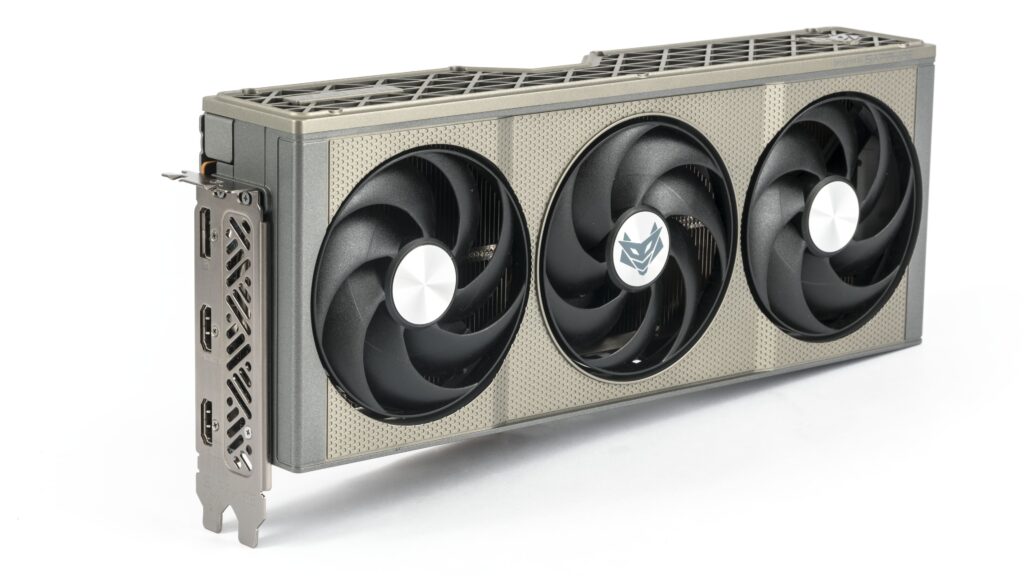
However, the suggested price for the RX 9060 XT starts a fair bit lower, necessitating cuts in manufacturing costs. Some features took the hit. The stylish mesh on the shroud was replaced by a plastic imitation, and even the power cable is no longer hidden away as it is on the more powerful model.
Thus, the card installed in a case doesn’t look as clean, with the power cable routed from its middle. But I don’t see this purely as a negative. On the Nitro+ RX 9070 XT, hiding the cable in the rear part of the cooler under the backplate compromised cooling.

The power cable with the Nitro+ AMD Radeon RX 9070 XT OC
On the Nitro+ RX 9060 XT, the rear section of the heatsink remains freely pass-through. The cooler can be quieter at the same temperatures than it would be with the foam padding used on the higher-end model.
The noise level values measured with the sound level meter didn’t fully correspond to what I’m used to. Typically, cards measuring under 34 dBA are inaudible to me from a two-meter distance; subjectively, the cooler’s noise didn’t match the measured value.
With the Nitro+ RX 9060 XT, a deeper tone from the fans was audible. This was caused by their higher noise output at frequencies around 210 Hz, which didn’t translate heavily into the overall dBA reading. However, the cooler can be quieted by manually lowering the fan speeds. Regarding temperatures, it has sufficient headroom for you to quiet it down. Under load, there’s also a faint coil whine audible, but its buzz isn’t as pronounced as on more powerful cards—in this regard as well, the card can be counted among the quieter ones.
The price of basic 16GB RX 9060 XT models starts at 370 EUR. For the Nitro+ AMD Radeon RX 9060 XT OC, you’ll pay about 25 EUR more. It is marginally better in every aspect than the previously tested Pulse AMD Radeon RX 9060 XT, but the differences are rather negligible—temperatures are 2–4 °C lower, noise is about 1 dBA less; simply put, it’s nothing you’d notice without measurements. Therefore, if you’re looking for a card with a good price/performance ratio and don’t need the colorful LEDs, the cheaper 16GB Pulse variant will definitely be a more advantageous choice. The Pulse RX 9060 XT OC itself already offers excellent characteristics, and with the Nitro+, you won’t significantly improve in that regard.
If you also care about how the card looks and how it will stand out behind the glass side panel of a lit-up build, then you probably won’t mind paying that extra money.
| Sapphire Nitro+ AMD Radeon RX 9060 XT OC (11350-01-20G) |
|
+ 16 GB of memory − Premium over basic models, worse price/performance ratio |
| Approximate retail price incl. VAT: 394 EUR |

English translation and edit by Jozef Dudáš



Honeslty, with how slow advancement in this tier is, there’s a very good argument for getting the Nitro on build so the thing will live as long as possible.