Improving production by making it cheaper is often done regardless of whether or not a particular product is doing well on the market. Scythe Fuma probably belongs to the “worse category“, which is also proved by its low availability. It seems that the manufacturer had to start to save up to maintain the production. It is no drama, but this tastes a bit bitter because the first version was the best product for its price.
Conclusion
We expected much more form Fuma rev. B. The original cooler was a decent opponent even for NH-D15, the rev. B acts a little bit like some 2nd class cooler. It is only slightly better than the cheaper Fera 3 v2 (and on the top of that, only in low noise modes).
With increasing demands for cooling performance, the pipes are obviously the limiter. Perhaps due to their design, and perhaps due to weaker pressure (we will test the influence of the pressure on the heat transfer intensity soon).
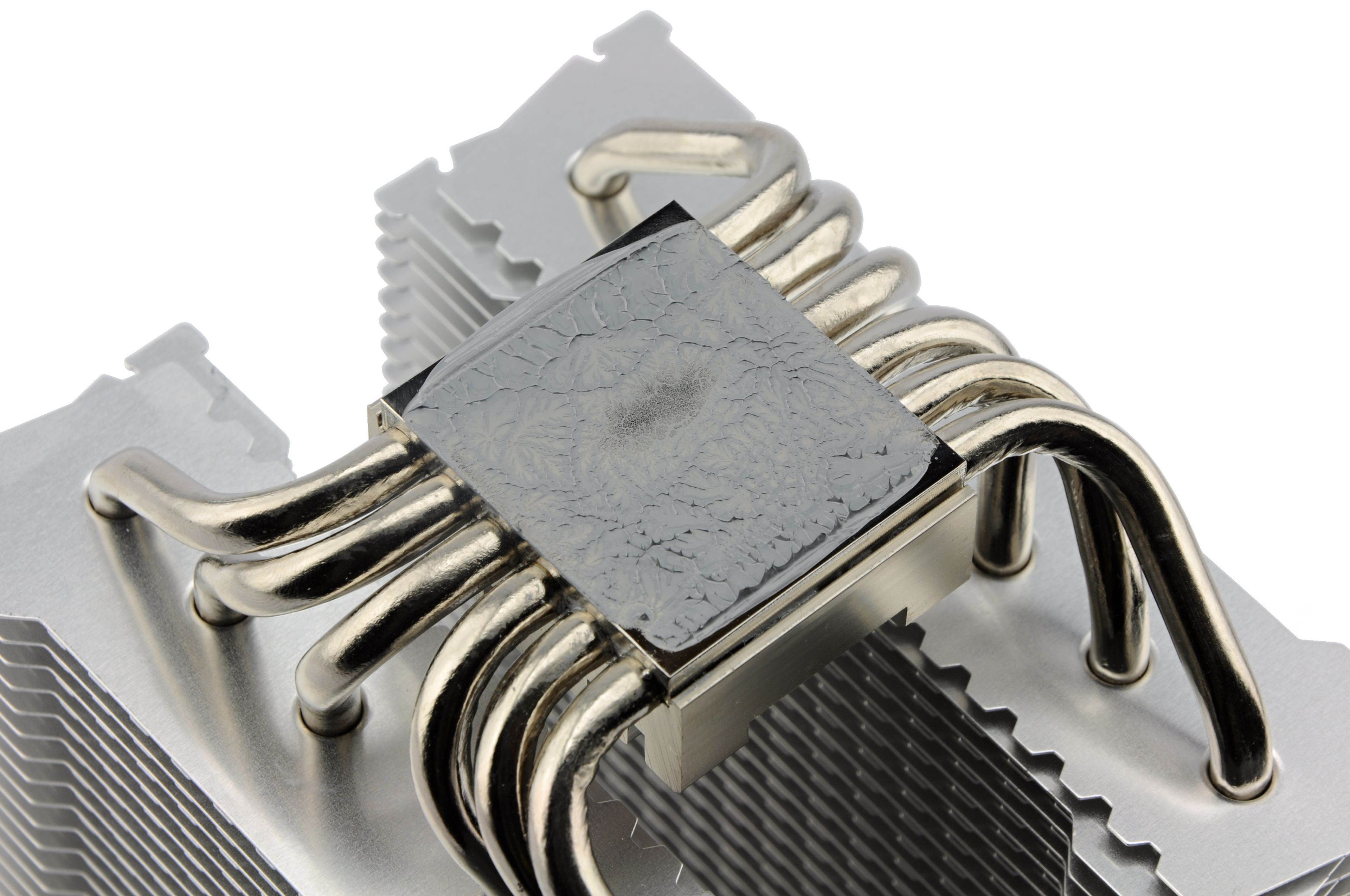
Prints of the compound cannot refute the theory about weak pressure. Compare them with those in this test where we used the first Fuma. Although the convex point is not in the middle of the base, it is positioned identically on both versions. The first one applies more pressure on the processor, which can be proved by tighter contact under convexity and also by more compound on the edges of the IHS. Since the convex point is a bit out of focus, we turned the heatsink 180 degrees, and tested it that way. However, the result did not change (as expected).

With default CPU settings, Fuma is significantly better than Fera 3 v2, but after overclocking (with the CPU around 180 W), the difference is not that significant at all. And it should be the exact opposite, in fact. It is also possible that we acquired a sample that is not 100% representative. We will verify this when we get the appropriate opportunity (assuming we will be able to get another sample – it can be difficult to purchase one because most shops are usually out of stock). And even Scythe itself does not supply samples of this cooler very often, according to available reviews. We’ve found just one review of it on TweakTown, although they tested it with a more cost-effective processor, where the performance deficit does not show up yet. Similar case like Arctic Freezer 33 which starts to “hobble“ only when facing stronger heat intensity.
Sadly, we must say that it does not pay off to get this cooler. Only if you are lucky enough and get a chance to buy the first version – that one is definitely a good deal. If you own Ryzen, you need to order AM4 kit separately.
| Scythe Fuma rev. B |
| + high cooling performance |
| + performance remains the same even after reducing the speed of the fans |
| + very quiet PWM regulation, both in burn and in idle |
| + comfortable assembly |
| + great compatibility, everything from the old Intel LGA 775 to AMD AM4 |
| + solid mounting accessories |
| + low height, ie. fits almost into every case |
| - less efficient than the first version (not the best deal for its price anymore) |
| - with a great thermal transfer (180 W +) it's only at SPC Fera 3 v2 level |
| - you can turn the heatsink only in one direction on AMD processors (horizontally) |
| - in the first three slots, it collides with RAM modules higher than 3 cm |
| - slightly "growling" fan |
If you like magazine HWCooling, please support us.
We cannot keep publishing this kind of detailed content on regular basis without your help because it is very time consuming. We will be grateful for every contribution. Thank you!