Image “upscaling” technologies have already won over most gamers. But there is still a camp of staunch opponents who prefer a faithfully rendered image over one “made up” by artificial intelligence. On a Radeon RX 9060 XT with AMD FSR 4, we’ll look at why that reading is inaccurate and how the new algorithms can turn low-resolution frames into images with a level of detail comparable to honest native-resolution rendering.
When the image is really upscaled by AI
The following comparison shows where the main issue lies when upscaling from a low resolution. We’ll examine how many details are retained in native resolution versus when rendering at half the resolution. Below are three images with 1:1 crops that can be enlarged to double size when clicked.
The first crop shows the game rendered at its native resolution of 2560 × 1440 pixels. The next examples are rendered at half the resolution—1280 × 720 pixels (or one-quarter of the original area)—and then upscaled using different methods, including AI with a trained neural network. A resolution of 1280 × 720 should roughly match what FSR uses when your monitor’s native resolution is 2560 × 1440 and you enable FSR in Performance mode.
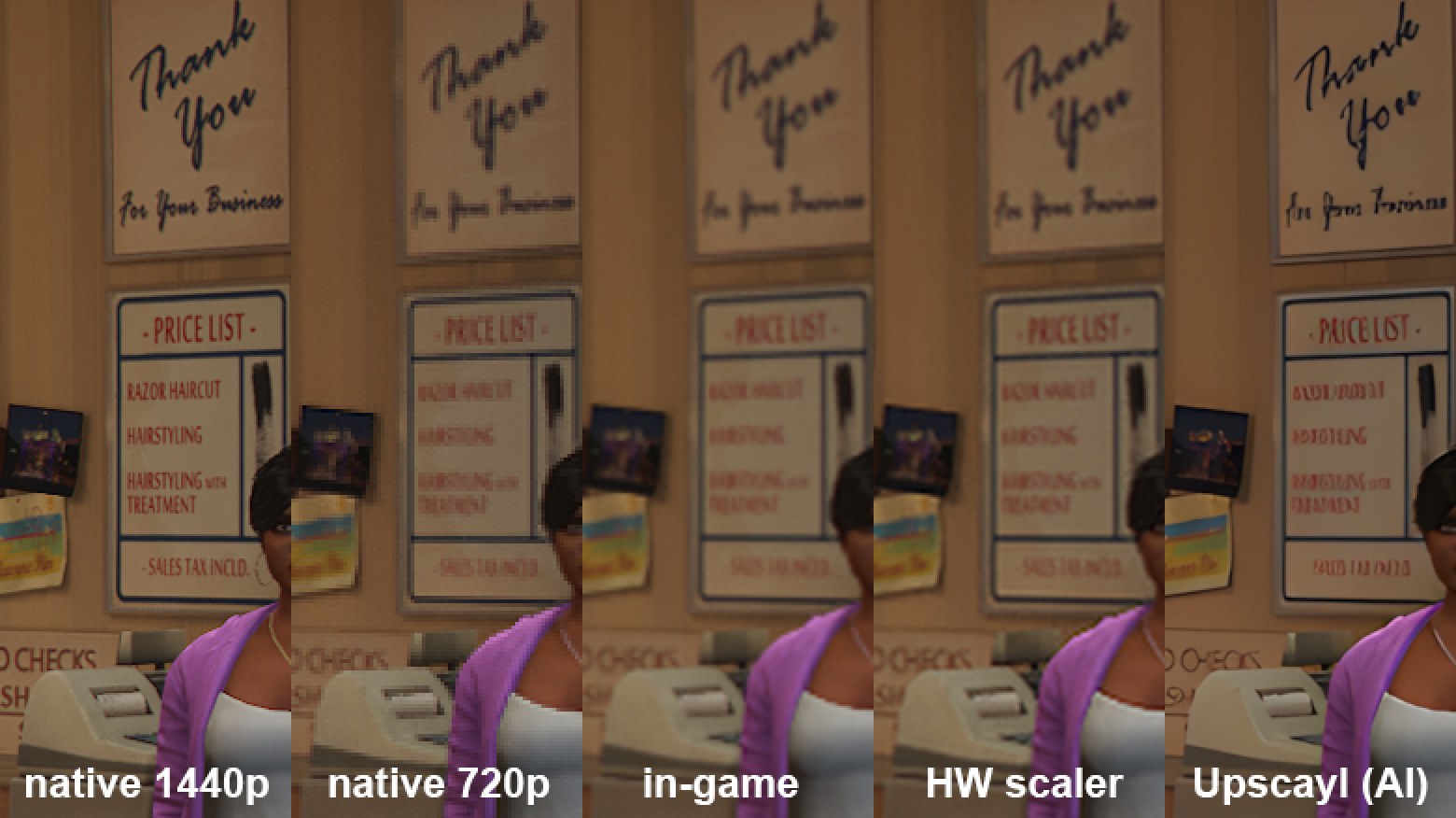
The second crop shows an image rendered at a resolution of 1280 × 720 pixels. This renders an area four times smaller with four times fewer pixels. To match the scale, I enlarged it using a sharp nearest-neighbor filter. Each rendered pixel is thus stretched to 2×2 pixels. The resulting size then corresponds to a native resolution image.
At 1280 × 720, a lot of detail is already lost. Small text becomes unreadable because each letter only gets a handful of pixels. When you interpolate this to a higher resolution, the image just gets blurred to hide jagged edges, but the small letters will remain illegible.
The third crop demonstrates how the game’s built-in upscaling handles this situation. The frame scaler is set to 1/2 (x0.500). Jagged edges are less noticeable now, but overall sharpness drops as a result. The fourth crop shows what happens when you set the game to 1280 × 720 and let the hardware scaler on the GPU or monitor upscale it. In this case, it was likely the scaler on an AverMedia GC573 capture card, which scaled the image back to 2560 × 1440.
The last crop illustrates what happens when a neural network does the upscaling. Here, the image was upscaled by AI using the Upscayl application, which employs models like Real-ESRGAN. The upscaling was done in Standard mode.
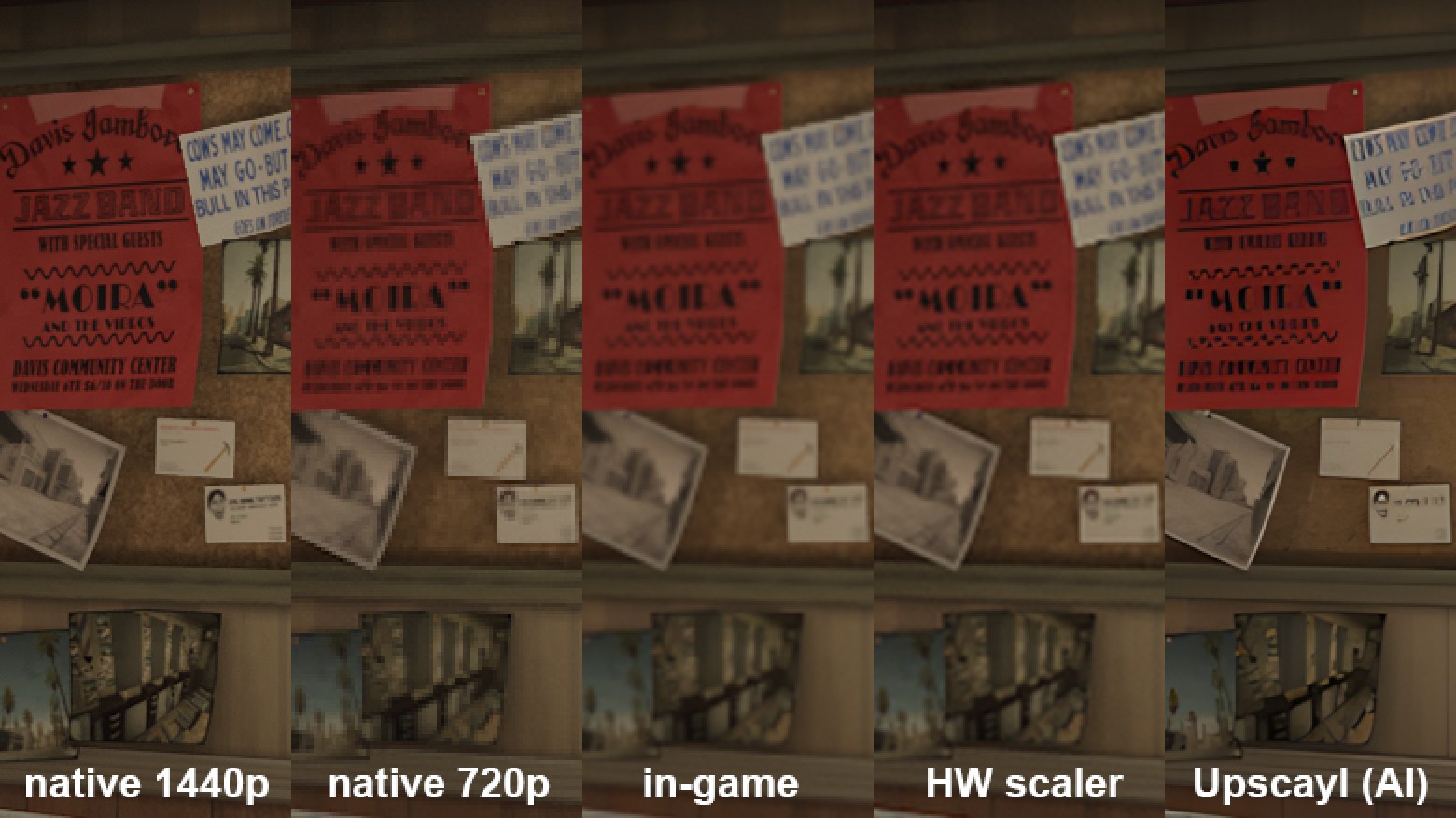
Even if I overlook the fact that the text remains unreadable, this implementation cannot be used in games. Upscaling a single frame takes on common PC over five seconds.
It’s clear that text is only legible at the native 1440p resolution. In this crop, you can see that AI does a nice job smoothing edges, enhancing recognized shapes, and sharpening the image. However, it can’t always reconstruct the original shape from just a few pixels. This is particularly evident with the stars on the red poster or the readability of text. From a four-pixel character, the AI cannot determine what letter was originally there; it replaces text with geometric shapes, leaving it unreadable. And I should remind you that upscaling a single frame to this quality takes about five seconds using GPGPU.
Although simple interpolation performed in-game and on the scaler don’t differ fundamentally in terms of rendering, the in-game method does have one advantage: while the image is rendered at a lower resolution, additional graphical interface elements like text or HUD are drawn over it at the display’s native resolution. This is visible in the lower left corner of the frames with the map—with in-game upscaling, the overlay map and text retain the same quality as in native resolution, whereas with all other interpolation methods, the interface is enlarged and becomes jagged, blurry, or harder to read.

Below are the full JPEG images with 99% compression quality. Remember, it’s essential to view them at a scale where one image pixel corresponds to one screen pixel. If you downscale or upscale them, interpolation in the browser will blur them, and you won’t see the differences at a significant downscaling.
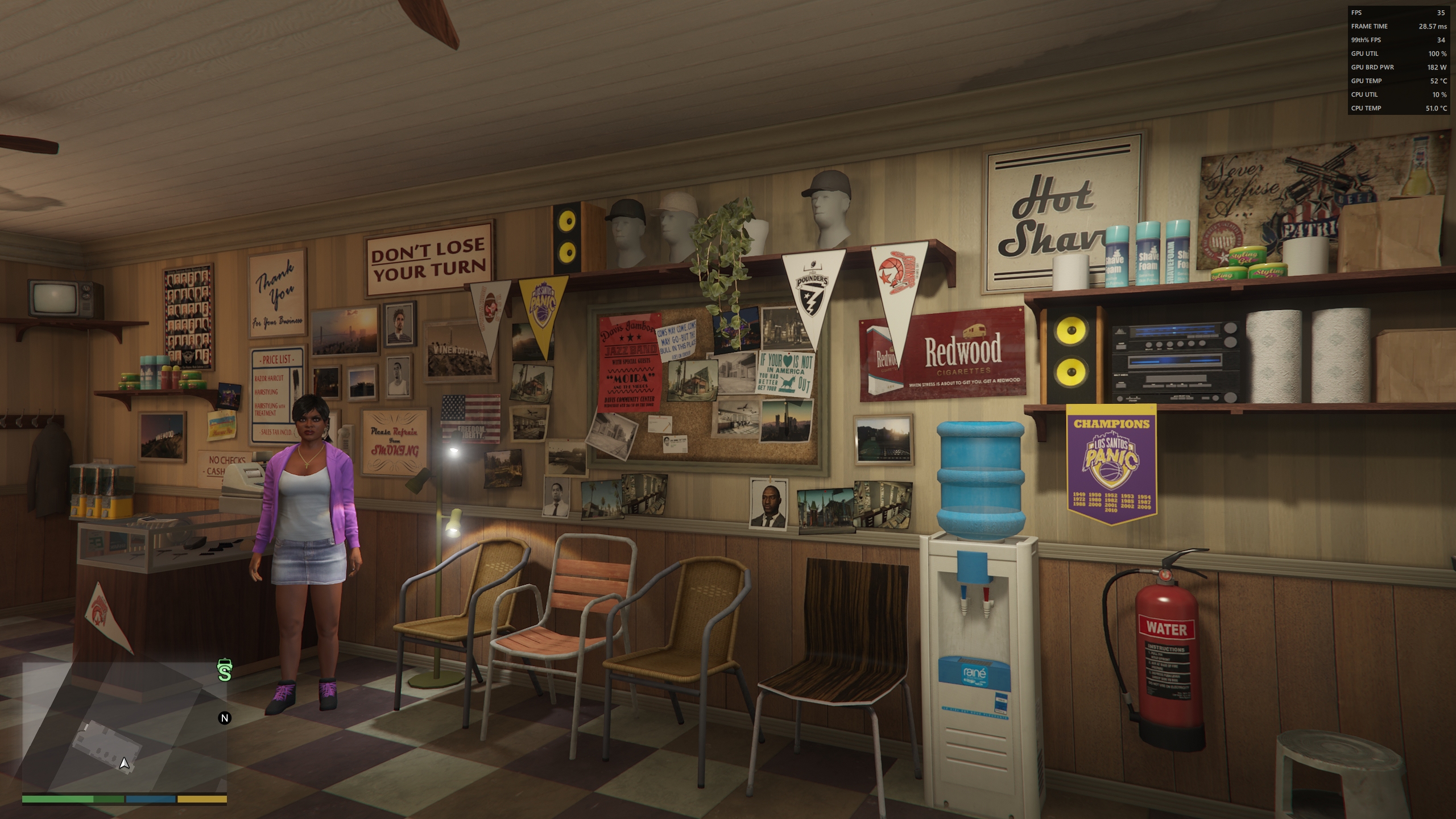

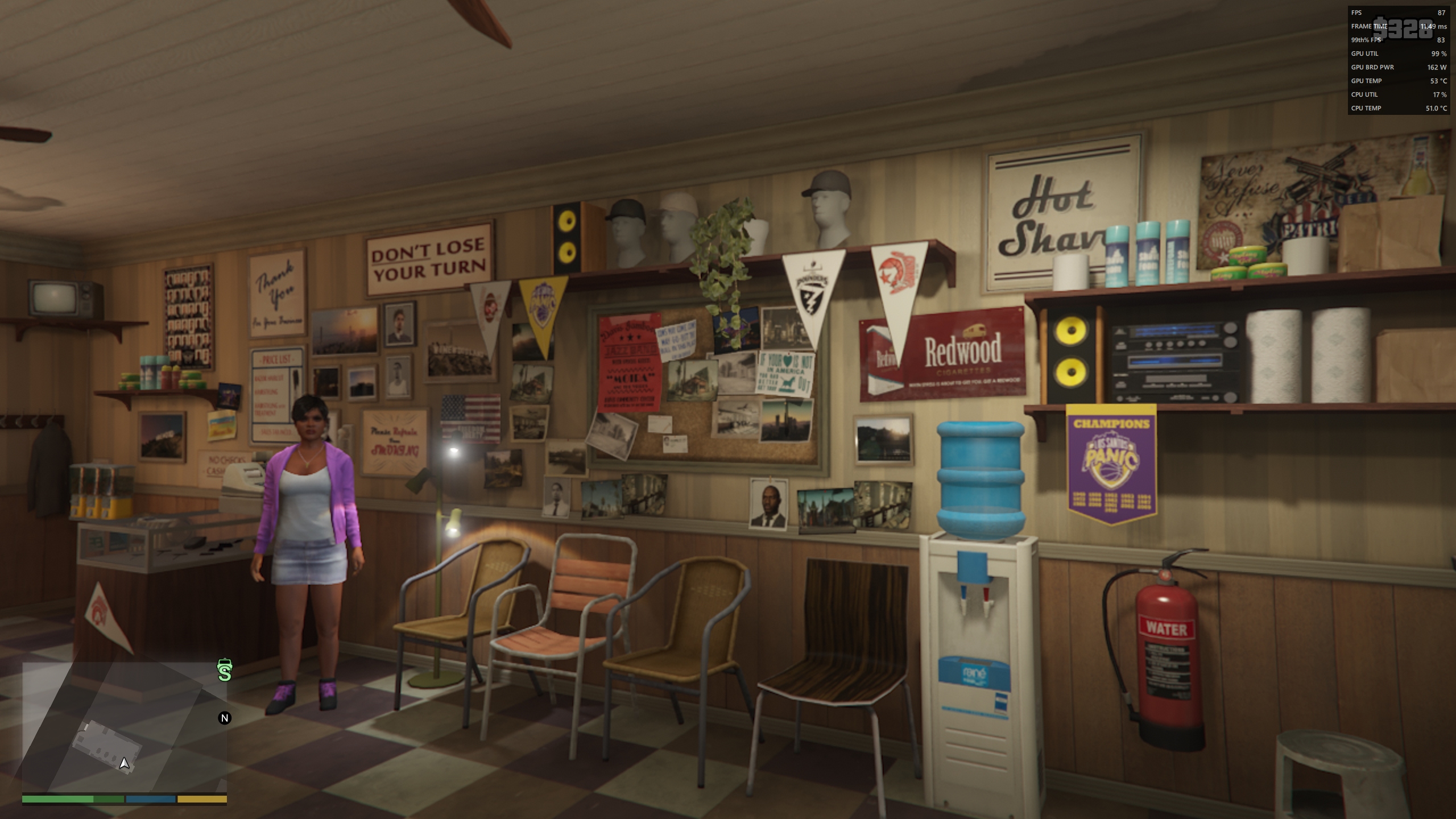


native 1440p | native 720p | in-game scaling 0,5 | hardware scaler | Upscayl (AI)
On the next page, we’ll take a look at what results can be achieved with FSR.
⠀