


On most mid-range Asus graphics cards, the shroud is easy to remove. We already tried classic 120 mm fans on this card, but they do not suit its narrow, long PCB: they make the card much wider and still fail to cover the heatsink along its full length. A trio of 92 mm Noctua fans fits better on the 30 cm card, and the range includes the low-profile NF-A9x14 for noticeably quieter cooling at lower speeds overall.
To mount the fans, I modeled a simple frame. With a length of around 30 cm, it doesn’t fit on most common 3D printers, so it’s split into two parts. The feet are separate. It’s a printed plastic part, so it’s not as robust, and if damaged, you can easily replace it; also, during prototyping, I don’t have to print the entire frame if its shape needs adjustment, for example, because it doesn’t precisely fit the screw holes on the card or collides with some component.


Everything is screwed together using M2 self-tapping screws for plastic. You can easily get them in packs of hundreds from Chinese e-shops.
For now, we’ll try the bare frame, which is seated in the grooves on the corners of the heatsink’s fin stacks.
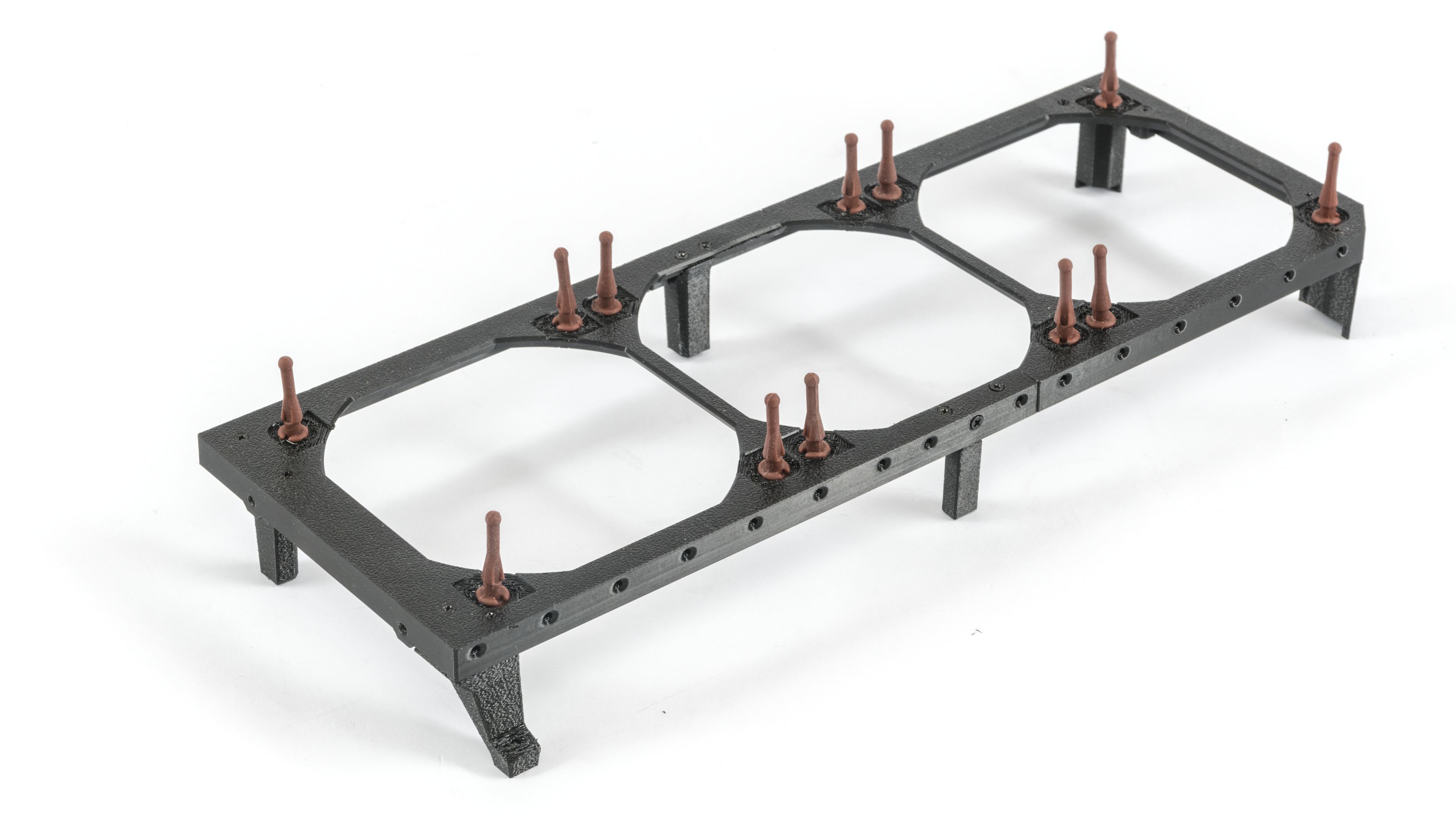
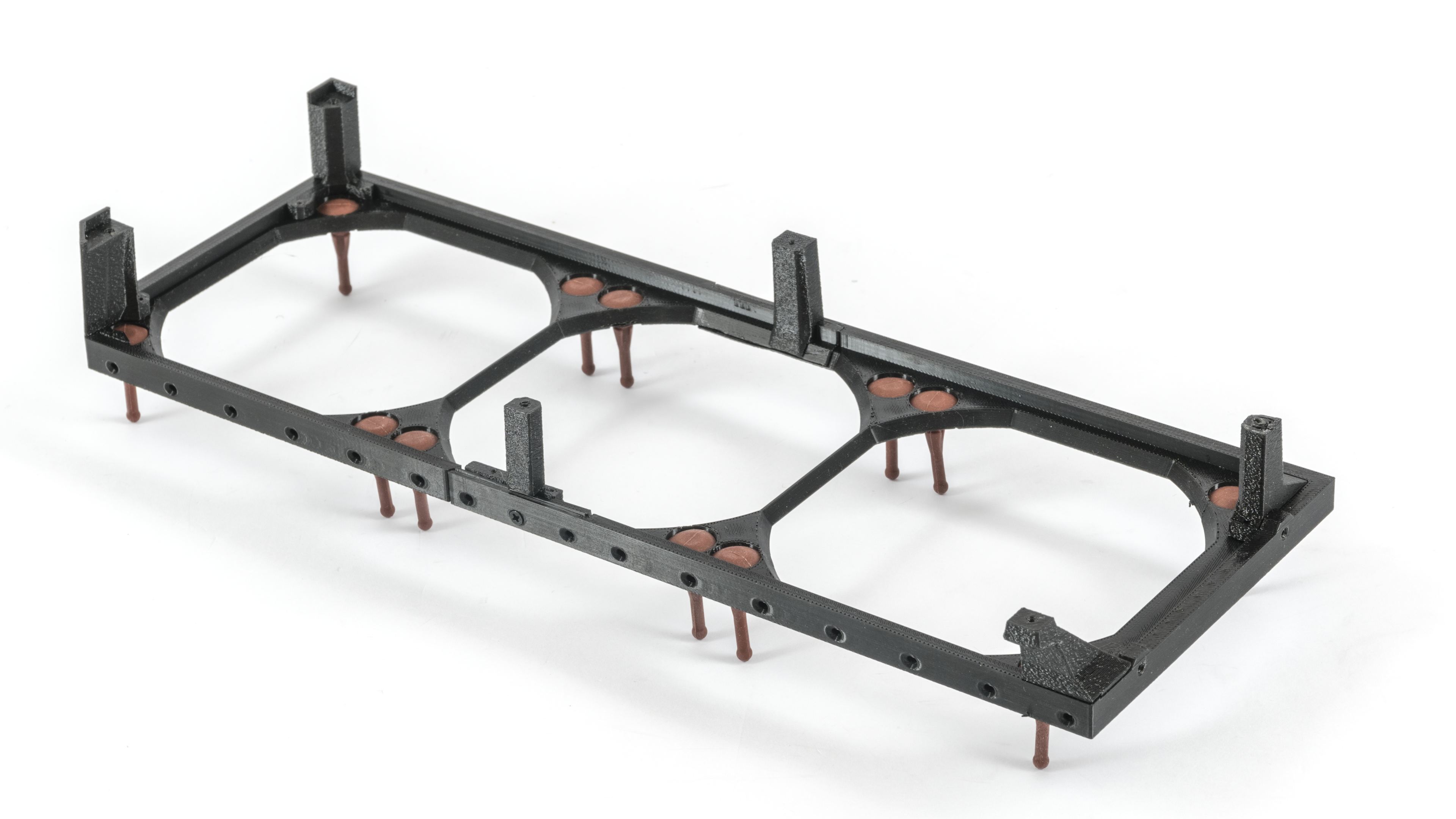
Thanks to the frame, the fans can be mounted on taller rubber anti-vibration mounts and be slightly farther from the fins without too much air escaping through the gap between the fan and the heatsink. There are holes for screws on the sides of the frame, so in the future, a fan shroud or covers for the fin stacks can be modeled and attached to it. A shroud would already be useful just to tidy up the cables, which are longer and bulkier than on the standard fans used on graphics cards.
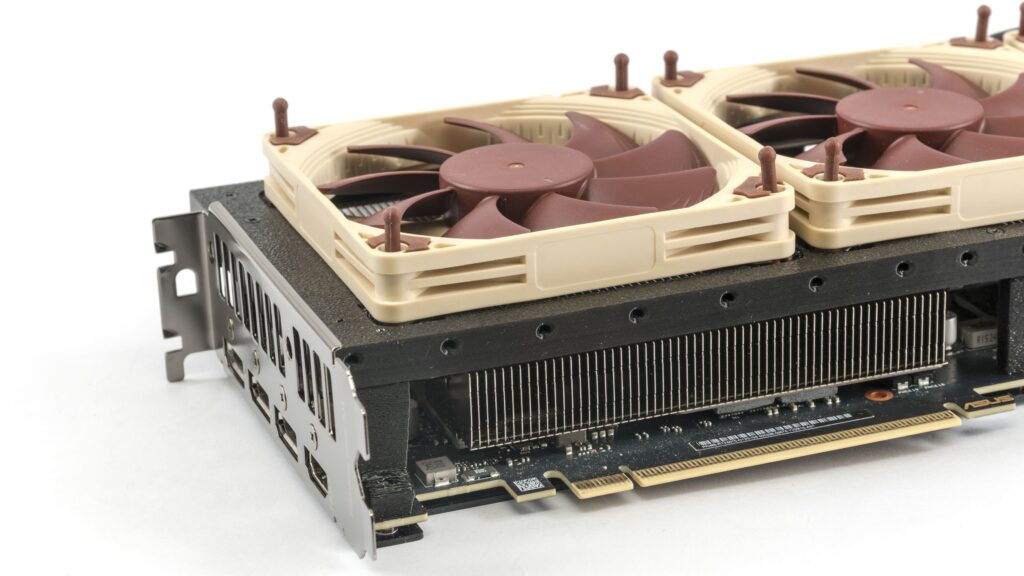
To mount the fans this time, I used the short anti-vibration mounts that are part of the package. They hold, but it’s not ideal. They were probably originally designed for larger fans that have a gap in the middle between the corners where the mount’s rim can sit. However, on the low-profile fan variant, the corner is solid, so the mount has nothing to catch onto and doesn’t hold as well. An alternative is the newer NA-SAV4 type, which already has provisions for fans with heights of 10, 14, 15, 20, and 25 mm.


First, let’s look at how the card performed with cooling across the entire operating speed range with the stock fans, and then we’ll go through the operating characteristics of the card with the Noctua NF-A9x14 fans.
⠀



Love this content.
Glad to this performed comparable to the A12X25. Interested to see how the A9X25 would improve the performance.
Some tests with the NF-A9x25 fans should be published this Friday, if nothing goes wrong. 🙂