


On most mid-range Asus graphics cards, the shroud is easy to remove. We already tried classic 120 mm fans on this card, but they do not suit its narrow, long PCB: they make the card much wider and still fail to cover the heatsink along its full length. A trio of 92 mm Noctua fans fits better on the 30 cm card, and the range includes the low-profile NF-A9x14 for noticeably quieter cooling at lower speeds overall.
Final thoughts
What we are probably most interested in here is the comparison with the original fans and how the card’s noise level changes at the same temperatures. Just to remind you, this particular card came with lower-quality fans, one of which was noticeably louder and still measured 32 dBA even at its minimum speed. I also tested a second unit, which was quieter, but even that one had a minimum of around 31 dBA.
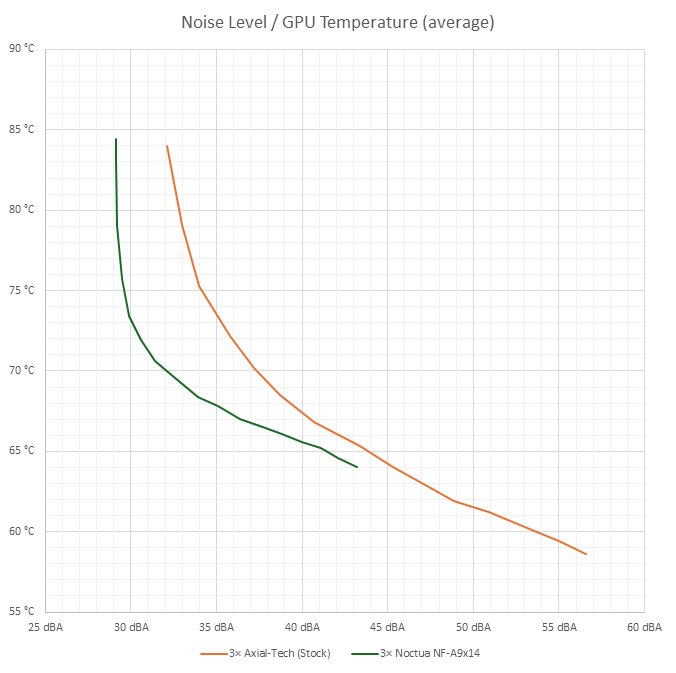
The following chart shows how the card’s noise level changes at the same temperatures. The horizontal axis shows the cooler’s noise level, and the vertical axis shows the temperature of the graphics chip. The values are the average GPU temperatures from the final 68-second test run.
Up to about 68 °C, the card with Noctua fans is noticeably quieter. Only at higher fan speeds do the noise levels start to even out. The Axial-Tech fans have the advantage of a higher maximum speed – in our test setup they can cool the GPU to lower temperatures and provide more headroom for cases with poorer airflow, allowing the temperature to be reduced by another 5 °C. However, this comes at the cost of significantly higher noise.
You can push the temperatures a little lower with the NF-A9x14 fans in the chromax.black version, which have a wider operating speed range – they can reach up to 2500 rpm, while the tested variant in the standard colours tops out at 2200 rpm.
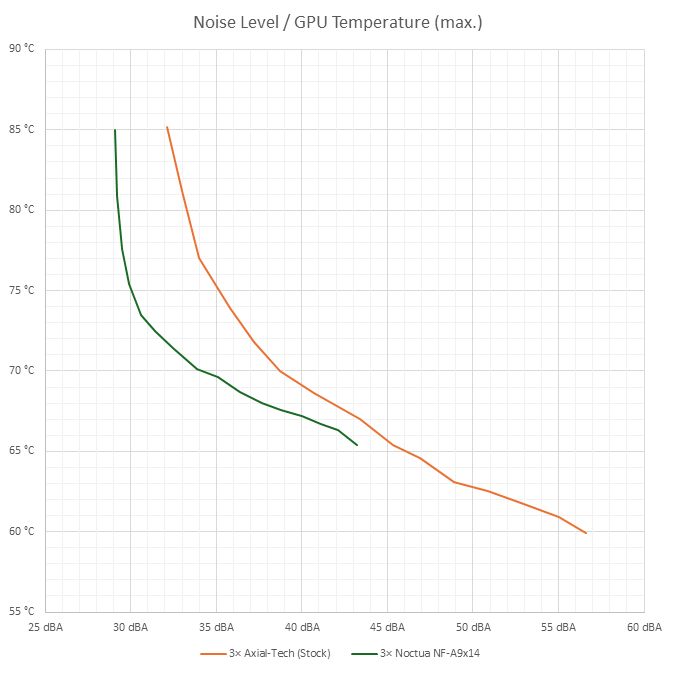
The next chart shows the maximum GPU temperature recorded during the last test run in relation to the cooler’s noise level. Here, the temperature is limited to 85 °C, which is where the over-temperature protection kicks in.
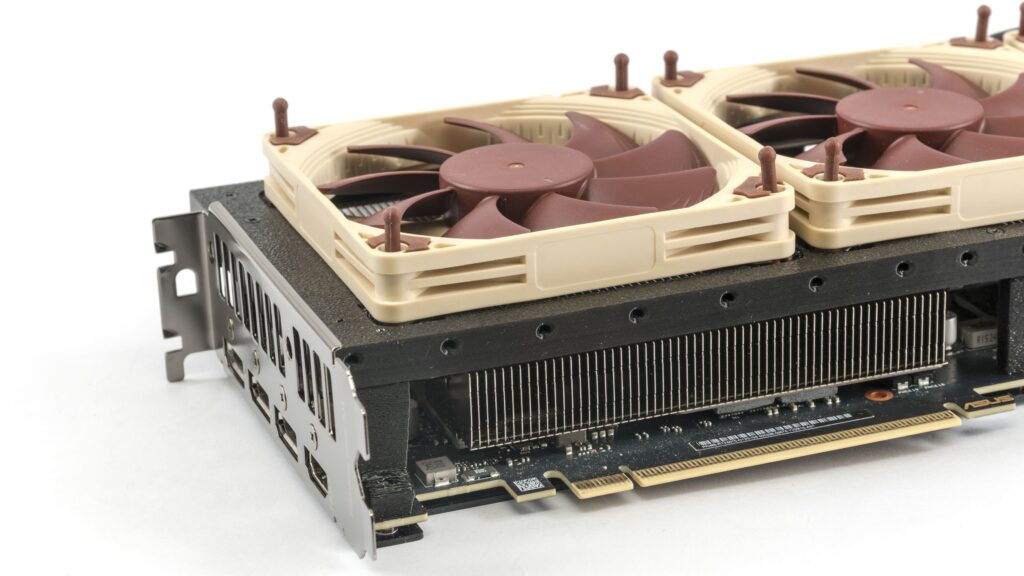
In the next article, we will also add results for the 92 mm variant with the standard 25 mm thickness. I will also provide a downloadable frame model for mounting the fans to the Asus Prime GeForce RTX 5070, ready for 3D printing. The model already works as intended, but it could still use a few refinements.

English translation and edit by Jozef Dudáš
⠀





Love this content.
Glad to this performed comparable to the A12X25. Interested to see how the A9X25 would improve the performance.
Some tests with the NF-A9x25 fans should be published this Friday, if nothing goes wrong. 🙂