GeForce RTX 5070 Ti appeals to gamers who don’t need top-tier cards but aren’t on a tight budget and don’t want to worry about running out of memory in games for the next few years. With 16 GB of GDDR7, it’s great not only for gaming but also for running local AI models. Asus once again relies on a solid design in its TUF model, with a massive cooler that keeps it quieter under load in Q mode than most graphics cards on the market.
Fan behavior, noise level
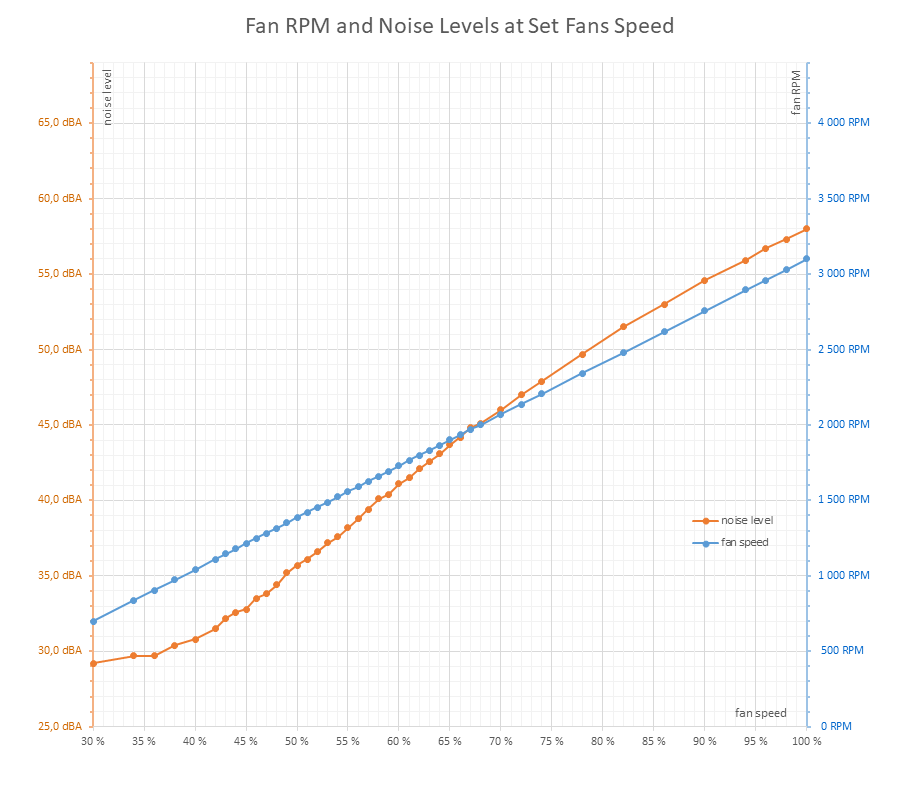
Fan speeds can be set between 30–100%, which corresponds to roughly 700–3100 RPM. On the sound meter, these speeds translated to noise levels between 29.2–58 dBA.
The 29.2 dBA noise level at the minimum fan speed is already below the measurement range of the sound meter.
For a warmed-up card in the default P mode, fan speeds in the tests hovered around 1650–1700 RPM, which corresponds to a measured noise level of about 40.1–40.4 dBA.
In the quieter Q mode, fan speeds for the warmed-up card ranged between 1220–1330 RPM across three tests, during which the sound meter showed noise levels of 32.8 to 34.7 dBA. It’s not the quietest card I’ve tested on HWCooling, but it definitely ranks among the best.
Cyberpunk 2077, RT Medium, 3840 × 2160 (P mode)
For testing operating characteristics of high-end graphics cards, I use Cyberpunk 2077 with RT Medium settings at a resolution of 3840 × 2160 pixels. The test consists of eight benchmark runs in a row.
Monitoring reports 100% GPU load (shown in purple in the graph below), but judging by the fact that the card isn’t constantly running at the power limit, the chip likely isn’t being pushed to its absolute max.

GPU clock speeds during the final pass of the test fluctuate between 2767 and 2797 MHz, averaging 2789 MHz.

The light green line shows that the power draw fluctuates, rather than staying flat at the 300 W limit. According to monitoring, the card’s power consumption ranges from 286 to 302 W, with an average of 295 W.

According to the sensors, the GPU temperature in the last run peaks around 65.8 °C, which is far from high enough to cause thermal throttling. Memory temperatures are mostly around 68 °C, occasionally hitting 70 °C. The new GeForce cards do not report hotspot temperatures.

These low temperatures, however, come at the cost of higher noise levels in P mode—at 1650 RPM, the card’s noise output is more or less average.

Even though the power consumption graph doesn’t show the card constantly hitting its power limit, the GPU Boost indicators suggest that clock speeds are being capped by the card’s power ceiling.

⠀