GeForce RTX 5070 Ti appeals to gamers who don’t need top-tier cards but aren’t on a tight budget and don’t want to worry about running out of memory in games for the next few years. With 16 GB of GDDR7, it’s great not only for gaming but also for running local AI models. Asus once again relies on a solid design in its TUF model, with a massive cooler that keeps it quieter under load in Q mode than most graphics cards on the market.
A detailed description of the new technologies brought by Nvidia’s new graphics cards has been compiled by Jan Olšan in the article Blackwell: GeForce RTX 5000 architecture and innovations. It introduces the individual graphics chips Nvidia is using in the new cards, the new GDDR7 memory type, and also covers changes in cache memory, GPU compute units, updates to shaders and tensor cores, as well as improved compute units for ray tracing. The new generation of GeForce also brings support for new standards such as DisplayPort 2.1b and PCI Express 5.0.
With the new generation of cards, DLSS capabilities are evolving as well. It now supports Multi Frame Generation, which allows the generation of up to three intermediate frames, and introduces Nvidia Reflex 2, the second generation of its latency-reduction technology. This includes Frame Warp, which adjusts object and camera motion in rendered frames based on the player’s most recent input device movement data received just before the already rendered frame is displayed. A more detailed explanation can be found in the aforementioned article.
The GeForce RTX 5070 Ti uses the same GB203 GPU as the higher-end GeForce RTX 5080 but features fewer active compute units. Crucially, it retains a 256-bit memory bus along with 16 GB of memory, similar to the RTX 5080 and the older RTX 4070 Ti Super. However, compared to the previous generation, the RTX 5070 Ti is equipped with faster GDDR7 memory, resulting in increased total memory bandwidth.
Compared to the higher-end RTX 5080, which features a fully enabled graphics chip, some compute units in the RTX 5070 Ti have been deactivated. As a result, it offers 8,960 shaders, 280 texture units, and 128 ROPs. Additionally, it includes 280 tensor cores for AI computations and 70 cores for ray tracing.
The base clock of the GPU is 2300 MHz, with a typical boost clock of 2452 MHz. The memory runs at 1750 MHz (28 Gb/s). For comparison, the GeForce RTX 5080 has a base clock of 2295 MHz and a higher boost clock of 2617 MHz. The total memory bandwidth is also slightly lower than on the RTX 5080 due to the lower clock speed of GDDR7—1750 MHz (28 Gb/s) on the RTX 5070 Ti versus 1875 MHz (30 Gb/s) on the RTX 5080.
A more detailed comparison of specifications with other “xx70” models can be found in the table below.
| RTX 5070 Ti | RTX 5070 | RTX 4070 Ti Super | RTX 4070 Ti | RTX 4070 | |
| Shader cores | Blackwell | Blackwell | Ada Lovelace | Ada Lovelace | Ada Lovelace |
| Nvidia CUDA cores (SP) | 8960 | 6144 | 8448 | 7680 | 5888 |
| RT cores | 133 TFLOPS | 94 TFLOPS | 102 TFLOPS | 93 TFLOPS | 67 TFLOPS |
| Tensor Cores | 1406 AI TOPS | 988 AI TOPS | 706 AI TOPS | 641 AI TOPS | 466 AI TOPS |
| Boost Clock | 2,45 GHz | 2,51 GHz | 2,61 GHz | 2,61 GHz | 2,48 GHz |
| Base Clock | 2,3 GHz | 2,16 GHz | 2,34 GHz | 2,31 GHz | 1,92 GHz |
| Memory | 16 GB GDDR7 | 12 GB GDDR7 | 16 GB GDDR6X | 12 GB GDDR6X | 12 GB GDDR6 12 GB GDDR6X |
| Memory Bus Width | 256-bit | 192-bit | 256-bit | 192-bit | 192-bit |
| Memory Bandwidth | 896 GB/s | 672 GB/s | 672 GB/s | 504 GB/s | 504 GB/s |
| Max. resolution | 4K at 480Hz or 8K at 120Hz with DSC | 4K at 480Hz or 8K at 120Hz with DSC | 4K při 240 Hz at 8K or 60 Hz with DSC, HDR | 4K at 240 Hz or 8K at 60 Hz with DSC, HDR | 4K at 240 Hz or 8K at 60 Hz with DSC, HDR |
| Standard Display Connectors | 3× DisplayPort, 1× HDMI | 3× DisplayPort, 1× HDMI | 3× DisplayPort, 1× HDMI | 3× DisplayPort, 1× HDMI | 3× DisplayPort, 1× HDMI |
| PCI Express | Gen 5 | Gen 5 | Gen 4 | Gen 4 | Gen 4 |
| Nvidia Encoder | 2× 9th gen. | 1× 9th gen. | 2× 8th gen. | 2× 8th gen. | 1× 8th gen. |
| Nvidia Decoder | 1× 6th gen. | 1× 6th gen. | 1× 5th gen. | 1× 5th gen. | 1× 5th gen. |
| length | by manufacturer | 242 mm | by manufacturer | by manufacturer | 244 mm |
| width | by manufacturer | 112 mm | by manufacturer | by manufacturer | 112 mm |
| height | by manufacturer | 2 slots | by manufacturer | by manufacturer | 2 slots |
| Total Graphics Power | 300 W | 250 W | 285 W | 285 W | 200 W |
| Supplementary Power Connectores | 2× 8pin PCIe (adapter) or 1× 300 W PCIe Gen 5 | 2× 8pin PCIe (adapter) or 1× 300 W PCIe Gen 5 | 2× 8pin PCIe (adapter) or 1× 300 W PCIe Gen 5 | 2× 8pin PCIe (adapter) or 1× 300 W PCIe Gen 5 | 2× 8pin PCIe (adapter) or 1× 300 W PCIe Gen 5 |
Today, we’re focusing on a mid-range model from Asus.
We’re testing the Asus TUF Gaming GeForce RTX 5070 Ti 16GB GDDR7 OC Edition
(TUF-RTX5070TI-O16G-GAMING)
In the GeForce RTX 5070 Ti lineup, Asus offers models from the Prime, TUF, ROG Strix, and a special TUF BTF variant designed for BTF cable-free builds. The most affordable Prime models currently start at 973 EUR, TUF at 1070 EUR, and the premium ROG Strix at around 1178 EUR.

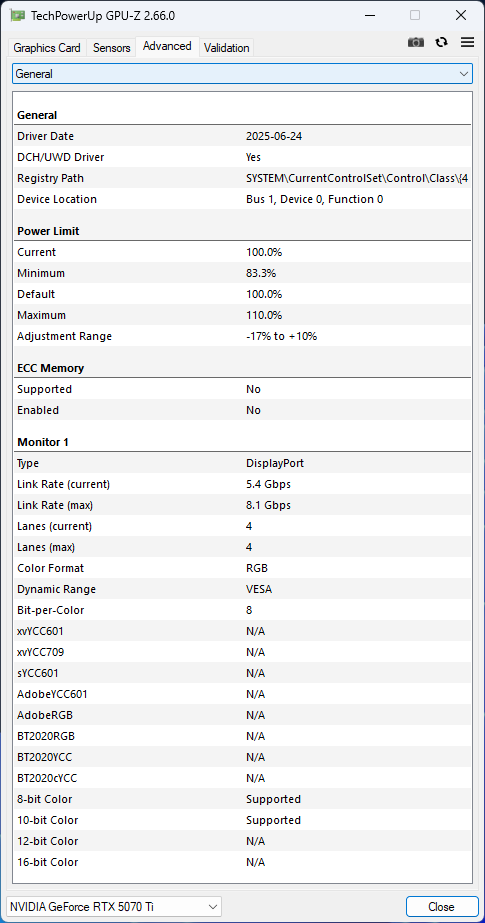
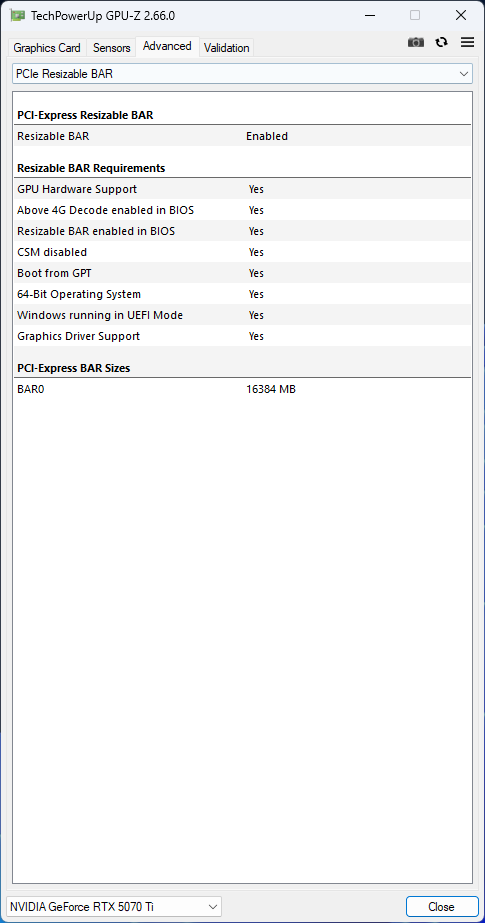
The manufacturer has increased the typical boost clock in the BIOS from the reference 2452 MHz to 2588 MHz. The power limit is set at the reference 300 W, which can be reduced by up to 17% to 250 W or increased by up to 10% to 330 W.

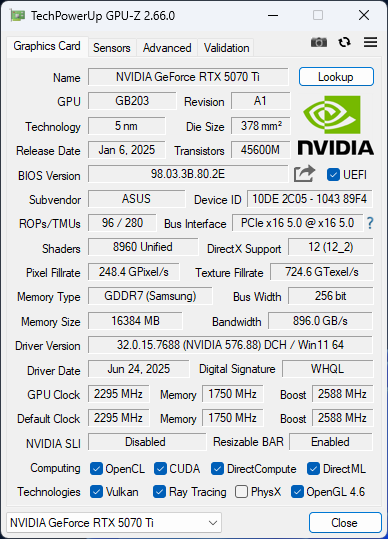
The GPU-Z monitoring shows the usual information. The three fans are split across two connectors.


HWiNFO provides far more sensor readings than GPU-Z. The available sensors in the current version are shown in the image below.

The next set of screenshots displays the values stored in the Quiet BIOS (Q mode). Compared to P mode, the only real difference lies in the fan behavior—the fans run more slowly because the fan performance curve is set lower in relation to temperature.



On the back of the packaging, the manufacturer highlights the features and technologies the card utilizes. High-quality coils, MOSFETs, and capacitors, along with Axial-tech fans with dual ball bearings, are designed to increase longevity. “MaxContact” is Asus’ term for an ultra-flat cold plate that ensures better contact with the GPU and more efficient heat dissipation. A steel frame around the GPU reinforces the chip to prevent cracking. Also mentioned are the stainless-steel bracket and the Asus GPU Tweak III software for tuning, overclocking, and monitoring.


The accessories include a basic power adapter from three standard 8-pins to a single 16-pin connector, a support bracket combined with a screwdriver, a Velcro strap for cables, a magnetic TUF logo badge, and brief installation manuals, a certificate, and a thank-you card.

We’ll look at the card’s detailed features in the next chapter.
⠀