GeForce RTX 5070 Ti appeals to gamers who don’t need top-tier cards but aren’t on a tight budget and don’t want to worry about running out of memory in games for the next few years. With 16 GB of GDDR7, it’s great not only for gaming but also for running local AI models. Asus once again relies on a solid design in its TUF model, with a massive cooler that keeps it quieter under load in Q mode than most graphics cards on the market.
Noise level, operating characteristics—F1 24, 3840 × 2160 (Q mode)
The following graphs show monitoring data from the F1 24 benchmark at 3840 × 2160 resolution with Ultra settings. The test takes place on the Singapore circuit in wet conditions. Unlike other benchmarks with multiple loops and cooling periods, this is a sustained game load over a five-lap race lasting over ten minutes. Values shown in the graphs are from the final lap, when the card is fully warmed up.
The frame rate averages 57 fps, which is just 0.7 fps lower.

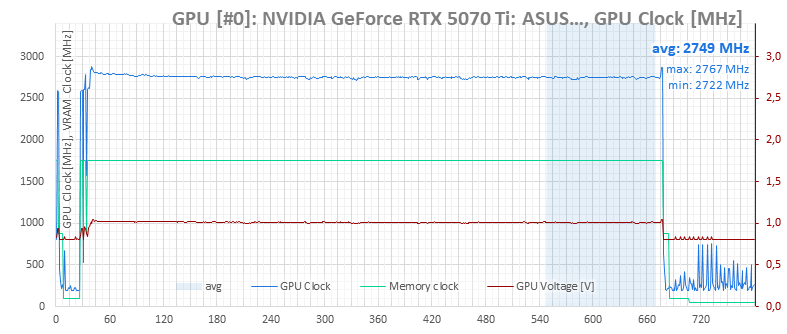
The average GPU clock dropped by 14 MHz to 2749 MHz, with a minimum of 2722 MHz and a maximum of 2767 MHz.
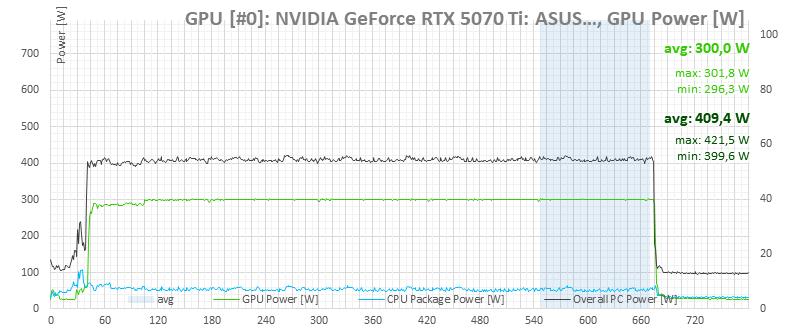
With slightly higher chip temperatures, it’s clear the power draw line flattens again—the card now averages 300 W.
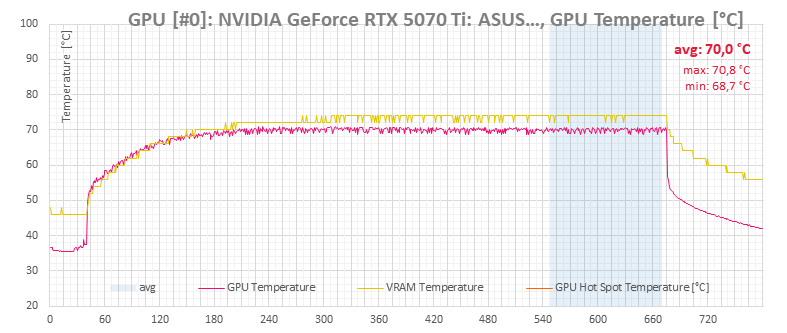
The average temperature of the warmed-up chip peaked at 70.8 °C, memory stayed mostly at 74 °C.
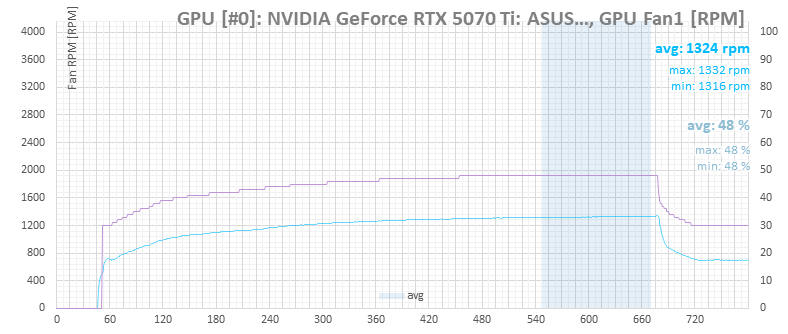
Maximum fan speeds were around 1330 RPM.
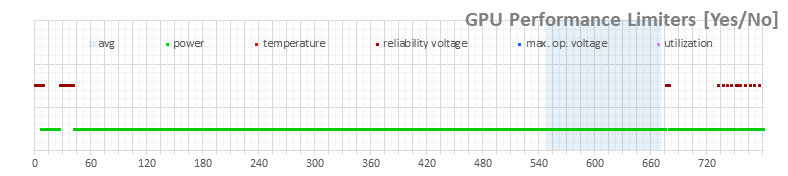
And again, monitoring indicates the GPU Boost is limited by the 300 W power cap.
⠀