GeForce RTX 5070 Ti appeals to gamers who don’t need top-tier cards but aren’t on a tight budget and don’t want to worry about running out of memory in games for the next few years. With 16 GB of GDDR7, it’s great not only for gaming but also for running local AI models. Asus once again relies on a solid design in its TUF model, with a massive cooler that keeps it quieter under load in Q mode than most graphics cards on the market.
Noise level, operating characteristics—F1 24, 3840 × 2160 (P mode)
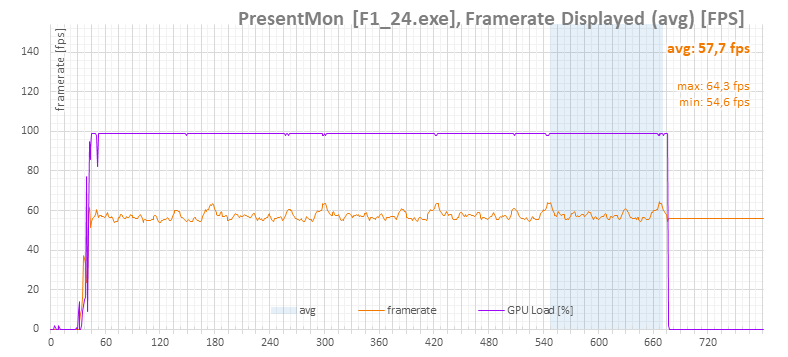
p>The following graphs show monitoring data from the F1 24 benchmark at 3840 × 2160 resolution with Ultra settings. The test takes place on the Singapore circuit in wet conditions. Unlike other benchmarks, which involve several loops with brief cooling intervals during loading, this is a continuous game load over a five-lap race lasting over ten minutes. The recorded values in the graphs are from the final lap, when the card is fully warmed up.
The average frame rate is 0.7 fps higher than in Q mode, but in F1 24, measurement variance tends to be slightly higher.
The average GPU clock is lower than in Cyberpunk: it ranged from 2730 to 2775 MHz, with an average of 276 MHz.

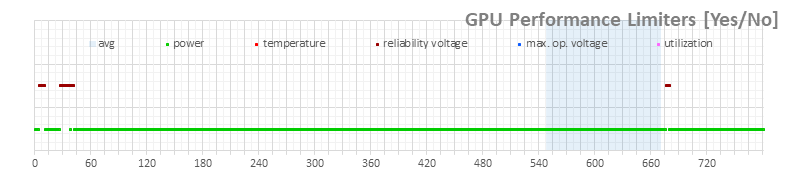
According to monitoring, the card’s power consumption now holds steady at the limit.

The average temperature of the warmed-up chip peaks at 65.6 °C, memory temperatures only occasionally hit 70 °C, typically hovering around 68 °C.
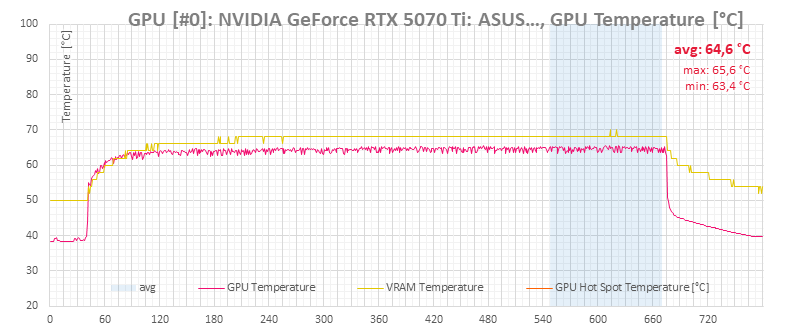
Fan speeds peaked at around 1750 RPM.

Monitoring shows that the GPU Boost clock is hitting the configured 300 W power limit throughout the entire load period.
⠀