


GS series includes a stylish and compact family of high-performance MSI laptops and the GS66 Stealth is its latest addition. I’ve always had a weakness for thin but powerful devices and that’s exactly what GS meets. However, with the high performance of Core i9 and RTX 2080 Super, the question arises as to how thermal management is handled. In less than 2 cm thin and about 2.1 kg body, it is really a challenge to deal with such powerful components.
Performance modes
The laptop offers a choice of Extreme Performance, Balanced and Silent modes in the MSI Dragon Center.
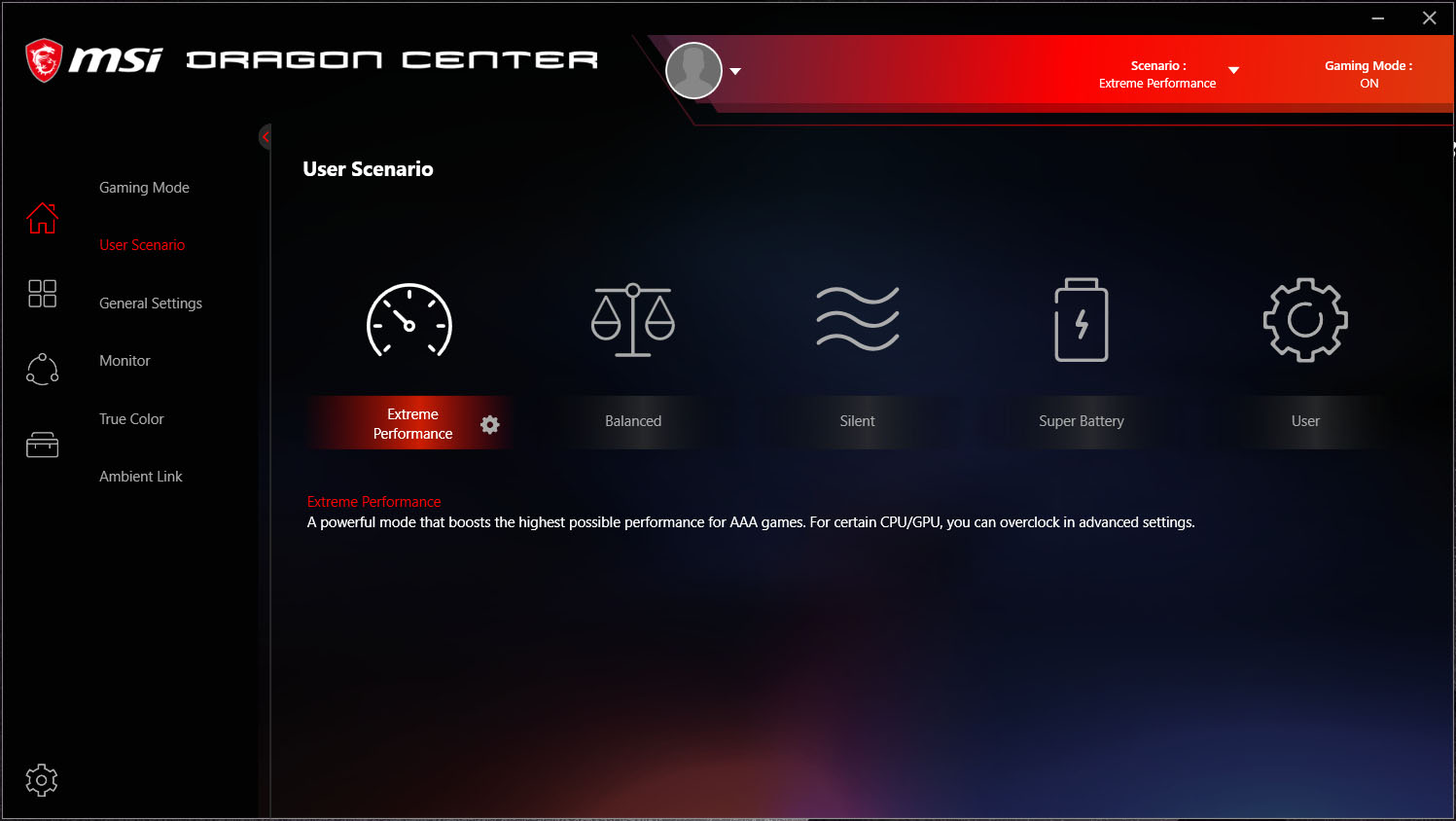
All the tests were performed in Extreme Performance mode, but it’s worth looking at what differences the individual modes offer. Therefore, we compare the performance curves of the combined load using 3DMark in the Fire Strike benchmark.

The processor clock speed shows a relatively stable curve in Extreme Performance mode, which moves around 4.3 GHz with milder drops. Balanced and Silent are no longer so stable and fluctuations between 4.0–4.3 GHz are common. However, the drops at the end of the test are much more dramatic than in the EP. Silent drops to 2.7 GHz and Balanced to 3.3 GHz. The names of the modes thus correspond to the course of performance.

Power consumption also shows the difference between the individual modes. Silent moves around 30 W, Balance has 45 W, but in the half of the test it drops and calls Silent. On the contrary, Extreme performance still holds about 45 W throughout the entire course. At the end of the test we see a big jump in consumption. In Silent it goes to 45 W, Balanced 50 W and EP up to 70 W.

Silent has lower temperatures due to lower clock speed, but during the test the temperature gradually rises until it almost matches the other modes. The EP remains at 90 degrees, while in Balanced the temperature dropped during the test.

How’s the graphics card? No differences in the load as with Blender, so the GPU always works at full speed.

Only a minimal difference can be seen in clock speed, Silent has a tad lower clock. Balanced and EP are almost identical.

Power consumption corresponds to the clock speed and therefore the differences are not visible here either.

But where the differences can be seen are temperatures. Silent grows faster and higher than the other two modes. Temperatures in this mode exceed 80 degrees, while with Balanced and EP they stop at about 70 degrees Celsius.
Differences between modes are also noted in the overall test results. There is a 6% difference between Balanced and Extreme Performance and an 8% difference between Silent and Balanced. Compared to the competition from Asus, these are smaller differences, but the results are clearly distinguishable, not as with OMEN 15, where the modes did not deliver expected results.





thank you for the information
What are the standout features of the MSI GS66 All Black Razor with Core i9 and RTX 2080 Super?
It will be the high gaming or application performance, which is likely to be connected with higher noise levels. 🙂