PhysX effects simulating realistic physics are a good example of the risks associated with proprietary technologies in games. Nvidia kept them as an exclusive feature available only on GeForce graphics cards for years, only to ditch support on the new RTX 5000 series, causing the effects to stop working. Ironically, this may have been the catalyst for an independent emulation effort that, years later, brings them to Radeon GPUs.
The open-source ZLUDA project has existed for several years. It creates an emulation layer (or alternative implementation) with near-native performance that allows applications programmed for the CUDA framework—which Nvidia exclusively offers only for its own GPUs—to run freely on other GPUs. ZLUDA was originally sponsored by AMD and later by other companies as well, but its developer, Andrzej Janik, is currently working on it only in his spare time (official backing may have become problematic for various companies due to the risk of legal action).
- Tip: RIP: GeForce RTX 5000 remove support for PhysX accelerated physics
- Tip: Nvidia re-enables PhysX for GeForce RTX 5000 in some games
In ZLUDA version 6, Andrzej Janik has now added support for games using CUDA-based PhysX through 32-bit libraries—precisely the games that Nvidia has stopped supporting. Although Nvidia partially reversed course in December by restoring partial support for selected popular titles, that solution is not universal. With ZLUDA, a broader range of games could eventually work again— on competing Radeon graphics cards, ironically. In those older games, Radeon GPUs would gain both higher performance and access to various special effects that until now were exclusively locked to older Nvidia GPUs.
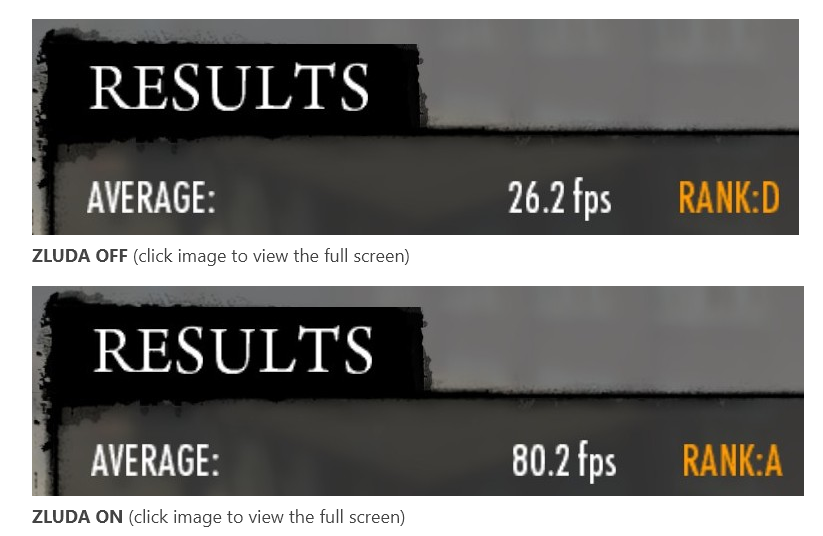
For now, however, this support is not yet complete. It is currently in a pre-alpha state and serves more as a proof of concept, while support is also incomplete (Janik notes that fluid simulation effects, for example, do not yet work entirely correctly). The implementation can already run Nvidia’s showcase demos on Radeon GPU, and he has also successfully launched and benchmarked the 2010 game Mafia II. Acceleration through ZLUDA increased its frame rate from 26.2 FPS to 80.2 FPS (with ZLUDA acceleration enabled).
For everyday use, however, it will probably be necessary to wait until this initial support reaches a more stable ZLUDA release and undergoes further improvements. Besides PhysX, this version of ZLUDA also adds basic texture handling support, enabling Blender rendering acceleration besides PhysX. It also improves operation under Windows, but ZLUDA supports Linux too and is designed to work under Wine and Proton (for running the affected games on Linux).
ZLUDA does not require any modifications to software—the goal is for original games and applications using CUDA to run unchanged. The developer is primarily targeting recent Radeon GPUs (RDNA architecture and newer), but not exclusively AMD hardware, meaning the project could also be usable on Intel GPUs in theory. Actual usability depends on the drivers and architecture of the specific GPU.
ZLUDA is by no means focused solely on running games that use CUDA, but rather on supporting a broad range of CUDA-based applications. In the past, for example, it focused on AI acceleration (although without active sponsorship from commercial users, that is probably a lower priority now). Only time will tell how comprehensive and robust the project’s CUDA software compatibility becomes—and whether any threat from Nvidia’s legal department could arise in the future.
Sources: Andrzej Janik, Tom’s Hardware
English translation and edit by Jozef Dudáš
⠀