Although Nvidia’s graphics cards of the new generation – the GeForce RTX 5090 and RTX 5080 – won’t be out until the 30th, the embargo is over and the first reviews of the top-of-the-line RTX 5090, which we also tested, are out. In this article, we take a look at the Blackwell architecture that powers these new GPUs, and its new features and functions. From DLSS 4, through compute unit architecture and chip features, to the software side of this new generation.
PCI Express 5.0
Blackwell introduces support for a newer generation of PCI Express interface – or rather, a more recent one. PCIe 5.0 introduced in Blackwell was actually expected to be featured in the previous Ada Lovelace generation in 2022, as this interface has already been available on LGA 1700 motherboards (not to mention the newer LGA 1851) and Intel Alder Lake processors since 2021. On the AMD side, Ryzen 7000 (and 9000) processors on the AM5 platform have supported it since 2022. The specification was finalized in 2019, and since 2021, the specification for the follow-up PCI Express 6.0 generation with double the speed has been out. This year, the PCIe 7.0 technology is even expected to be finalized. It’s fair to say that gaming GPUs (across all brands, not just Nvidia) are significantly behind in this regard. Both GB203 and GB205 support PCI Express 5.0, just like the high-end GB202.
PCI Express 5.0, in any case, brings double the bandwidth for the interface between the processor (and the whole the computer system including RAM and storage) and the graphics card. With PCIe 5.0 ×16, this amounts to up to 64 GB/s (in both directions, as PCIe is duplex). Alternatively, this can be utilized in scenarios where the GPU is allocated only eight lanes (×8), for example, on motherboards that divert some lanes from the graphics card slot to M.2 slots for SSDs. PCIe 5.0 provides bandwidth equivalent to a previous-gen full PCIe 4.0 ×16 interface in such scenarios. The impact of bandwidth between the GPU and the rest of the system may be slightly more pronounced in compute applications than it is in games, but in any case, faster PCI Express raises the capacity of one of the potential performance bottlenecks, even if it is one that likely is not being hit very often.
techPowerUp tested the performance scaling across different generations of PCI Express on the GeForce RTX 5090 and found that this GPU does benefit slightly from PCIe 5.0 ×16. In other words, when using only PCIe 4.0 ×16 (or PCIe 5.0 ×8), there is a slight performance drop – though not hugely significant. The average difference is only about 1%, but some games show exceptions (larger drops, for example, in the game No Rest For The Wicked). Older PCI Express 3.0 ×16 (or the equivalent PCIe 4.0 ×8) has a more noticeable impact, with an average performance loss of about 4%. The drops are usually more severe at resolutions of 2560 × 1440 and 3840 × 2160 and less so at 1920 × 1080. However, among the tested games, some behaved the opposite way, with more severe performance degradation at 1920 × 1080. It’s possible that this inconsistency was caused by driver issues or bugs in some cases.
DisplayPort 2.1b
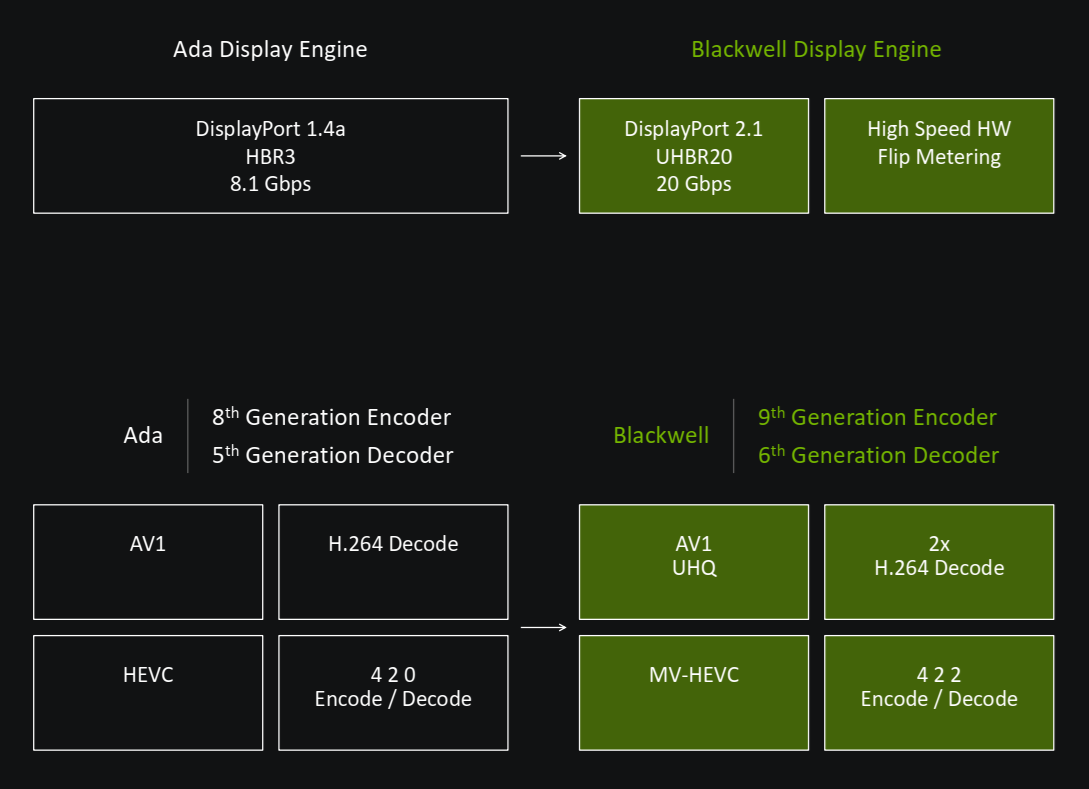
Blackwell also addresses another overdue feature and something that was expected from the previous generation but wasn’t supported: finally, it introduces support for DisplayPort 2.0/2.1 for connecting monitors with higher resolutions and refresh rates. Alternatively, this allows for less aggressive lossy compression, which is commonly used in monitors today. This was a more regrettable debt compared to PCIe 5.0, because DisplayPort 2.1 has already been supported by some GPUs from the previous generation – such as Radeon RX 7000 and Intel Arc Alchemist cards (and the newer Battlemage generation as well).
GeForce RTX 5000 graphics cards can already do DisplayPort 2.1b with support for longer active cables. The output is also supported in the fastest (in terms of transfer capacity) UHBR20 mode, with a bandwidth of 77.37 Gb/s (practically triple the DisplayPort 1.4a bandwidth that was the maximum for the Ada Lovelace/RTX 4000 generation GPUs).
Thanks to DP 2.1, Blackwell GPUs – like Radeon RX 7000s – support 8K resolution screens at up to 165 Hz (until now, the maximum for GeForce cards was 60 Hz) or 4K at up to 480 Hz. Nvidia’s documentation mentions that UHBR20 will require active cables (DP80LL introduced in DP 2.1b), while competing cards should be able to do UHBR20 on passive cables up to 1–1.2 meters long (Radeon Pro cards with RDNA 3 architecture can do UHBR20, although gaming cards support only UHBR13.5). Whether GeForce RTX 5000 actually can’t handle this or it’s just some unclear formulation is something that remains to be clarified. But at least UHBR13.5 (which is still double bandwidth compared to DP1.4a) should work with a regular cheap cables.
The Blackwell architecture doesn’t support the upcoming HDMI 2.2, but that wasn’t something that was expected as the spec isn’t even ready yet.
Multimedia acceleration: incremental improvement
The GPUs, on the other hand, should have a newer generation multimedia engines (9th generation NVEnc, 6th generation NVDec). There’s one (RTX 5070 Ti, RTX 5070) or two video decoders, and there are up to three encoders on the chip (for RTX 5090), but fewer for lower models (RTX 5070 has only one). But we don’t know if these are the actual maximum specs of the chips. For gaming cards, some units can be artificially disabled, as was the case in the previous generation where dies physically had 3+3 units bude only 1-2 of each were enabled on GeForce cards, likely for segmentation purposes (full multimedia support was gated to the more costly workstation and compute cards).
Those multimedia engines are of new generations, but they don’t seem to be able to handle new formats (VVC format acceleration is missing, it’s currently only supported by the Intel Lunar Lake/Core 200V processor). However, there is supposed to be an improvement in compression quality when encoding AV1, and an additional “Ultra Quality” compression setting has been added. Nvidia claims up to a 4–18% improvement in compression (or BD-Rate PSNR and BD.BR VMAF metrics).

Nvidia has also added support for 4:2:2 chroma subsampling in YUV colors for some formats (HEVC and H.264). This encoding is used by some professional camera outputs.
Hotspot temperature data will not be accessible
A thing that might bother overclockers is the removal of hotspot temperature information (so you won’t see it in HWiNFO, for example). This wasn’t any particular sensor, but information about what the highest temperature is reached on the GPU in any of the sensors. There should be more temperature sensors in the chip, so this gives better information in addition to the average temperature, identifying potential local overheating of the chip.
A potential use of this information could be, for example, when a cooler is poorly fitted or paste is not applied correctly – a large discrepancy between the average temperature (which may still look innocent) and the hotspot temperature could have been used as some sort of warning sign until now. It is unknown for what reason exactly has Nvidia made hotspot temperature information unavailable to the user in Blackwell GPUs. According to the company, these numbers have never been very useful, but it may raise suspicions that the figure may have been unflattering – especially, say, for the top-of-the-line RTX 5090 with its 575W TDP.
The article continues on the next page.
⠀⠀