


With the Mobius 120 OC fan, Cooler Master could prove that it has worked on and avoided the rookie mistakes of older models. Partly yes, it removed some flaws, but it added (or strengthened) others in the process. Still, the current most expensive 120 mm CM fan has one ace up its sleeve, for which it will be extremely attractive in some use cases. Again, though, this is… how to put it… a somewhat “peculiar” execution.
The basis of the methodology, the wind tunnel
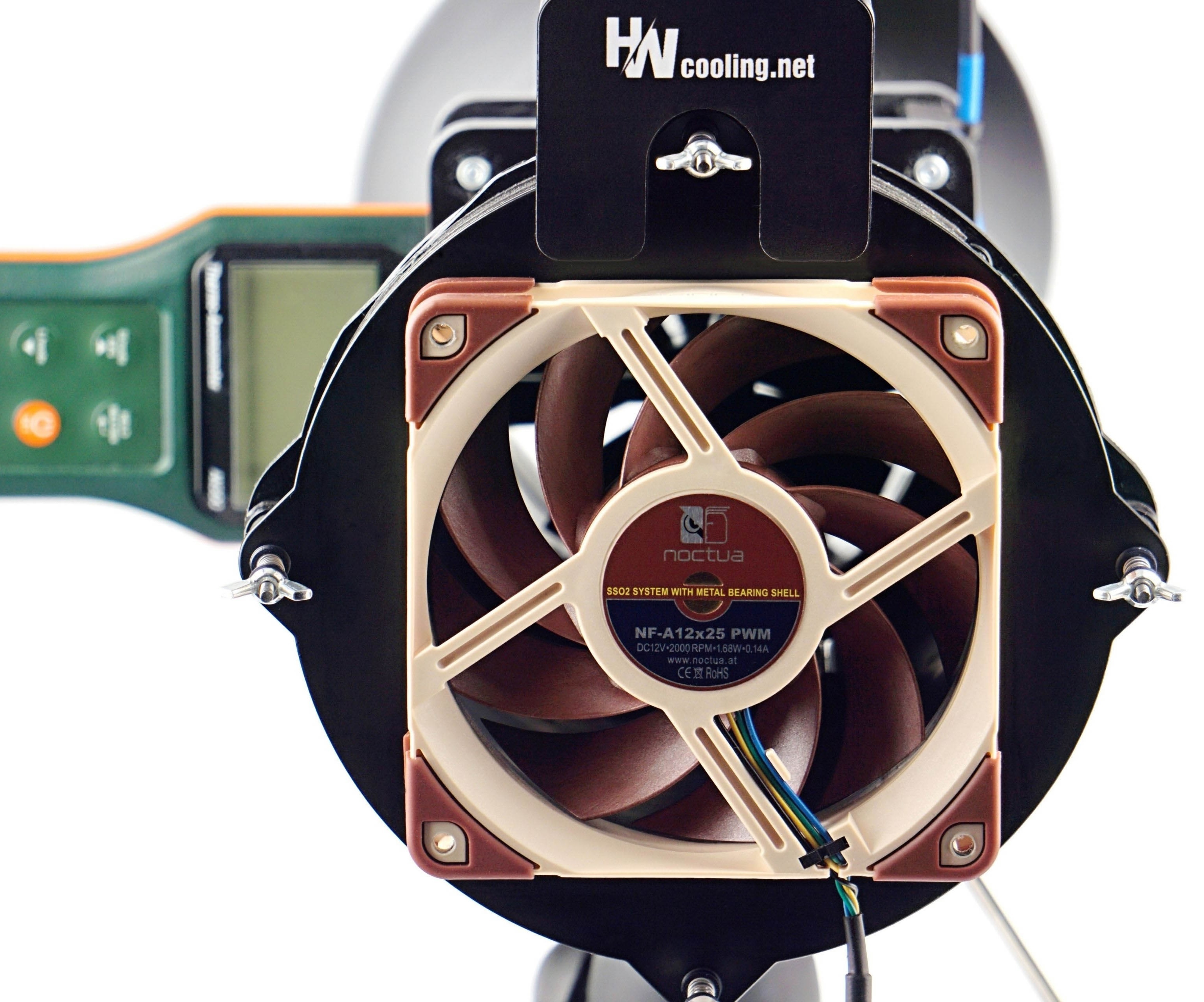
Before you start reading the methodology with all the details, take a look at the test tunnel as a whole. This is the heart of the whole system, to which other arteries are connected (manometer, vibrometer, powermeter, …). The only solid part of the tunnel from the measuring instruments is the anemometer.
The shape of the wind tunnel is inspired by the Venturi tube, which has long been used to measure the flow of liquids and gasses. The Venturi effect for wind speed measuring is also known from the aerospace industry. However, the design for measuring computer fans has its own specificities, which this proposal of ours reflects.
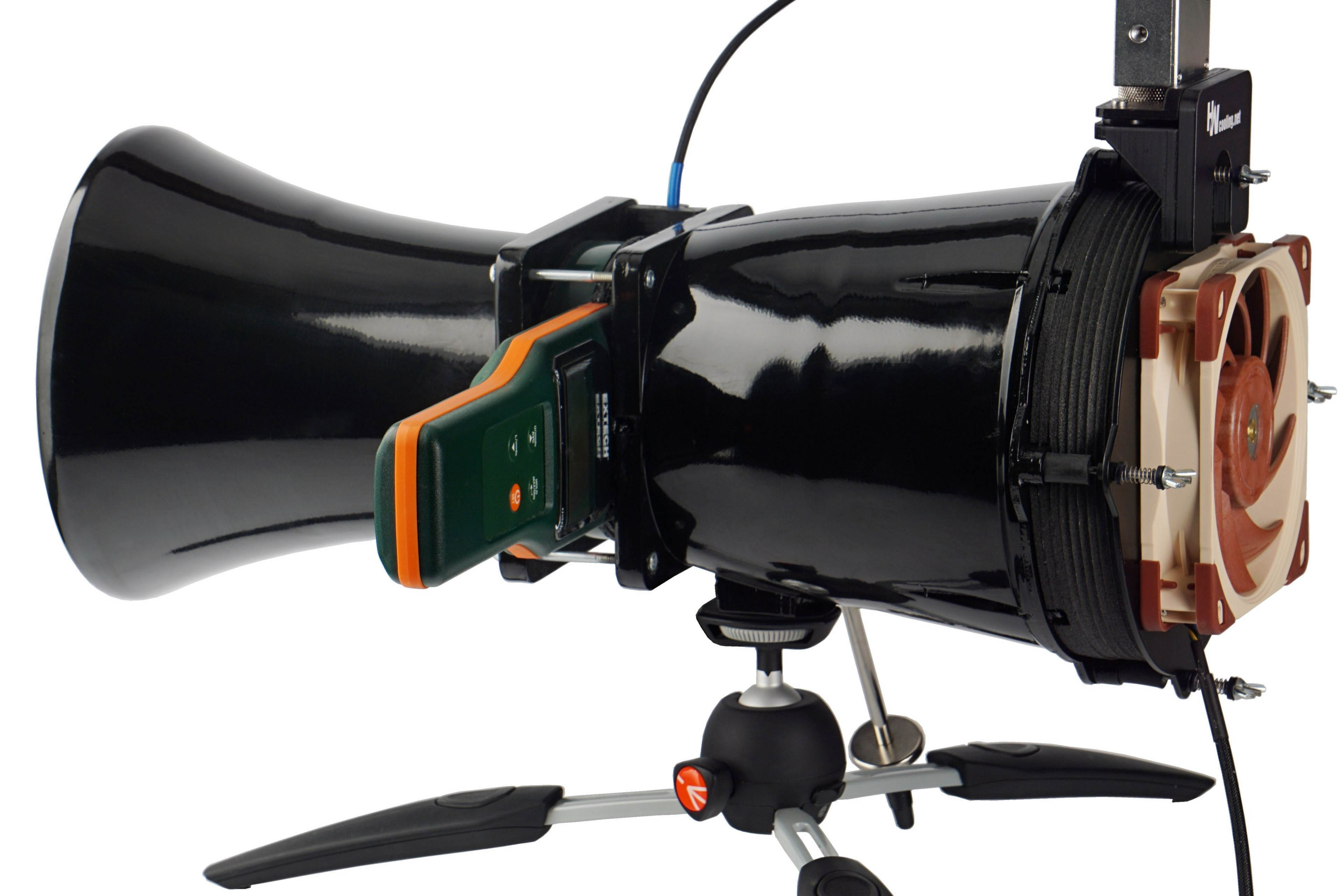
The individual parameters of the HWC wind tunnel for fan tests are the result of physical simulations and practical debugging. All the details (folds, material or finish used) have a rationale behind them and are designed this way for a specific reason. We will discuss the individual design details in turn in the description of the sub-variable measurements.
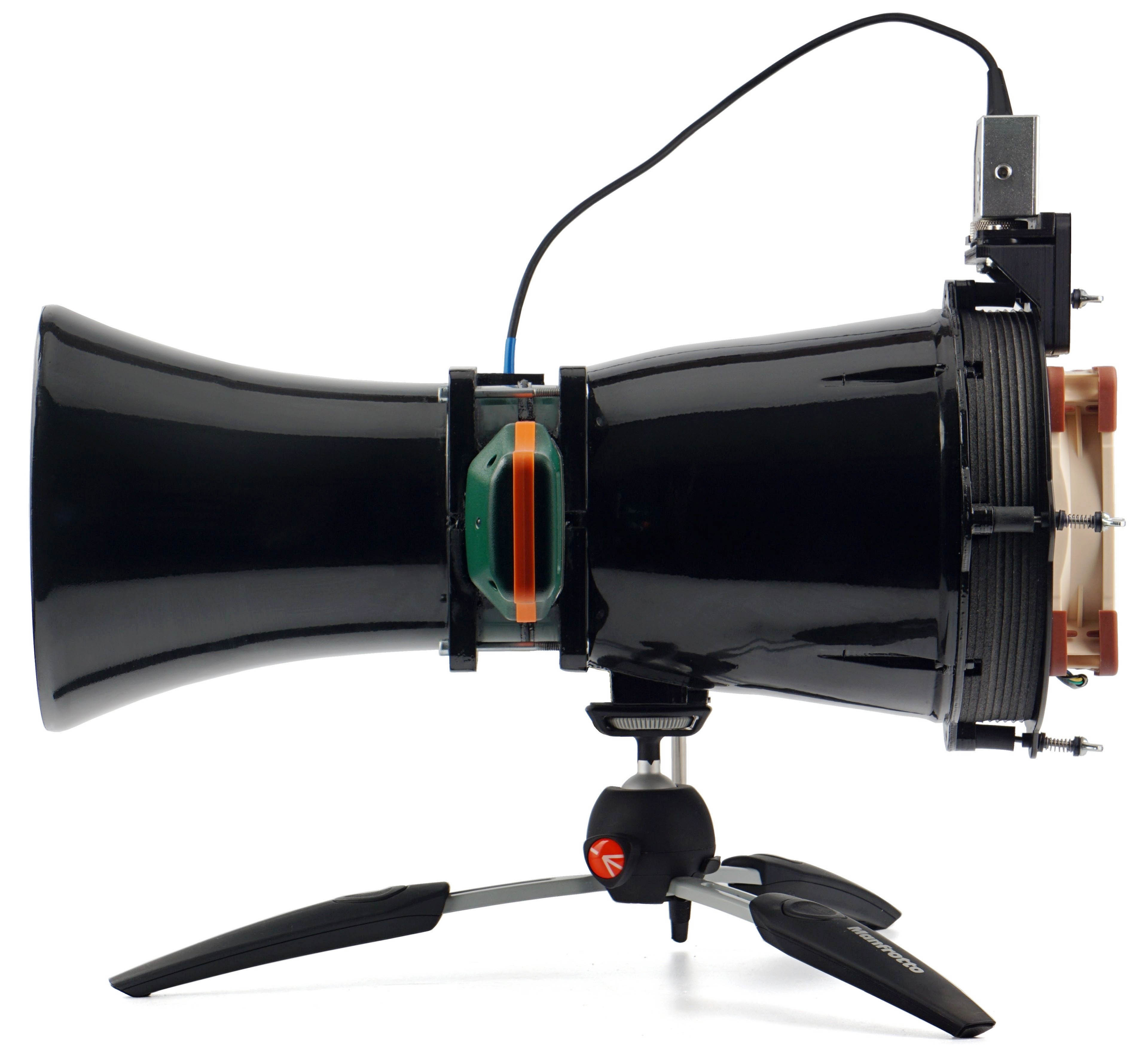
Now we will briefly elaborate on some things that do not fit thematically into the text of the following chapters. Namely, for example, that the skeleton of the wind tunnel is the work of a 3D printer (PLA). The rough print was, of course, then thoroughly machined by grinding, fusing, polishing and varnishing. Especially important is the smooth finish of the interior walls.
When joining the individual parts, the emphasis was on making sure that they fit together flawlessly, that they were sealed flawlessly (we will come back to this when we describe the test procedures for pressure measurement), but also that the joints were not loosened by use. Everything is disassemblable for servicing purposes, but it is ensured that the properties are maintained during use and, for example, even under the stress of vibration. The threads are secured with either lock nuts or thread-locking fluid. It depends on which is more suitable in which place.
When the wind tunnel is not in use, it is enclosed in a dust-tight chamber. In addition to the technical equipment and its correct storage, it is also important for objective outputs that all measuring instruments are calibrated according to the standard. Without this, it would be impossible to stand behind your results and rely on the manufacturers’ specifications. Calibration protocols are therefore an important part of the methodology. Testing is carried out at an ambient air temperature of 21–21.3 °C, humidity is approximately 45 % (± 2 %).
Fans come to us for testing in at least two pieces of the same model. If the deviations of any of the measured values are greater than 5 %, we also work with a third or fourth sample and the average value is formed by the results of the fans that came out the most similar and the differences between them fit under 5 %.




I found your website in the course of my accidental search, the evaluation is detailed and respectful, I have a certain demand for RGB now, and Cooler Master said that the performance of mobius 140 ARGB is very powerful, there are too few evaluations now, I hope you can give it a look Make a review, many thanks.
We will gradually test all available fans. Only those that will stop selling over time will be unlucky (or lucky, depending on your point of view…).
We are excited to have a new reader. We welcome you dearly. 🙂
For the price, there are unfortunately too many flaws. The only application where the fan is strong is running at full speed disregarding noise, and even at that niche, the 12 cm Silent Wings Pro 4 is very close (and I would expect extremely tough competition from Phanteks T30 and Lian Li P28 as well). The poor PWM implementation on a modern fan is also very puzzling to me, especially at that price point.
The fan could be interesting server-grade solution. Maybe next time, I mean with ultra-long-life bearings and without vibrations.
I also tested Mobius 120 OC on thinner radiator recently, I can say this fan is one of the worst choice at its price.
There are many products on the market that obviously surpass Mobius 120 OC.
In terms of maximum airflow and price, Sanyo Denki 9G1212P4H06-4P, Thermalright TL-B12 EXTREM, Arctic P12 Max can perfectly replace Mobius 120 OC.
In terms of noise-airflow efficiency, PH-F120T30, NF-A12X25 and SW Pro 4 definitely outperform it.
Unlike Mobius 120(P), Mobius 120 OC seems difficult to survive the competition.
Thanks for the cross-verification of the results. 🙂
Actually I doubted my result of Mobius 120 OC because it showed 20%p lower noise-airflow efficiency than PH-F120T30, which was unbelievably poor result for an expensive fan. Now the cross-validation is possible with your thinner radiator test, and the two results are showing similar tendency about the fan. Thanks a lot!
I would LOVE to see you review the regular (non OC) Mobius fans. Particularly the 120p RGB version. It would be interesting to see just how close or far away from the OC performance they are.
Thanks for the tip. As long as the Mobius 120P RGB doesn’t stop selling before we can get our hands on it, we’ll be sure to include it in our tests. Gradually all fans available in the shops will be put in a confrontation. 😉