


With the Mobius 120 OC fan, Cooler Master could prove that it has worked on and avoided the rookie mistakes of older models. Partly yes, it removed some flaws, but it added (or strengthened) others in the process. Still, the current most expensive 120 mm CM fan has one ace up its sleeve, for which it will be extremely attractive in some use cases. Again, though, this is… how to put it… a somewhat “peculiar” execution.
… and airflow
With airflow measurements, we can well explain why the test tunnel is shaped the way it is. It doesn’t consist of two parts just so that the “exhaust” can be conveniently clogged for pressure measurements. The anemometer (i.e. the wind speed measuring instrument) is held together by two parts, two formations, through the flanges.
The front part, at the beginning of which the fan is mounted, becomes steadily narrower and from about two thirds of the way through the cross-section is smaller than that of a 120 mm fan. The reason for this is that the cross-section of the anemometer is always smaller than that of the fans tested. The taper towards the anemometer fan is as smooth as could be chosen and the tunnel walls are smooth. This has minimized the occurrence of unnatural turbulence.
The difference between the cross section at the intake (fan under test) and at the constriction point (anemometer) also means a difference in dynamic pressure, the principles of the Venturi effect apply here. In order to avoid distortion at this level and to ensure that the fan airflow is not different from what it actually is, the Bernoulli equation must be applied to the measured values (for maximum accuracy, the calculation also takes into account the internal cross-sectional area of the anemometer, i.e. its inactive part ). After all this, it is again possible to confront our results with the paper parameters.
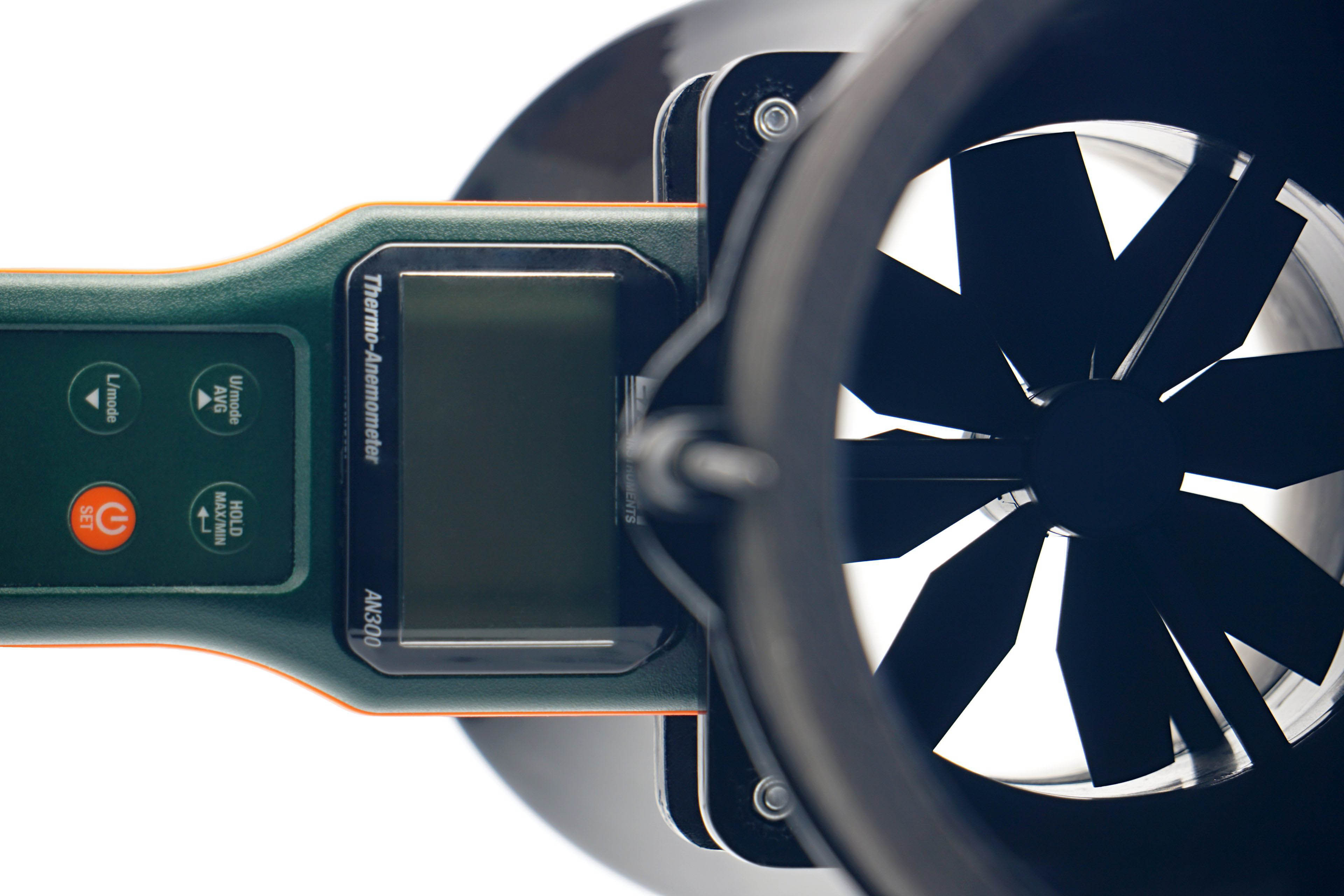
We use an Extech AN300 anemometer with a large 100 mm fan for the measurements. Its big advantage over other anemometers is that it is made for bidirectional sensing. This allows tests at different fan orientations. However, the “pull” position is more suitable or accurate for measurements, even though it may not seem so at first glance, but we’ll explain.
Here, we get to the second part of the tunnel, the part behind the anemometer. It is part of the whole device, mainly to allow a laminar flow of air to arrive at the rotor of the anemometer. Otherwise, uncontrolled side whirls would be reflected in the results, which are inconsistent with accurate measurements. Therefore, we will test the flow in the pull position. If anyone would like us to elaborate more on this topic, we can elaborate further at any time in the discussion below the article. Ask away. 🙂
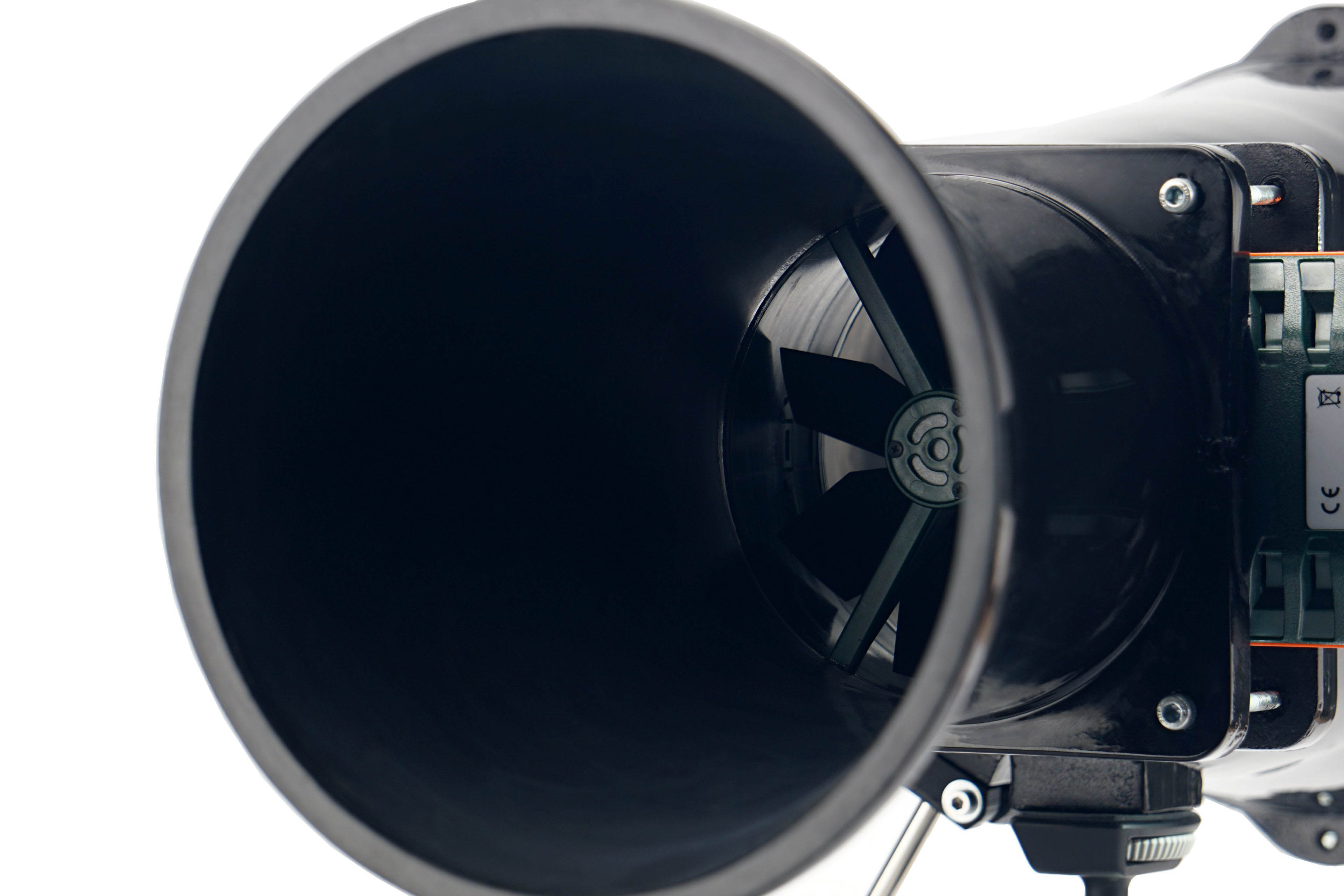
In regard to the anemometer, we shall return for a bit to noise measurements and to setting modes according to fixed noise levels. It may have occurred to you as you were reading that the anemometer fan is also a source of sound that needs to be filtered out when measuring fans. For this reason, we insert a securing pad between the frame and the anemometer fan before each measurement and mode setting according to the fixed noise level. This, by the way, also holds the anemometer fan during static pressure measurements.




I found your website in the course of my accidental search, the evaluation is detailed and respectful, I have a certain demand for RGB now, and Cooler Master said that the performance of mobius 140 ARGB is very powerful, there are too few evaluations now, I hope you can give it a look Make a review, many thanks.
We will gradually test all available fans. Only those that will stop selling over time will be unlucky (or lucky, depending on your point of view…).
We are excited to have a new reader. We welcome you dearly. 🙂
For the price, there are unfortunately too many flaws. The only application where the fan is strong is running at full speed disregarding noise, and even at that niche, the 12 cm Silent Wings Pro 4 is very close (and I would expect extremely tough competition from Phanteks T30 and Lian Li P28 as well). The poor PWM implementation on a modern fan is also very puzzling to me, especially at that price point.
The fan could be interesting server-grade solution. Maybe next time, I mean with ultra-long-life bearings and without vibrations.
I also tested Mobius 120 OC on thinner radiator recently, I can say this fan is one of the worst choice at its price.
There are many products on the market that obviously surpass Mobius 120 OC.
In terms of maximum airflow and price, Sanyo Denki 9G1212P4H06-4P, Thermalright TL-B12 EXTREM, Arctic P12 Max can perfectly replace Mobius 120 OC.
In terms of noise-airflow efficiency, PH-F120T30, NF-A12X25 and SW Pro 4 definitely outperform it.
Unlike Mobius 120(P), Mobius 120 OC seems difficult to survive the competition.
Thanks for the cross-verification of the results. 🙂
Actually I doubted my result of Mobius 120 OC because it showed 20%p lower noise-airflow efficiency than PH-F120T30, which was unbelievably poor result for an expensive fan. Now the cross-validation is possible with your thinner radiator test, and the two results are showing similar tendency about the fan. Thanks a lot!
I would LOVE to see you review the regular (non OC) Mobius fans. Particularly the 120p RGB version. It would be interesting to see just how close or far away from the OC performance they are.
Thanks for the tip. As long as the Mobius 120P RGB doesn’t stop selling before we can get our hands on it, we’ll be sure to include it in our tests. Gradually all fans available in the shops will be put in a confrontation. 😉