


With the Mobius 120 OC fan, Cooler Master could prove that it has worked on and avoided the rookie mistakes of older models. Partly yes, it removed some flaws, but it added (or strengthened) others in the process. Still, the current most expensive 120 mm CM fan has one ace up its sleeve, for which it will be extremely attractive in some use cases. Again, though, this is… how to put it… a somewhat “peculiar” execution.
Base 6 equal noise levels…
There are several options by which to normalize the test modes for fans. In the previous chapter, we wrote that perhaps the least appropriate option is equal speed.
Settings according to the same static pressure or flow are for consideration, but we find it most sensible in the long term to normalize the measurement modes according to the same noise levels. Firstly because decibels are a logarithmic unit and all others scale linearly, but mainly because you can orientate fastest by the same noise levels. The easiest way to compare the efficiency of fans is just by how they perform at the same sound pressure level. Of all the options, this is the one that most people can best imagine and bounce off of when considering other variables.
The individual noise level modes are adjusted from low levels continuously to higher levels. All users will find their results in the tests, regardless of whether they prefer very quiet operation at the limit of audibility or whether high performance is paramount.
The quietest mode corresponds to 31 dBA, followed by 33 dBA, and for each additional mode we add 3 dBA, which always doubles the noise level (36, 39, 42 and 45 dBA). Finally, we measure the fans at maximum power. Here, each one already has a slightly different noise level, which we also report. If there are missing measurements between the results for any of the fans, this means that it was not possible to set the target noise level. Either because its minimum speed exceeds the quietest mode of 31 dBA or vice versa because the fan is quieter than 45 dBA at maximum power.
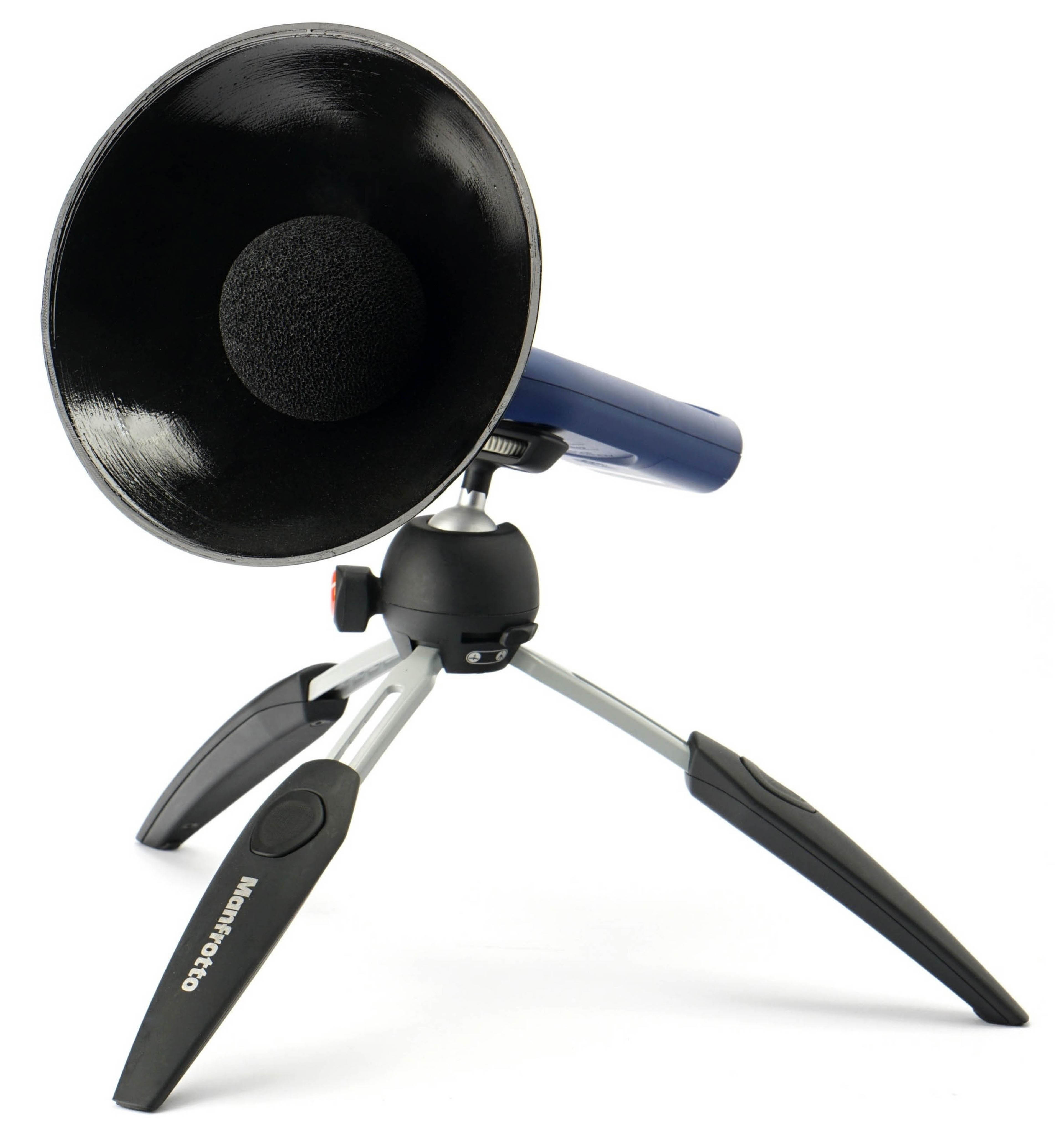
It is important to add that our noise level measurements are incomparable to the values quoted by the fan manufacturers in their specifications. One of the reasons is because we use a parabola-shaped collar around the sensor of the noise meter, which increases sensitivity. This is important in order to distinguish and set to the same noise level even modes at very low speeds, especially 31 dBA.
The noise meter next to the fan is quite close for sufficient resolution. The distance between the frame and the sensor is 15 centimeters. The sensor is positioned in such a way that there is no distortion or that the noise level measurements are not affected by airflow. Therefore, the noise meter is centered perpendicularly to the frame that defines the depth of the fan. Everything is always at the same angle and at the same distance. We use an inclinometer and markers to set the distances precisely and always the same.

We use a Reed R8080 noise meter to measure noise levels. This allows real-time averaging of samples, which is important for fine-tuning individual modes. We tune the fans until the specified noise level is reached to two decimal places, for example 31.50 dBA. The noise meter is the only instrument we calibrate inside our testlab. The other instruments have been calibrated by the relevant technical institutes. However, in the case of the noise meter, calibration is required before each test and we therefore have our own calibrator. This is already calibrated externally according to the standard.




I found your website in the course of my accidental search, the evaluation is detailed and respectful, I have a certain demand for RGB now, and Cooler Master said that the performance of mobius 140 ARGB is very powerful, there are too few evaluations now, I hope you can give it a look Make a review, many thanks.
We will gradually test all available fans. Only those that will stop selling over time will be unlucky (or lucky, depending on your point of view…).
We are excited to have a new reader. We welcome you dearly. 🙂
For the price, there are unfortunately too many flaws. The only application where the fan is strong is running at full speed disregarding noise, and even at that niche, the 12 cm Silent Wings Pro 4 is very close (and I would expect extremely tough competition from Phanteks T30 and Lian Li P28 as well). The poor PWM implementation on a modern fan is also very puzzling to me, especially at that price point.
The fan could be interesting server-grade solution. Maybe next time, I mean with ultra-long-life bearings and without vibrations.
I also tested Mobius 120 OC on thinner radiator recently, I can say this fan is one of the worst choice at its price.
There are many products on the market that obviously surpass Mobius 120 OC.
In terms of maximum airflow and price, Sanyo Denki 9G1212P4H06-4P, Thermalright TL-B12 EXTREM, Arctic P12 Max can perfectly replace Mobius 120 OC.
In terms of noise-airflow efficiency, PH-F120T30, NF-A12X25 and SW Pro 4 definitely outperform it.
Unlike Mobius 120(P), Mobius 120 OC seems difficult to survive the competition.
Thanks for the cross-verification of the results. 🙂
Actually I doubted my result of Mobius 120 OC because it showed 20%p lower noise-airflow efficiency than PH-F120T30, which was unbelievably poor result for an expensive fan. Now the cross-validation is possible with your thinner radiator test, and the two results are showing similar tendency about the fan. Thanks a lot!
I would LOVE to see you review the regular (non OC) Mobius fans. Particularly the 120p RGB version. It would be interesting to see just how close or far away from the OC performance they are.
Thanks for the tip. As long as the Mobius 120P RGB doesn’t stop selling before we can get our hands on it, we’ll be sure to include it in our tests. Gradually all fans available in the shops will be put in a confrontation. 😉