


With the Mobius 120 OC fan, Cooler Master could prove that it has worked on and avoided the rookie mistakes of older models. Partly yes, it removed some flaws, but it added (or strengthened) others in the process. Still, the current most expensive 120 mm CM fan has one ace up its sleeve, for which it will be extremely attractive in some use cases. Again, though, this is… how to put it… a somewhat “peculiar” execution.
Initial warm-up…
Before we even start measuring anything, we let the fans run “idle” for a few minutes after plugging them in. This is because immediately after a cold start the fans reach different parameters than after a certain amount of short-term operation.
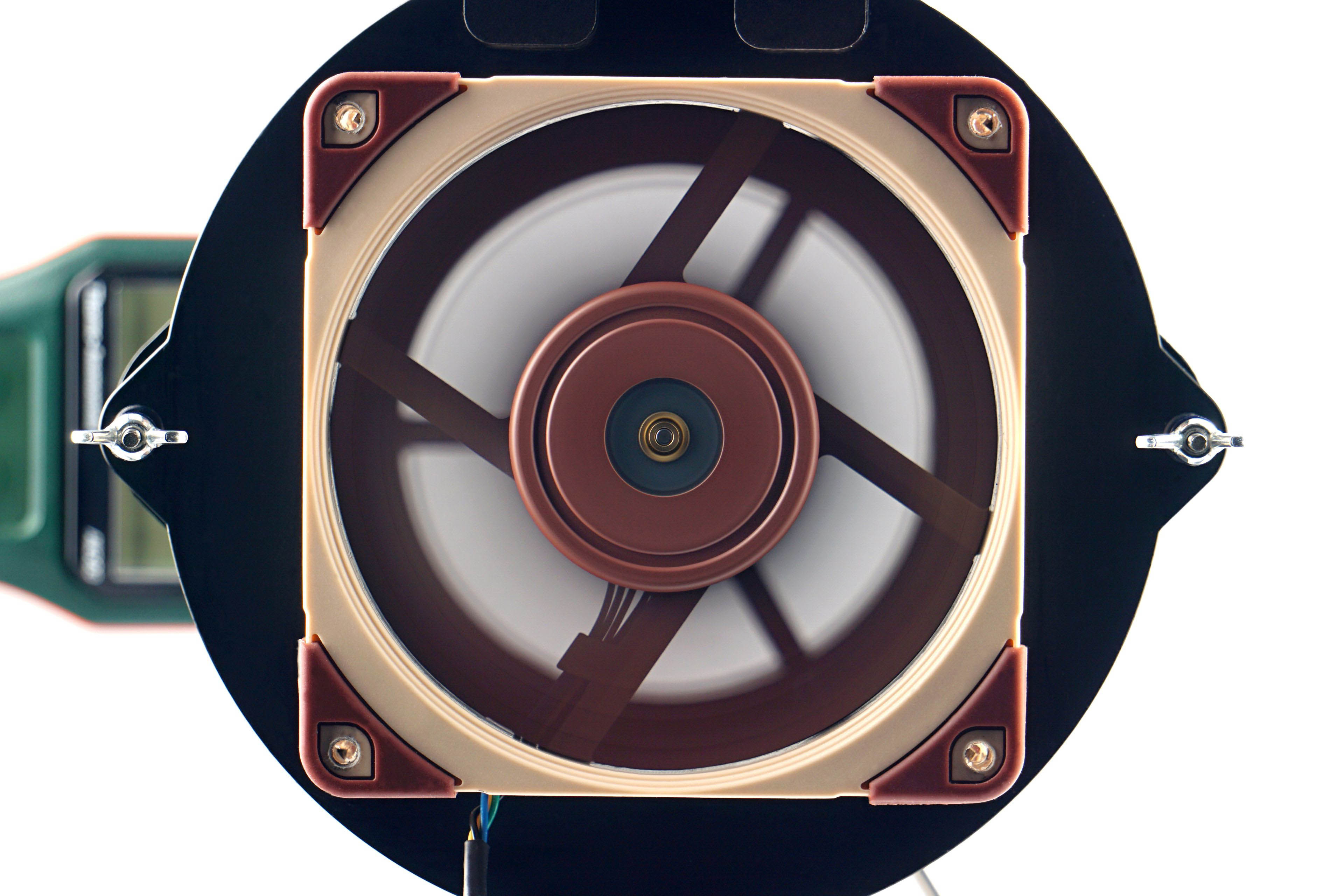
Until the operating temperature of the lubricant is stabilized, a typically lower maximum performance is achieved. This is because at lower temperatures the lubricant is denser, which is associated with higher friction. Therefore, the fans do not reach maximum speed immediately, but only after the first few seconds. Before the first measurements, we therefore leave the fans running for at least 300 seconds at 12 V, or 100 % PWM intensity.
…and speed recording
The speed of the fans is monitored using a laser tachometer, which reads the number of revolutions from a reflective sticker on the rotor. For this purpose, we use the UNI-T UT372 device, which also allows real-time averaging of samples. Thus, we do not record the peak value in the graphs, but the average speed value from a 30-second time period.
However, the speed itself is a relatively unimportant parameter that is often given more attention than is appropriate. This is the case even in many fan or cooler tests, where speed is used to normalize the different modes in which other variables are measured.
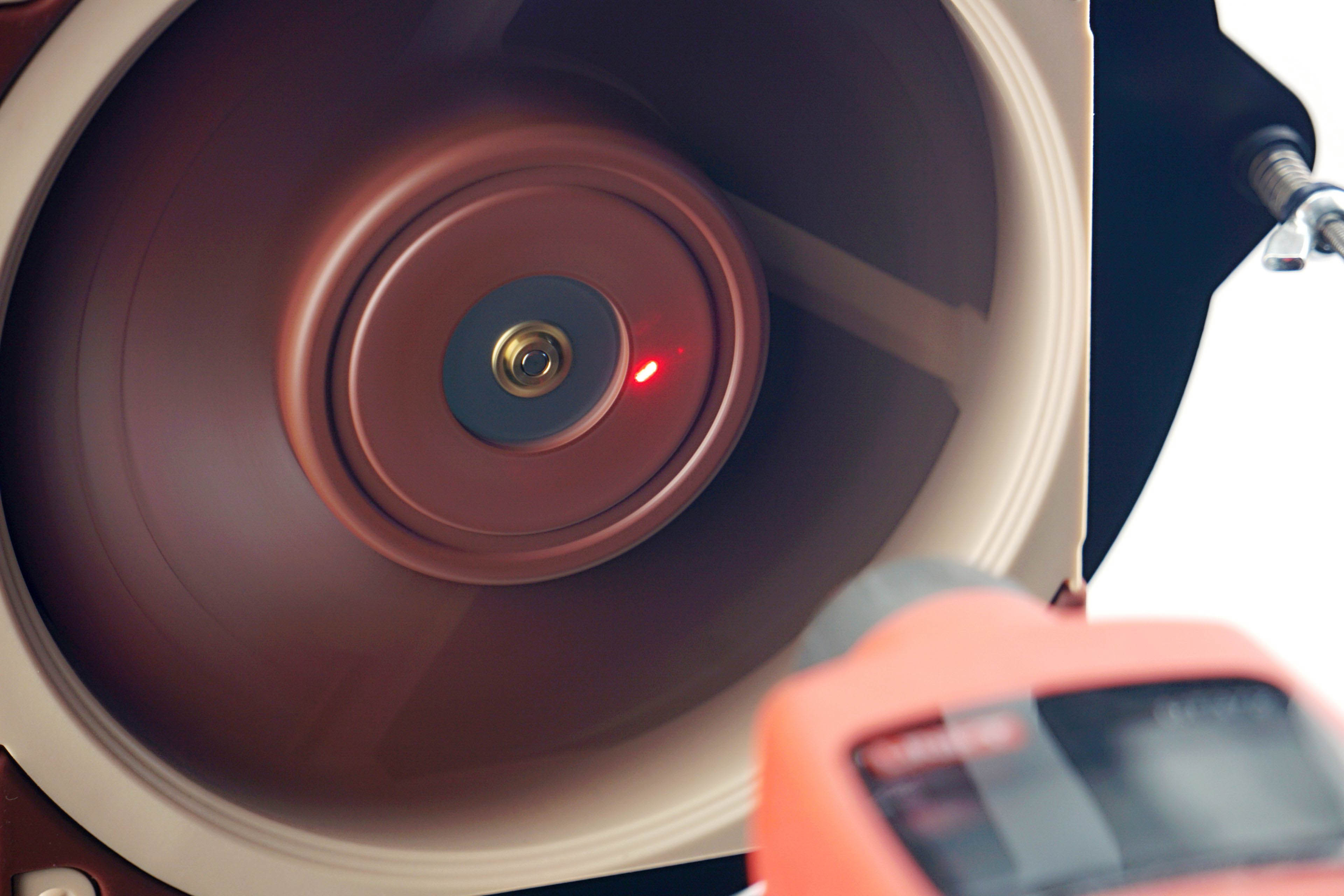
However, hyper-focusing on a specific speed is a rather unfortunate decision if only because the fans don’t gain any commonality. At the same speed all other variables are different, there is no intersection. It can be noted that a better normalization would have been by any other variable, whether it be static pressure, flow or noise level, which wins in our case. But more on that in the next chapter.
We only measure the speed so that you can associate a particular parameter (such as the amount of static pressure or some noise level) with something according to which you can adjust the fan yourself. Perhaps for that alone, the information about the achieved speed is useful. As part of the fan analysis, we will also indicate what the fans’ starting and minimum speeds are. Start-up speeds tend to be higher than minimum speeds because more force is required to get the rotor moving than once the fan rotor is spinning, and a minimum power intensity is sought at which the fan does not stall.




I found your website in the course of my accidental search, the evaluation is detailed and respectful, I have a certain demand for RGB now, and Cooler Master said that the performance of mobius 140 ARGB is very powerful, there are too few evaluations now, I hope you can give it a look Make a review, many thanks.
We will gradually test all available fans. Only those that will stop selling over time will be unlucky (or lucky, depending on your point of view…).
We are excited to have a new reader. We welcome you dearly. 🙂
For the price, there are unfortunately too many flaws. The only application where the fan is strong is running at full speed disregarding noise, and even at that niche, the 12 cm Silent Wings Pro 4 is very close (and I would expect extremely tough competition from Phanteks T30 and Lian Li P28 as well). The poor PWM implementation on a modern fan is also very puzzling to me, especially at that price point.
The fan could be interesting server-grade solution. Maybe next time, I mean with ultra-long-life bearings and without vibrations.
I also tested Mobius 120 OC on thinner radiator recently, I can say this fan is one of the worst choice at its price.
There are many products on the market that obviously surpass Mobius 120 OC.
In terms of maximum airflow and price, Sanyo Denki 9G1212P4H06-4P, Thermalright TL-B12 EXTREM, Arctic P12 Max can perfectly replace Mobius 120 OC.
In terms of noise-airflow efficiency, PH-F120T30, NF-A12X25 and SW Pro 4 definitely outperform it.
Unlike Mobius 120(P), Mobius 120 OC seems difficult to survive the competition.
Thanks for the cross-verification of the results. 🙂
Actually I doubted my result of Mobius 120 OC because it showed 20%p lower noise-airflow efficiency than PH-F120T30, which was unbelievably poor result for an expensive fan. Now the cross-validation is possible with your thinner radiator test, and the two results are showing similar tendency about the fan. Thanks a lot!
I would LOVE to see you review the regular (non OC) Mobius fans. Particularly the 120p RGB version. It would be interesting to see just how close or far away from the OC performance they are.
Thanks for the tip. As long as the Mobius 120P RGB doesn’t stop selling before we can get our hands on it, we’ll be sure to include it in our tests. Gradually all fans available in the shops will be put in a confrontation. 😉