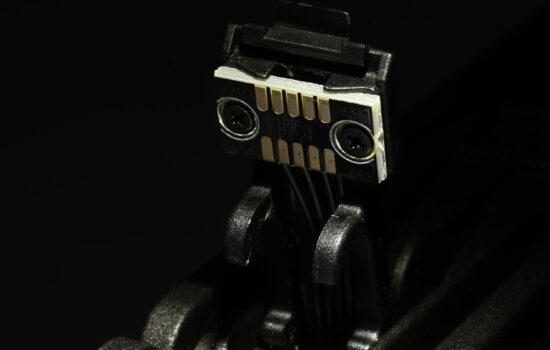
Easier installation? Yes, that’s why it’s done. Daisy-chaining fans using contacts in their frames is great, but it often also comes with pitfalls that reduce “cooling efficiency”. Manufacturers deal with this in different ways. One does it technically one way, another differently. In any case, they know that a frame that is too thick means less space for the blades. And that does not improve airflow per unit of noise. Read more “Fan frame daisy-chaining trend. When is it (not) helpful”
IBM’s Processor Supports Two Instruction Sets at Once: Z and Arm
We wrote that AMD has once again canceled its plans to produce Arm processors. However, the industry veteran IBM is now moving in the opposite direction, actually adopting the Arm instruction set. But it is doing so in an interesting way—it is not replacing its existing architecture (or at least not yet), but is introducing a processor that features its own instruction set while also being fully compatible with the Arm architecture. Read more “IBM’s Processor Supports Two Instruction Sets at Once: Z and Arm”
Selection of Older but Still Relevant Tests (Part 6)
HWC has published several analyses that deserve to be revisited. Although they are not from today—or even yesterday—we still consider them useful in practice. How can cooling performance be affected by the use of heatsinks in a space where there would otherwise be a fan? What is the difference between a punched and a wire grille (in PC cases)? Did you know that airflow in some situations also depends on the shape of the fan frame? Read more “Selection of Older but Still Relevant Tests (Part 6)”
Surprise Triumph for Intel? Razor Lake has a new P-Core
We recently reported that Intel is preparing special laptop CPUs with BLLC, its equivalent of AMD’s 3D V-Cache. CPUs with BLLC will feature up to 144 MB of L3 cache promising significant boost in games. BLLC will come to laptops in the Razor Lake lineup, but that will not be the only interesting thing about them. A leaker has shared further details, suggesting that this could be a surprisingly powerful generation. Read more “Surprise Triumph for Intel? Razor Lake has a new P-Core”
Is There Anything You Would Like to Know About HWiNFO?
If you have a question about the HWiNFO application that has been nagging at you, let us know and we will ask its author about it as part of an interview. If you find something unclear, we will be happy to find out the answer—an exact explanation. And directly from the source, the author of one of the world’s most widespread (and widely used) monitoring and diagnostic tools. Read more “Is There Anything You Would Like to Know About HWiNFO?”
First Intel Nova Lake Processors Spotted, with AVX-512 and APX
While AMD is preparing its next-gen Zen 6 CPUs, Intel is also approaching the launch of a significant next-gen CPUs codenamed “Nova Lake”. With 2nm process and a new architecture, it could improve the competitiveness of Intel’s chips after the somewhat disappointing Core Ultra 200 “Arrow Lake” generation. The first functional and running Nova Lake chips have now apparently emerged, revealing these CPUs for the first time. Read more “First Intel Nova Lake Processors Spotted, with AVX-512 and APX”
How a Motherboard Works. Intended for Secondary Schools
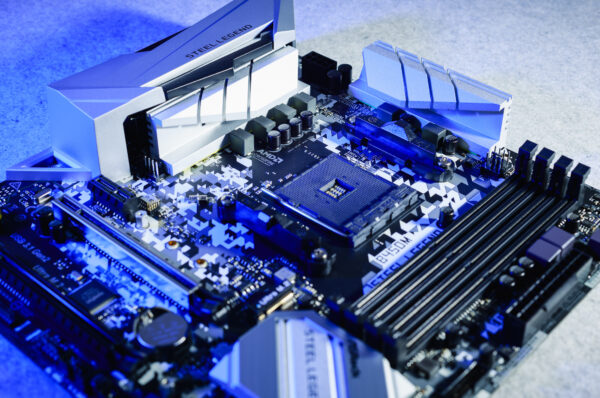
The motherboard is a component that’s commonly not even listed in the hardware specifications provided by PC vendors or sellers, ironically. Yet it is one of the most important components, because it interconnects almost all the other parts and has to handle a lot of work. In this article, we’ll look at what you should know about desktop computer motherboards and how to handle them when building a PC or performing maintenance. Read more “How a Motherboard Works. Intended for Secondary Schools”
AMD Chipset Cards Adding PCIe, SATA Lanes Emerge in China
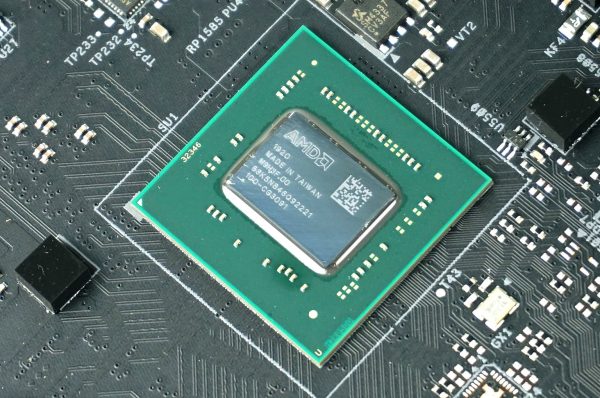
Although chipsets are considered a specialized component characteristic of motherboards, a chipset is actually not all that critical (or even required at all) on AMD’s AM4 and AM5 desktop platforms. Chipsets such as the B650 are just bridges that expand PCIe 4.0 (and SATA) connectivity. And as it turns out, they can do this as add-in cards as well. You can even use one to add M.2 or SATA interfaces to an Intel processor. Read more “AMD Chipset Cards Adding PCIe, SATA Lanes Emerge in China”
Questions for Noctua: Tell us what you’d like to know
We’re preparing an interview that you can contribute to. With any questions you may have for Noctua. Whether it’s about coolers, fans, thermal interface materials, technical support, or anything else that keeps you up at night. This is your opportunity to get some answers. We’ll be glad if you become co-authors of anything constructive that the HWCooling editorial team hasn’t thought of. And there are quite a few things like that… Read more “Questions for Noctua: Tell us what you’d like to know”
Selection of Older but Still Relevant Tests (Part 5)
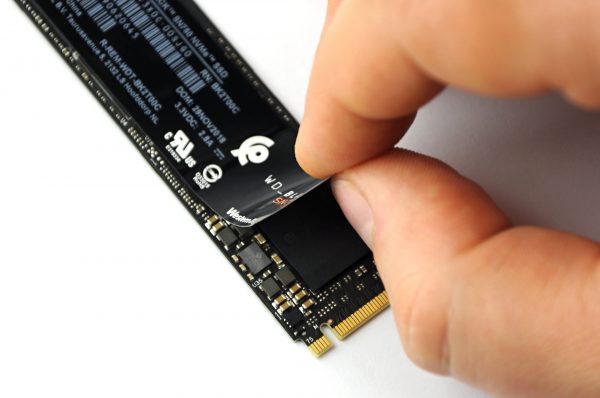
HWC has published several analyses that deserve to be revisited. Although they are not from today—or even yesterday—we still consider them useful in practice. In the past, we tested how HDD vibrations affect noise levels and whether removing the label from an SSD makes sense in terms of cooling efficiency. More recently, HWCooling reached the milestone of one hundred tested fans. Read more “Selection of Older but Still Relevant Tests (Part 5)”
DeepCool Riddle (8/2026). Can you guess what’s in the photo?
In cooperation with DeepCool, we have prepared a cyclical activity for this year, which may be of interest to HWCooling readers. We’ll post a detail of some piece of hardware and you can guess what it is. You can compete (and eventually win something) on a regular basis, with a new challenge every month. But for now, you need to get “to the next round” through the next one, in August. Read more “DeepCool Riddle (8/2026). Can you guess what’s in the photo?”
What can Instinct MI455X tell us about RDNA 5 GPUs? [Analysis]
Last month, AMD unveiled its CDNA 5 architecture-based Instinct MI455X AI accelerators. This matters even outside AI and server workloads, because CDNA 5 is now related to the RDNA 5 architecture that will power the next generation of Radeon gaming GPUs. Let’s take a look at what the new Instincts reveal about RDNA 5 and what else has leaked about this architecture. This includes one change that is rather surprising. Read more “What can Instinct MI455X tell us about RDNA 5 GPUs? [Analysis]”
AMD processors and Asus motherboards? DeepCool coolers, too…
We consider the HWCooling Techtour conference a small holiday when it comes to PC hardware in our country, Slovakia. The 2026 edition will feature truly exceptional guests with attractive topics. World‑class experts from the field will show students and talk to them about modern processors and the motherboards designed for them. And you can be there as well. We’ll be glad. The format will once again be an online broadcast. Read more “AMD processors and Asus motherboards? DeepCool coolers, too…”
Arctic BioniX P12 A-RGB: Efficient, inexpensive, illuminated and…
And with very clever daisy‑chaining from one fan to the next. This is what can fill in the ellipsis in the headline. The aerodynamic efficiency remains top‑tier, built on a design that Arctic revised some time ago (with the P12 Pro fans), but which can still be considered “new.” The BioniX P12 A‑RGB fans certainly are (new), and in this in‑depth analysis we focus on how they work. Read more “Arctic BioniX P12 A-RGB: Efficient, inexpensive, illuminated and…”
Intel CPUs To Get Hyper‑Threading Back in Two Years
One of the signs—or perhaps more a symbol—accompanying Intel’s decline in the processor space the company was an unchallenged leader of just a few years ago, was the removal of HT or Hyper‑Threading, a technology processing two threads on a single core that significantly boosted multithreaded performance. So much so that the new CEO promised a reintroduction. Intel has now confirmed this, providing an outlook on when it will happen. Read more “Intel CPUs To Get Hyper‑Threading Back in Two Years”
HWiNFO Now Shows Temps of Individual Video Memory Chips
Not long ago, HWiNFO gained the ability to monitor GPU hotspot temperatures—local hotspots with significantly higher temps than the average having been reported by Nvidia chips. This has been followed by another improvement in graphics card temperature monitoring. You will now be able to look at the temperatures of all memory chips on the card, which can reveal cooling problems in much the same way as the GPU hotspot temperature. Read more “HWiNFO Now Shows Temps of Individual Video Memory Chips”


Latest comments