




The concerns were unwarranted. The Arctic P14 Pro (PST) fans are, at a comparable price, more appealing than their predecessors—the P14 series. They’re a step up in engineering refinement, pushing the limits across all key aspects you can think of. It’s clear that Arctic knew exactly what it was doing, and even after a major aerodynamic redesign, the company still holds the crown for overall excellent budget-friendly fans in the 140 mm format.
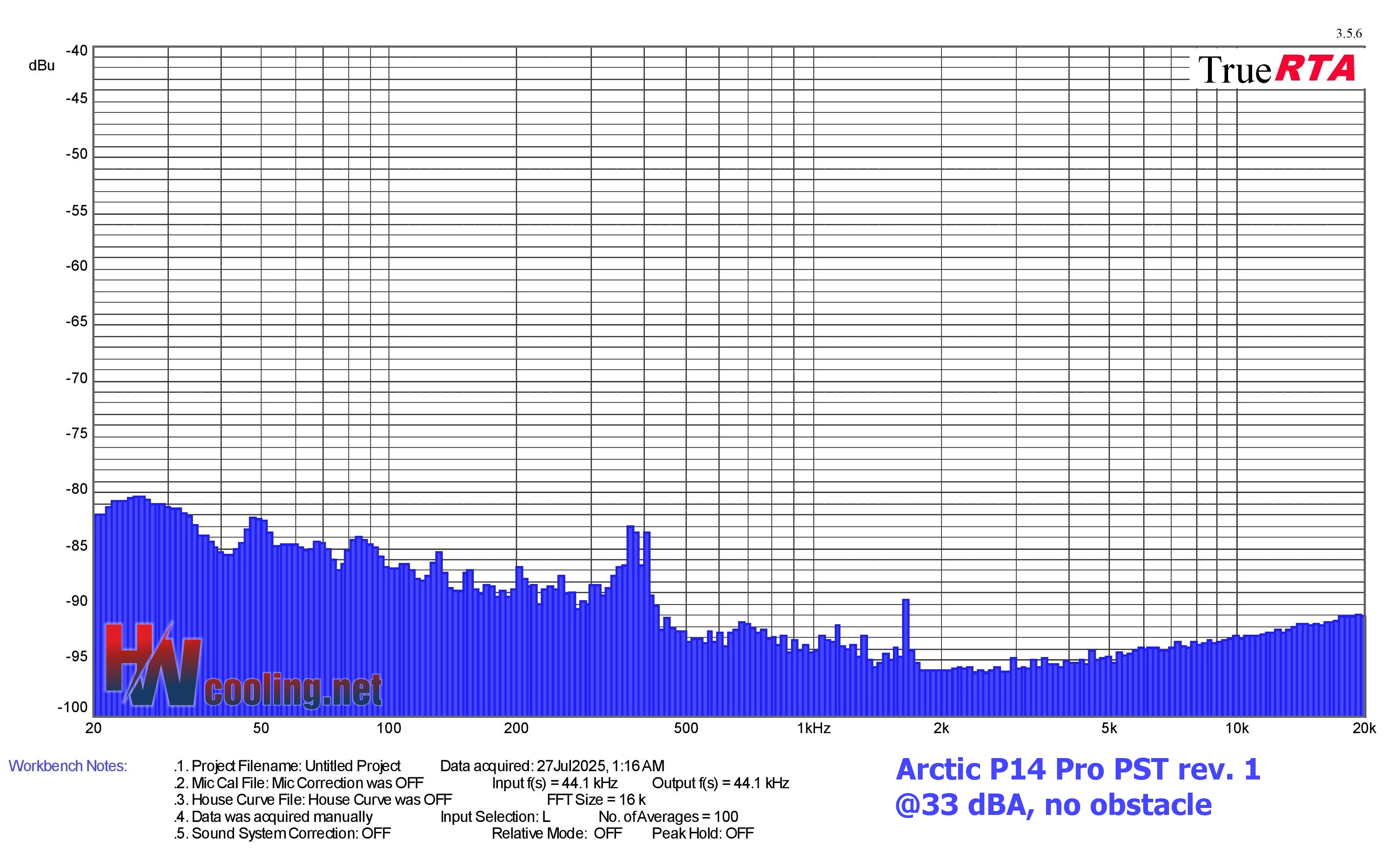
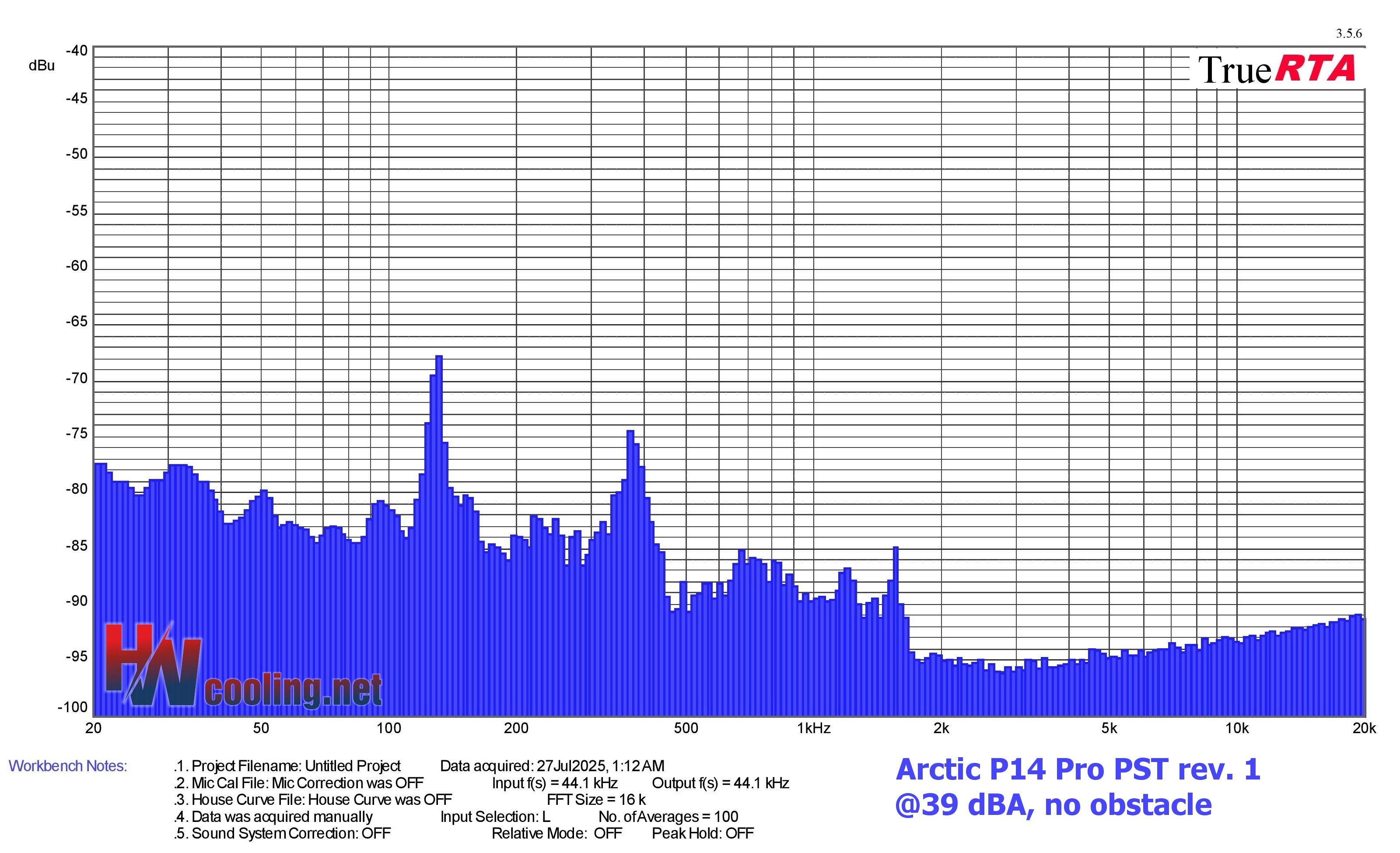
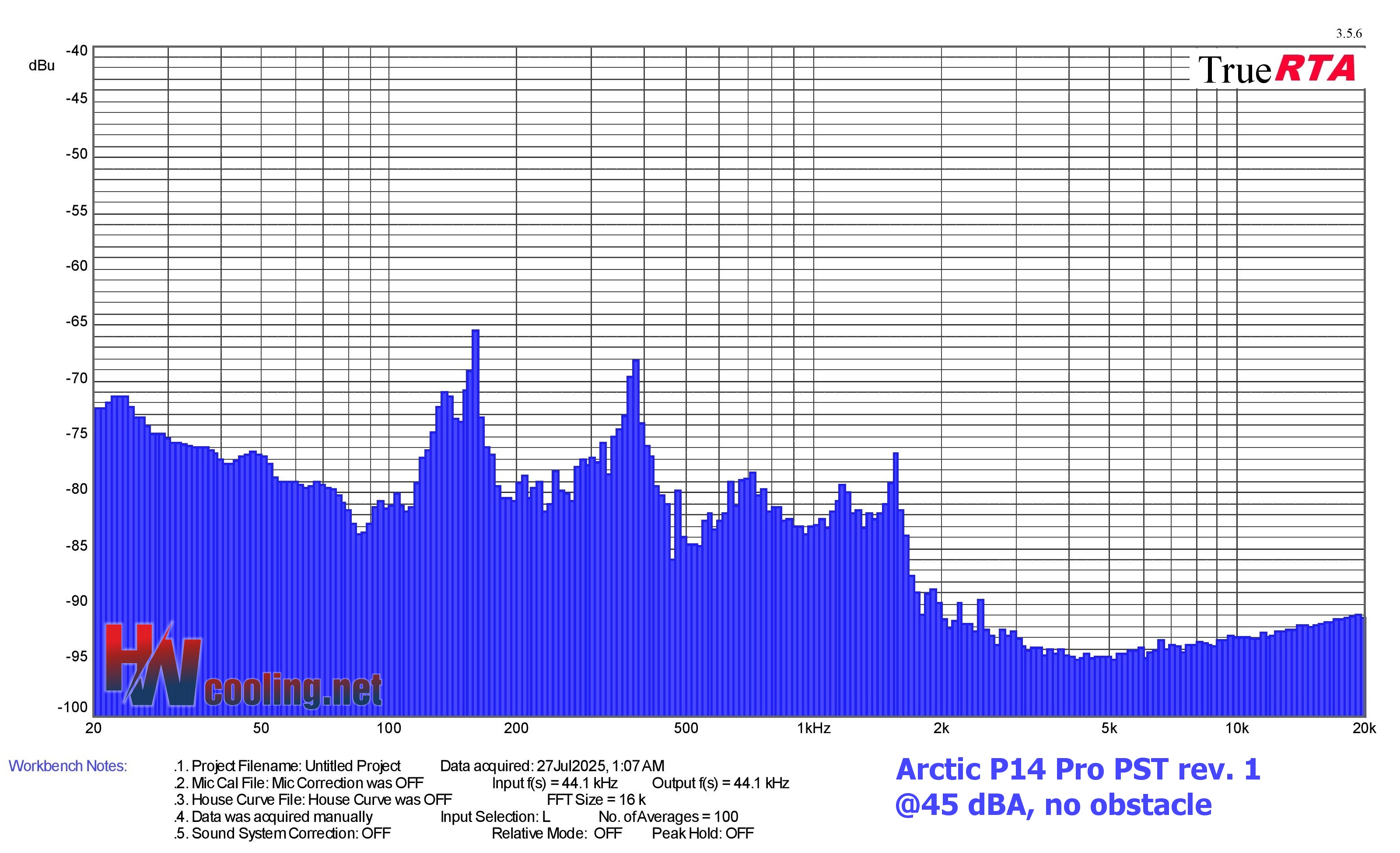
Results: Frequency response of sound w/o obstacles
Measurements are conducted using TrueRTA, which captures audio data across 240 frequency bands within the 20–20,000 Hz range. To facilitate comparisons between articles, we extract and present the dominant frequency from each of three spectral bands: low (20–200 Hz), mid (201–2000 Hz), and high (2001–20,000 Hz) in standardized bar graphs.
However, for an even more detailed analysis of the sound expression, it is important to perceive the overall shape of the graph and the intensity of all frequencies/tones. If any aspects of the graphs or data tables are unclear, detailed interpretation guidelines are provided in this article.
Most fan-related acoustic activity occurs within the 70–7000 Hz range. Frequencies above 7000 Hz typically represent electromagnetic interference from the test environment, while the lowest bands below 70 Hz may also include such noise, albeit mixed with aerodynamic sound. Although we could exclude these frequency extremes, they are retained to detect and visualize potential anomalies.
| Arctic P12 Max (Black) rev. 2 |
| + Suitable for every usage |
| + Cooling efficiency (airflow/pressure per unit of noise) at a very high level |
| + Attractive price-to-airflow ratio... |
| + High airflow and static pressure even through restrictive obstacles |
| + Exceptionally wide speed range |
| + Quiet motor and bearing operation |
| + Very low, negligible vibrations at low to medium speeds |
| + Exceedingly powerful motor (over 10 W) |
| - Potential collision with nylon dust filters |
| - Medium to high vibrations at higher speeds |
| Approximate retail price: 8 EUR |
| Značka a model ventilátora | Udávané „papierové“ parametre * | Cena [eur] | ||||||||
| Formát (a hrúbka) v mm | Pripojenie | Rýchlosť [ot./min] | Prietok vzduchu [m3/h] | Statický tlak [mm H2O] | Hladina hluku [dBA] | Ložiská | MTBF [h] | |||
| Motor | RGB LED | |||||||||
| CPS PCCooler F7 X120 | 120 (25) | 4-pin (PWM) | 3-pin (5 V) | 500–3000 | 141,02 | 5,70 | 15,0–31,1 | guľôčkové | N/A | ~40 |
| Arctic P12 Max (Black) rev. 2 | 120 (25) | 4-pin (PWM) | nemá | 400–3300 | 137,69 | 4,35 | 37,5 | fluidné | N/A | 8 |
| Arctic S12038-4K | 120 (38) | 4-pin (PWM) | nemá | 600–4000 | 180,10 | 11,45 | N/A | guľôčkové | 490 000 | 13 |
| Gigabyte Aorus EZ Chain Fan 120 Ice | 120 (25) | 4-pin (PWM) | 3-pin (5 V) | 600–2000 | 101,94 | 2,75 | 8,2–29,0 | hydrodynamické | 40 000 | 18 |
| BeQuiet! Pure Wings 3 (BL105) | 120 (25) | 4-pin (PWM) | nemá | 1600 | 84,78 | 1,45 | 25,5 | rifle | 80 000 | 14 |
| Scythe Grand Tornado 120 | 120 (25) | 4-pin (PWM) | nemá | 400–3000 | 20,78–166,20 | 0,62–5,13 | 9,3–36,6 | fluidné | 370 000 | 20 |
| DeepCool FT12 | 140 (25) | 4-pin (PWM) | nemá | 500–2150 | 127,43 | 4,20 | 32,0 | fluidné | N/A | 20 |
| DeepCool FT14 | 140 (25) | 4-pin (PWM) | nemá | 200–1650 | 133,93 | 3,60 | 25,1 | fluidné | N/A | 25 |
| Noctua NF-A14x25 G2 PWM | 140 (25) | 4-pin (PWM) | nemá | 1500 | 155,60 | 2,56 | 24,8 | SSO2 | 150 000 | 40 |
| Asus TUF Gaming TR120 (Reverse) | 120 (28) | 4-pin (PWM) | nemá | 2000 | 129,63 | 2,75 | 29,0 | hydrauilické | 40 000 | 20 |
| BeQuiet! Pure Wings 3 (BL113) | 140 (25) | 4-pin (PWM) | nemá | 1800 | 122,60 | 2,44 | 30,5 | rifle | 80 000 | 11 |
| Arctic P14 Max | 140 (27) | 4-pin (PWM) | nemá | 400–2800 | 161,40 | 4,18 | N/A | fluidné | N/A | 13 |
| Arctic P14 PWM PST CO | 140 (27) | 4-pin (PWM) | nemá | 200–1700 | 123,76 | 2,40 | 10,6 | guľôčkové | N/A | 11 |
| Arctic P14 PWM PST | 140 (27) | 4-pin (PWM) | nemá | 200–1700 | 123,76 | 2,40 | 10,6 | fluidné | N/A | 9 |
| BeQuiet! Silent Wings 4 (BL117) | 140 (25) | 4-pin (PWM) | nemá | 1900 | 133,20 | 2,36 | 29,3 | fluidné | 300 000 | 23 |
| Endorfy Stratus 140 PWM | 140 (25) | 4-pin (PWM) | nemá | 200–1200 | N/A | N/A | N/A | fluidné | 80 000 | 8 |
| CPS PCCooler F5 R120 BK | 120 (25) | 4-pin (PWM) | nemá | 500–2200 | 147,36 | 3,20 | 32,0 | fluidné | 60 000 | 17 |
| Thermaltake Toughfan 14 Pro | 140 (25) | 4-pin (PWM) | nemá | 500–2000 | 203,20 | 3,57 | 31,6 | hydraulické | 40 000 | 23 |
| Fractal Design Venturi HP-14 PWM | 140 (25) | 4-pin (PWM) | nemá | 1500 | 132,70 | 1,94 | 30,1 | fluidné | 150 000 | 22 |
| Seasonic MagFlow ARGB | 120 (25) | 4-pin (PWM) | 3-pin (5 V) | 2000 | 84,05 | 2,28 | 30,2 | fluidné | 100 000 | 34 |
| Noctua NF-A14 PWM | 140 (25) | 4-pin (PWM) | nemá | 1500 | 140,20 | 2,08 | 24,6 | SSO2 | 150 000 | 26 |
| BeQuiet! Pure Wings 3 (BL108) | 120 (25) | 4-pin (PWM) | nemá | 1200 | 97,50 | 0,96 | 21,9 | rifle | 80 000 | 15 |
| Endorfy Stratus 120 PWM | 120 (25) | 4-pin (PWM) | nemá | 200–1400 | N/A | N/A | N/A | fluidné | 80 000 | 6 |
| Phanteks PH-F120T30 | 120 (30) | 4-pin (PWM) | nemá | 0–3000 | 171,40 | 7,11 | 39,7 | „dual vapo“ | 150 000 | 30 |
| BeQuiet! Light Wings White (BL101) | 120 (25) | 4-pin (PWM) | 3-pin (5 V) | 2500 | 88,86 | 2,60 | 31,0 | rifle | 60 000 | 23 ** |
| Scythe Kaze Flex II 120 | 120 (25) | 4-pin (PWM) | nemá | 300–2000 | 28,71–153,39 | 0,08–2,67 | 4,0–36,2 | fluidné | 120 000 | 16 |
| Valkyrie X12 | 120 (25) | 4-pin (PWM) | 3-pin (5 V) | 800–2150 | 135,92 | 3,14 | 29,0 | fluidné | 50 000 | 28 |
| Fractal Design Silent R3 140 mm | 140 (25) | 3-pin (DC) | nemá | 1000 | 95,31 | 0,87 | 21,6 | rifle | 40 000 | 12 |
| Arctic P12 PWM PST A-RGB | 120 (25) | 4-pin (PWM) | 3-pin (5 V) | 200–2000 | 82,91 | 1,85 | 10,6 | fluidné | N/A | 14 |
| Scythe Kaze Flex II 120 Slim | 120 (15) | 4-pin (PWM) | nemá | 300–1800 | 13,86–81,55 | 0,05–1,36 | 2,6–27,8 | fluidné | 120 000 | 17 |
| Seasonic MagFlow 1225 PWM | 120 (25) | 4-pin (PWM) | nemá | 600–2000 | 107,60 | 2,61 | 9,9–33,8 | fluidné | 100 000 | 37 |
| Arctic P12 PWM PST | 120 (25) | 4-pin (PWM) | nemá | 200–1800 | 95,65 | 2,20 | 10,6 | fluidné | N/A | 6 |
| Cooler Master Mobius 120 OC | 120 (25) | 4-pin (PWM) | nemá | 0–3200 | 149,68 | 4,75 | 39,3 | guľôčkové | 200 000 | 32 |
| Corsair AF120 RGB Elite | 120 (25) | 4-pin (PWM) | 4-pin (5 V) iCUE | 550–2100 | 23,45–111,40 | 0,17–2,68 | 5,0–34,1 | fluidné | N/A | 29 |
| Enermax SquA RGB White | 120 (25) | 4-pin (PWM) | 3-pin (5 V) | 300–1500 | 41,67–115,99 | 0,17–1,90 | 12,0–23,0 | N/A | 100 000 | 20 |
| Endorfy Fluctus 140 PWM | 140 (25) | 4-pin (PWM) | nemá | 250–1800 | N/A | N/A | N/A | fluidné | 100 000 | 13 |
| Endorfy Fluctus 140 PWM ARGB | 140 (25) | 4-pin (PWM) | 3-pin (5 V) | 250–1800 | N/A | N/A | N/A | fluidné | 100 000 | 17 |
| Arctic P12 Slim PWM PST | 120 (15) | 4-pin (PWM) | nemá | 300–2100 | 71,53 | 1,45 | 10,6 | fluidné | N/A | 7 |
| BeQuiet! Silent Wings Pro 4 (BL099) | 140 (25) | 4-pin (PWM) | nemá | 2400 | 165,50 | 3,64 | 36,8 | fluidné | 300 000 | 33 |
| Fractal Design Prisma AL-14 PWM | 140 (25) | 4-pin (PWM) | 3-pin (5 V) | 500–1700 | 176,44 | 2,38 | 34,1 | klzné | 100 000 | 21 |
| Gigabyte Aorus 140 ARGB | 140 (25) | 4-pin (PWM) | 3-pin (5 V) | 800–1700 | 51,48–103,03 | 0,59–2,18 | 8,9–35,8 | klzné | 73 500 | 28 |
| BeQuiet! Light Wings (BL075) | 140 (25) | 4-pin (PWM) | 3-pin (5 V) | 2200 | 121,82 | 2,30 | 31,0 | rifle | 60 000 | 29 |
| Fractal Design Aspect 14 RGB PWM | 140 (25) | 4-pin (PWM) | 3-pin (5 V) | 500–1700 | 33,98–132,52 | 0,09–1,93 | 10,0–35,5 | rifle | 90 000 | 18 |
| DeepCool FK120 | 120 (25) | 4-pin (PWM) | nemá | 500–1850 | 117,21 | 2,19 | 28,0 | fluidné | N/A | 11 |
| Asus TUF Gaming TF120 | 120 (25) | 4-pin (PWM) | 3-pin (5 V) | 1900 | 129,12 | 2,50 | 29,0 | fluidné | 250 000 | 14 |
| BeQuiet! Light Wings (BL072) | 120 (25) | 4-pin (PWM) | 3-pin (5 V) | 1700 | 70,53 | 1,66 | 20,6 | rifle | 60 000 | 26 |
| DeepCool FC120 | 120 (25) | 6-pin (PWM) | 6-pin (5 V) | 500–1800 | 105,19 | 1,83 | 28,0 | hydrodynamické | N/A | 20 |
| Nidec Servo Gentle Typhoon D1225C (2150/12) | 120 (25) | 4-pin (PWM) | nemá | 2150 | 117,23 | 2,87 | 30,0 | guľôčkové | 100 000 | 20 |
| BeQuiet! Shadow Wings 2 (BL085) | 120 (25) | 4-pin (PWM) | nemá | 1100 | 65,41 | 0,82 | 15,9 | rifle | 80 000 | 15 |
| Noctua NF-A12x25 PWM | 120 (25) | 4-pin (PWM) | nemá | 450–2000 | 102,10 | 2,34 | 22,6 | SSO2 | 150 000 | 28 |
| Corsair AF120 Elite (black) | 120 (25) | 4-pin (PWM) | nemá | 400–1850 | 18,52–100,41 | 0,09–1,93 | 31,5 | fluidné | N/A | 24 |
| Cooler Master MasterFan SF120M | 120 (25) | 4-pin (PWM) | nemá | 650–2000 | 105,33 | 2,40 | 5,5–22,0 | guľôčkové | 280 000 | 33 |
| Akasa Alucia SC12 | 120 (25) | 4-pin (PWM) | nemá | 500–2000 | 95,65 | 1,94 | 33,1 | hydrodynamické | N/A | 12 |
| BeQuiet! Silent Wings Pro 4 (BL098) | 120 (25) | 4-pin (PWM) | nemá | 3000 | 142,50 | 5,31 | 36,9 | fluidné | 300 000 | 32 |
| Thermalright X-Silent 120 | 120 (25) | 3-pin (DC) | nemá | 1000 | 61,31 | N/A | 19,6 | fluidné | N/A | 10 |
| Fractal Design Aspect 12 RGB PWM | 120 (25) | 4-pin (PWM) | 3-pin (5 V) | 500–2000 | 22,09–95,14 | 0,23–2,34 | 10,0–33,2 | rifle | 90 000 | 16 |
| BeQuiet! Silent Wings 3 (BL066) | 120 (25) | 4-pin (PWM) | nemá | 1450 | 85,80 | 1,79 | 16,4 | fluidné | 300 000 | 21 |
| Gelid Zodiac | 120 (25) | 4-pin (PWM) | 3-pin (5 V) | 700–1600 | 111,29 | 1,47 | 35,0 | hydrodynamické | N/A | 10 |
| Fractal Design Dynamic X2 GP-12 PWM | 120 (25) | 4-pin (PWM) | nemá | 500–2000 | 148,83 | 0,51–2,30 | 10,0–32,2 | rifle | 100 000 | 12 |
| BeQuiet! Pure Wings 2 (BL039) | 120 (25) | 4-pin (PWM) | nemá | 1500 | 87,00 | 1,25 | 19,2 | rifle | 80 000 | 11 |
| Gigabyte Aorus 120 ARGB | 120 (25) | 4-pin (PWM) | 3-pin (5 V) | 800–1700 | 31,47–69,40 | 0,37–1,48 | 7,3–28,6 | klzné | 73 500 | 25 |
| Arctic BioniX P120 A-RGB | 120 (30) | 4-pin (PWM) | 3-pin (5 V) | 400–2300 | 81,55 | 2,10 | 33,4 | fluidné | N/A | 21 |
| Akasa OTTO SF12 | 120 (25) | 4-pin (PWM) | nemá | 0–2000 | 164,84 | 3,59 | 7,1–31,7 | guľôčkové | 80 000 | 22 |
| Cooler Master SickleFlow 120 ARGB | 120 (25) | 4-pin (PWM) | 3-pin (5 V) | 680–1800 | 105,34 | 2,50 | 8,0–27,0 | rifle | 160 000 | 15 |
| Alphacool SL-15 PWM | 120 (15) | 4-pin (PWM) | nemá | 600–1800 | 71,40 | 1,20 | 32,0 | guľôčkové | 50 000 | 11 |
| Arctic BioniX F120 | 120 (25) | 4-pin (PWM) | nemá | 200–1800 | 117,00 | 2,10 | 20,0 | fluidné | N/A | 10 |
| SilverStone SST-AP123 | 120 (25) | 3-pin (DC) | nemá | 1500 | 96,84 | 1,46 | 23,8 | fluidné | 50 000 | 25 |
| Noctua NF-P12 redux-1700 PWM | 120 (25) | 4-pin (PWM) | nemá | 400–1700 | 120,20 | 2,83 | 25,1 | SSO | 150 000 | 13 |
| SilentiumPC Fluctus 120 PWM | 120 (25) | 4-pin (PWM) | nemá | 300–1800 | N/A | N/A | N/A | fluidné | 100 000 | 12 |
| MSI MEG Silent Gale P12 | 120 (25) | 4-pin (PWM) | nemá | 0–2000 | 95,48 | 2,21 | 22,7 | hydrodynamické | 50 000 | 31 |
| Asus ROG Strix XF120 | 120 (25) | 4-pin (PWM) | nemá | 1800 | 106,19 | 3,07 | 22,5 | „MagLev“ | 400 000 | 23 |
| Akasa Vegas X7 | 120 (25) | 4-pin (PWM) | 4-pin (12 V) | 1200 | 71,19 | N/A | 23,2 | fluidné | 40 000 | 11 |
| Reeven Coldwing 12 | 120 (25) | 4-pin (PWM) | nemá | 300–1500 | 37,54–112,64 | 0,17–1,65 | 6,5–30,4 | klzné | 30 000 | 12 |
| Reeven Kiran | 120 (25) | 4-pin (PWM) | zdieľané | 400–1500 | 110,10 | 2,95 | 33,6 | fluidné | 120 000 | 17 |
| SilentiumPC Sigma Pro 120 PWM | 120 (25) | 4-pin (PWM) | nemá | 500–1600 | 79,00 | N/A | 15,0 | hydraulické | 50 000 | 7 |
| SilentiumPC Sigma Pro Corona RGB 120 | 120 (25) | 4-pin (PWM) | 4-pin (12 V) | 1500 | 56,58 | N/A | N/A | hydraulické | 50 000 | 12 |
| SilverStone SST-AP121 | 120 (25) | 3-pin (DC) | nemá | 1500 | 60,08 | 1,71 | 22,4 | fluidné | 50 000 | 18 |
| SilverStone SST-FQ121 | 120 (25) | 7-pin (PWM) | nemá | 1000–1800 | 114,68 | 0,54–1,82 | 16,4–24,0 | fluidné | 150 000 | 20 |
| Xigmatek XLF-F1256 | 120 (25) | 3-pin (DC) | nemá | 1500 | 103,64 | N/A | 20,0 | rifle | 50 000 | 16 |
| Fan | Dominant sound freq. and noise level, no obstacle@45 dBA | ||||||
| Low range | Mid range | High range | |||||
| Frequency [Hz] | Noise level [dBu] | Frequency [Hz] | Noise level [dBu] | Frequency [Hz] | Noise level [dBu] | ||
| Fractal Design Momentum 12 RGB (Black) | 20,6 | -62,6 | 380,5 | -71,0 | 2215,8 | -84,7 | |
| Noctua NF-A12x25 G2 PWM | 25,6 | -73,8 | 246,8 | -70,0 | 2215,8 | -90,8 | |
| Fractal Design Momentum 12 (Black) | 28,3 | -73,2 | 380,5 | -71,5 | 2152,7 | -88,1 | |
| Thermalright TL-C12C | 160,0 | -71,2 | 380,5 | -64,5 | 19330,5 | -91,3 | |
| Adata XPG Vento Pro 120 PWM | 28,3 | -74,0 | 246,8 | -59,3 | 6639,8 | -85,5 | |
| CPS PCCooler F7 X120 | 20,6 | -62,7 | 219,8 | -60,7 | 19330,5 | -90,8 | |
| Arctic P12 Max (Black) rev. 2 | 151,0 | -65,0 | 369,7 | -70,9 | 5747,0 | -89,4 | |
| Arctic S12038-4K | 127,0 | -59,3 | 201,6 | -61,8 | 2957,7 | -84,8 | |
| Gigabyte Aorus EZ Chain Fan 120 Ice | 164,7 | -67,5 | 369,7 | -67,7 | 2487,1 | -87,9 | |
| BeQuiet! Pure Wings 3 (BL105) | 130,7 | -70,4 | 369,7 | -69,6 | 2487,1 | -89,3 | |
| Scythe Grand Tornado 120 | 23,1 | -68,6 | 369,7 | -67,3 | 18780,2 | -91,1 | |
| DeepCool FT12 | 130,7 | -65,5 | 369,7 | -69,7 | 19330,5 | -90,9 | |
| Asus TUF Gaming TR120 (Reverse) | 123,4 | -70,7 | 369,7 | -59,6 | 19330,5 | -90,7 | |
| BeQuiet! Pure Wings 3 (BL113) | 213,6 | -72,3 | 391,7 | -69,4 | 2487,1 | -87,6 | |
| PCCooler CPS F5 R120 BK | 23,1 | -66,3 | 207,5 | -74,0 | 2487,1 | -90,7 | |
| Seasonic MagFlow ARGB | 25,6 | -67,8 | 239,7 | -63,9 | 2347,5 | -90,1 | |
| BeQuiet! Pure Wings 3 (BL108) | N/A | N/A | N/A | N/A | N/A | N/A | |
| Endorfy Stratus 120 PWM | 23,1 | -73,7 | 219,8 | -61,9 | 2487,1 | -90,5 | |
| Phanteks PH-F120T30 | 190,3 | -69,0 | 380,5 | -71,5 | 2957,7 | -90,8 | |
| BeQuiet! Light Wings White (BL101) | 123,4 | -68,0 | 285,1 | -64,2 | 2215,8 | -89,3 | |
| Scythe Kaze Flex II 120 | 130,7 | -69,5 | 380,5 | -69,3 | 19330,5 | -90,8 | |
| Valkyrie X12 | 23,1 | -69,6 | 879,3 | -68,7 | 19330,5 | -90,7 | |
| Arctic P12 PWM PST A-RGB | 146,7 | -64,2 | 1566,8 | -74,5 | 19330,5 | -90,7 | |
| Scythe Kaze Flex II 120 Slim | 184,9 | -65,9 | 391,7 | -69,7 | 2031,9 | -90,8 | |
| Seasonic MagFlow 1225 PWM | 195,8 | -63,8 | 958,9 | -67,0 | 18780,2 | -90,8 | |
| Arctic P12 PWM PST rev. 1 | 130,7 | -57,9 | 415,0 | -59,1 | 19897,0 | -90,6 | |
| Cooler Master Mobius 120 OC | 20,6 | -68,1 | 369,7 | -71,3 | 3417,2 | -89,3 | |
| Corsair AF120 RGB Elite | 134,5 | -67,3 | 269,1 | -62,2 | 19330,5 | -90,9 | |
| Enermax SquA RGB White | 184,9 | -67,4 | 369,7 | -70,4 | 19897,0 | -90,9 | |
| Arctic P12 Slim PWM PST | 155,4 | -67,8 | 380,5 | -63,5 | 2031,9 | -89,0 | |
| BeQuiet! Light Wings (BL075) | 130,7 | -78,8 | 232,9 | -62,1 | 19330,5 | -90,9 | |
| DeepCool FK120 | 23,1 | -68,0 | 604,1 | -65,8 | 19897,0 | -91,0 | |
| Asus TUF Gaming TF120 | 23,1 | -66,2 | 380,5 | -70,6 | 2957,7 | -88,1 | |
| BeQuiet! Light Wings (BL072) | N/A | N/A | N/A | N/A | N/A | N/A | |
| DeepCool FC120 | 195,8 | -71,5 | 380,5 | -72,8 | 3417,2 | -85,7 | |
| Nidec Servo Gentle Typhoon D1225C (2150/12) | 25,6 | -68,0 | 239,7 | -62,3 | 2280,7 | -84,1 | |
| BeQuiet! Shadow Wings 2 (BL085) | N/A | N/A | N/A | N/A | N/A | N/A | |
| Noctua NF-A12x25 PWM | 28,3 | -72,5 | 269,1 | -69,8 | 2215,8 | -89,6 | |
| Corsair AF120 Elite (black) | 130,7 | -78,5 | 369,7 | -70,9 | 19330,5 | -90,9 | |
| Cooler Master MasterFan SF120M | 184,9 | -69,7 | 369,7 | -67,9 | 4305,4 | -73,8 | |
| Akasa Alucia SC12 | 130,7 | -70,3 | 380,5 | -68,6 | 2031,9 | -90,4 | |
| BeQuiet! Silent Wings Pro 4 (BL098) | 47,6 | -75,5 | 339,0 | -60,5 | 2791,7 | -83,3 | |
| Thermalright X-Silent 120 | 82,3 | -74,9 | 369,7 | -91,1 | 18780,2 | -91,1 | |
| Fractal Design Aspect 12 RGB PWM | 130,7 | -69,5 | 285,1 | -67,2 | 19330,5 | -90,8 | |
| BeQuiet! Silent Wings 3 (BL066) | 164,7 | -64,2 | 339,0 | -69,1 | 18780,2 | -90,8 | |
| Gelid Zodiac | 184,9 | -61,8 | 380,5 | -68,7 | 18780,2 | -90,8 | |
| Fractal Design Dynamic X2 GP-12 PWM | 146,7 | -72,2 | 391,7 | -71,5 | 2280,7 | -83,1 | |
| BeQuiet! Pure Wings 2 (BL046) | 130,7 | -71,3 | 369,7 | -69,3 | 19330,5 | -90,6 | |
| Gigabyte Aorus 120 ARGB | 160,0 | -61,9 | 369,7 | -70,4 | 2487,1 | -88,3 | |
| Arctic BioniX P120 A-RGB | 151,0 | -67,6 | 369,7 | -72,0 | 2873,5 | -90,6 | |
| Akasa OTTO SF12 | 190,3 | -66,7 | 380,5 | -67,7 | 4695,1 | -86,3 | |
| Cooler Master SickleFlow 120 ARGB | 138,5 | -66,7 | 1076,3 | -67,1 | 3835,7 | -89,2 | |
| Alphacool SL-15 PWM | 151 | -71,5 | 232,9 | -66,5 | 2280,7 | -89,6 | |
| Arctic BioniX F120 | 195,8 | -68 | 201,6 | -62,2 | 19330,5 | -90,7 | |
| SilverStone SST-AP123 | 130,7 | -70,9 | 369,7 | -67,7 | 19897 | -90,9 | |
| Noctua NF-P12 redux-1700 PWM | 184,9 | -62,2 | 369,7 | -67,0 | 19897 | -91,1 | |
| SilentiumPC Fluctus 120 PWM | 25,6 | -69,6 | 239,7 | -62,0 | 2957,7 | -90,0 | |
| MSI MEG Silent Gale P12 | 28,3 | -73,5 | 380,5 | -71,0 | 2487,1 | -85,9 | |
| Asus ROG Strix XF120 | 23,1 | -62,9 | 369,7 | -71,7 | 2347,5 | -89,1 | |
| Akasa Vegas X7 | N/A | N/A | N/A | N/A | N/A | N/A | |
| Reeven Coldwing 12 | 195,8 | -68,3 | 380,5 | -71,3 | 2031,9 | -90 | |
| Reeven Kiran | 130,7 | -73,1 | 219,8 | -70,2 | 17726,2 | -89,4 | |
| SilentiumPC Sigma Pro 120 PWM | 138,5 | -70,0 | 1522,2 | -71,9 | 2560 | -82,9 | |
| SilentiumPC Sigma Pro Corona RGB 120 | 190,3 | -70,5 | 369,7 | -66,5 | 2416,3 | -82,4 | |
| SilverStone SST-AP121 | 130,7 | -66,8 | 439,7 | -66,1 | 2347,5 | -90,9 | |
| SilverStone SST-FQ121 | 127 | -71,2 | 369,7 | -66,5 | 2031,8 | -81,4 | |
| Xigmatek XLF-F1256 | 130,7 | -71,5 | 239,7 | -60,9 | 18780,2 | -91,1 |



Here are direct comparisons of the frequency characteristics with the predecessor, measured at 33 dBA (filter, grille, radiator).
Thank you, perfect! 🙂
Thank you for such an in-depth and thorough review!
One thing that I would like to ask though, do you think it would be possible to include an option to display the RPM values in the charts as well?
It would be really useful to see the RPM values at a given sound or airflow level.
Thank you for the comment. The fan speeds corresponding to the individual modes normalized by comparable noise levels in the article are in Chapter 13. 🙂
From Chapter 5, you can also find out the method (the technique) used for recording the fan speeds.
Thank you for replying to my comment!
I realised that what I was looking was in Chapter 13 after posting my initial comment. However, I guess what I was referring to was to be able to see the RPM values in the other charts, without having to go back and forth to Chapter 13. Maybe when hovering the mouse pointer over the other chart results/values, the RPMs can be displayed then?
Be careful, the RPM value is different for other applications (filters, rads…) and is not recorded. 😉
Thanks for pointing that out! That’s why I asked if this would be something that the author can implement, as it would be handy to have when configuring the fans once installed in the case. Since you’re recording various data, specifying the RPM value would be an additional step, but an important and useful one.
Thanks for the note. We considered that when designing the testing methodology, and in the end—within the available (time) constraints—we decided to record fan speeds only in the unobstructed scenario. That said, I completely understand that having RPM data in other scenarios would definitely be useful. Of course, so the user can easily fine-tune the fan based on how it behaves in a given mode. 🙂
I have found on forums that , there is a problem with Artic fans Pack of 3 Fans :
The Pack of 3 Fans or more are cheaper BUT they have more failures than single boxed fans .
Buyers think there is no quality control on those Eco pack…
Thanks for the info. Do you have more details on this? For example, what exactly is the bottleneck or likely failure point in the fans, and so on.
I would think that quality control for 3-packs wouldn’t differ significantly from individually sold fans. In both cases, manufacturing tolerances are probably going to be looser—Arctic P14 Pro are, after all, budget-friendly fans. 🙂
“what exactly is the bottleneck or likely failure point in the fans,”
I believe I can answer this as I have tested almost a hundred P12 Pro fans at this point.
The fan blade ring to chassis distance has a very small tolerance. There is also a level of imbalanced impellers between fans. Combined, on defective models they can increase noise somewhat heavily. I encountered these problems on, maybe 2 out of the 5 fans in the 5 packs.
There is another element that has to do with the fan frame being quite cheap. When mounting them, you must be careful to screw them in evenly and gently, as uneven/too much mounting pressure can deform the frame and can exacerbate the above issue.
No issues with the bearings as of yet, which in my experience is a large improvement from their P12 Max models.
Yes, with cheaper fans, the production tolerances are higher, and as a result, each fan may behave differently. This is well illustrated by this vibration test of 15 Stratus 120 PWM fan samples. The large spread of vibrations at the same speeds shows clear signs of different manufacturing flaws—or simply variations—that occur. Sometimes you get lucky and avoid them altogether; other times, you have to pick through “better” and “worse” pieces. 🙂
A test like this for the arctic fans would be interesting imo
I agree, it would certainly be a useful analysis for Arctic fans as well. However, our capacity doesn’t allow us to dedicate time to that, and I’ll be glad when we manage to complete the vibration tests for the 15 Noctua NF-A14x25 G2 PWM fans. We announced them a year ago and haven’t made much progress since—we have the fans, they are ready, but we lack the time to focus on them. 🙂
https://www.hwcooling.net/en/thermaltake-toughfan-14-pro-number-one-for-radiators-review/
Does arctic p1 pro outperform both in performance and noise than ‘Thermaltake Toughfan 14 Pro: Number one for radiators’ you rated best?
The price is not important to me.
We need the best radiator fans.
For your information, Noctua did not perform well.
I assume you mean the P14 Pro when comparing it with the Toughfan 14 Pro?
Yes, the Toughfan 14 Pro has excellent aerodynamics—but so does the P14 Pro. A common drawback of these fans can be lower manufacturing quality. They are budget fans, where shortcomings may arise from production cost constraints. With Thermaltake fans, we did encounter such issues (and this is mentioned in the article). With Arctic fans, we haven’t—though that doesn’t mean it can’t happen. I’d say that Noctua NF-A14x25 G2 PWM fans won’t be affected by these kinds of production defects, while at the same time offering comparable real-world results in terms of cooling efficiency, or cooling performance per unit of noise. At least when it comes to working on liquid cooler radiators. By “Noctua” do you mean the NF-A14x25 G2 fans? If not, and you meant the older NF-A14 with the previous aerodynamic design, then yes—the aerodynamic efficiency of those older fans can be significantly lower.
Regardless of noise levels, at maximum performance the Toughfan 14 Pro and Arctic P14 Pro fans provide significantly higher cooling performance because they have higher airflow. But compared to the Noctua NF-A14x25 G2, they are also noisier.
It really seems like these P14 Pros are the best for my use case, noise normalized beating everything at 31dBA and 36dBA (the two noise levels I target). Disregarding reliability concerns (a 5 pack in my country is less than a single A14x25 G2), these are the undisputed best in 140mm radiator fans?
They have such a high static pressure, to my understanding: Dense radiators used in custom watercooling would surely benefit heavily from them.
Mr. Samák, you are very experienced with fans, so your opinion is valuable to me.
If we take into account both results and price, then yes—on radiators (and in many other scenarios), the Arctic P14 Pro 14 A-RGB can indeed be considered among the “best” fans. I personally use the word “best” rather reluctantly, because it is quite subjective and everyone may imagine different qualities under it (it’s enough for someone to dislike the acoustic profile and suddenly it’s a deal-breaker, haha). But yes… if the P14 Pro A-RGB fan is technically fine (not defective), then very few models can surpass its aerodynamic properties. One could also mention the TT Toughfan 14 Pro, which is likewise excellent on radiators. However, even with it, you may encounter samples that are not in optimal condition. If you look at the conclusions of our tests on our site, you’ll see that weaker pieces, in terms of build quality, can occur with it as well. Despite being an LCP fan, its relatively low price naturally reflects some cost-cutting in critical aspects, which can (but do not necessarily have to) show up negatively in practice.
With the Arctic P14 Pro (A-RGB), weaker results may sometimes appear in pull position (against an obstacle), as indicated by our grille test results. Certain types of obstacles clearly can significantly increase the noise of this aerodynamic design, and therefore in noise-normalized tests the performance can look weaker. Something very similar can, however, also be observed with significantly more expensive fans such as the Noctua NF-A14x25 G2. 🙂
–“…weaker results may sometimes appear in pull position (against an obstacle)…”
Well, when I look at the pull/push coefficient
…and the excellent results on the nylon filter. I rather think that it creates the kind of pressure/flow that causes higher noise and turbulence on the hex/plastic filters precisely due to its ability to pull.
…if it were moved away from the obstacle through some extender, I think that would be sufficient. 😛
…who knows how a BQ SW 4 would turn out with such an adjustment, it has a completely brutal coefficient (one could say significantly unbalanced).
That’s just my guess, maybe wrong 😉
„Well, when I look at the pull/push coefficient…“
These results are not influenced by the grille changing the noise characteristics. The pull/push coefficient is measured in an environment without obstacles.
If you space the fan away from the grille with a spacer, the results would almost certainly be more favorable. Naturally, what you describe is caused by input turbulence, which itself is created by the grille structure. With a nylon filter, this effect doesn’t occur in the same way, because its structure doesn’t push the fan into resonance frequencies.
yes, that’s exactly what I meant, 😉
…that due to its strong pull ability it may be causing a lot of turbulence and noise (when close to the obstacle) and that’s why it’s not so at the top in the hex/plast charts, but is at the top in the nylon chart. 😛
I see. Very insightful and objective reply, which I thank you for.
I have the time to return defective fans, so I will purchase more than what I need and return the rest.
Thanks for sharing your experience.
What you describe most likely stems from variations in the production quality of the fan shaft itself (this comes from fan manufacturing information—we haven’t examined it physically in detail). Some shafts are perfectly straight, others are… let’s say, not quite so straight. And from that, many other behaviors follow. The degree of fan misalignment depends largely on how straight or not straight that shaft is. 🙂
Yes, the amount of mounting pressure when tightening the fan on its frame can also cause different kinds of deformation. Noctua, for example, explored this issue in depth. What exactly does that mean? We even published an interview about it: https://www.hwcooling.net/en/noctua-on-nf-a14x25-g2-frame-deformations-interview/
I knows it’s an old comment, but you easily could buy p14 pros in a pack of 5, test which ones are least noisy, and use them on the radiator.
Thank you for the comment. Yes, this is an option as well. 🙂
Thanks for the review – I purchased a 5-pack of these ($6.80 each) and another ($10.50). Very economical, appear to work very well and quietly at low RMP. I plan to put these on radiators in a Fractal Design Meshify 3XL case. They spin much more slowly than the fans that came with the fractal case. I like them a lot.
One thing I would like to mention is that these P14 PRO PST fans are 27mm thick, which is 2mm thicker than usual fans. This means one would need slightly longer screws for mounting onto a radiator, and possibly implications for clearance. For example these fans barely fit on the front of the Meshify 3XL under the front panel when screwed in from inside. BUT, I have not yet tried to see how they fit mounted to a radiator with the screw-heads protruding forward. In the same case, these fans wouldn’t fit into the side radiator mount with a 30mm radiator (won’t clear the air guide panel – there is probably 56mm of thickness room there).
Thanks for the useful information. Yes, the Arctic P14 Pro fans are thicker and have worse compatibility in other aspects as well, but with a 27 mm thick profile, they are still better in this regard than ones with 30 mm. 🙂
I’m using LianLi O11 Air Mini case, the revised one with a couple of different fans. The config is:
2x 140mm BeQuiet Pure Wings 2 High Speed PWM – front
2x 140mm LianLI case fans ~ 800 RPM – bottom
2x 120mm Arctic P12 Bionix – side
1x 140mm BeQuiet Pure WIngs 2 High Speed PWM – top exhaust
1x 120mm BeQuiet Pure Wings 2 – back exhaust
I want to buy these new fans, they seem like a good option for me, both performance wise and appearance wise. I just want to ask a simple question: they are going to be better than my current config, right?
Do you notice any difference in CPU and GPU temperatures when the side fans (Bionix) are turned off/on?
Yeah, GPU temp dropped a bit, but I cant tell you the exact numbers. I have 7900XT with reference design, so every bit of fresh air helps.
I don’t know if other fans will have any significant impact on temperatures. 🤷
What will change is the sound profile and noise level (depending on the settings).
Does the current setup not suit you in terms of tone/noise?
If so, you can trh it…otherwise I wouldn’t bother with it 😛
New FD Momentum 14 and Noctua G2 have a nice sound profile (for me at least, have both in Lancool 207) 😉
Ha! Maybe it’s like this. I think we both basically wrote the same thing, just phrased a bit differently. 🙂
There’s no simple answer to that one. The P12 Pro fans are excellent budget options, but the Pure Wings 2 are great as well. Of course, the newer Arctic fans generally achieve a higher airflow per unit of noise, but in terms of case cooling, that difference may not even show up in practice. It might—or might not—it depends on the situation.
There are also many other aspects that determine whether one fan is “better” or “worse,” including the tonal quality of the noise—its frequency characteristics. Naturally, these differ, and everyone has their own preferences. 🙂
“Is it okay to use Arctic P14 Pro PST fans in a push or pull configuration on an Arctic Liquid Freezer III 420 mounted in the front of the case?”
“Should I use push or pull for the Arctic P14 Pro PST on an LF III 420 (front mount)?”
First of all, thank you for the questions. 🙂
Arctic P14 Pro PST fans can be used on the Liquid Freezer III 420 radiator in both pull and push configurations, with comparable efficiency. In the past, this was also examined during cooler testing by our colleague Pavel Sekerka, and I even have specific numbers somewhere—but they remain internal for now due to capacity constraints that prevented publication.
It’s true that in pull orientation, fans often reach higher noise levels due to interaction with an obstacle, but this generally doesn’t apply much to radiators. Radiators have a fin structure that usually doesn’t increase noise significantly.
Of course, results depend on the specific fan and its aerodynamic impeller design, but when you analyze the impact of fan placement (push vs pull) for the P14 Pro PST on a radiator, you’ll likely find the difference to be minimal. The same applies to cooling performance.
Yes, we do record the push/pull coefficient, but it’s important to note that this represents the upper limit at zero airflow. In real use, there is always some airflow through the radiator, meaning the environment has significantly lower resistance.
So yes—on the Liquid Freezer III radiator, you can use the fans in either push or pull without worrying that one configuration would be worse than the other.
As for front-mounted radiator placement in a case, we don’t have exact data for that, so we can’t give precise advice. The best approach is to test it in your specific setup, and we’d be happy if you came back later to share what you found. 🙂