
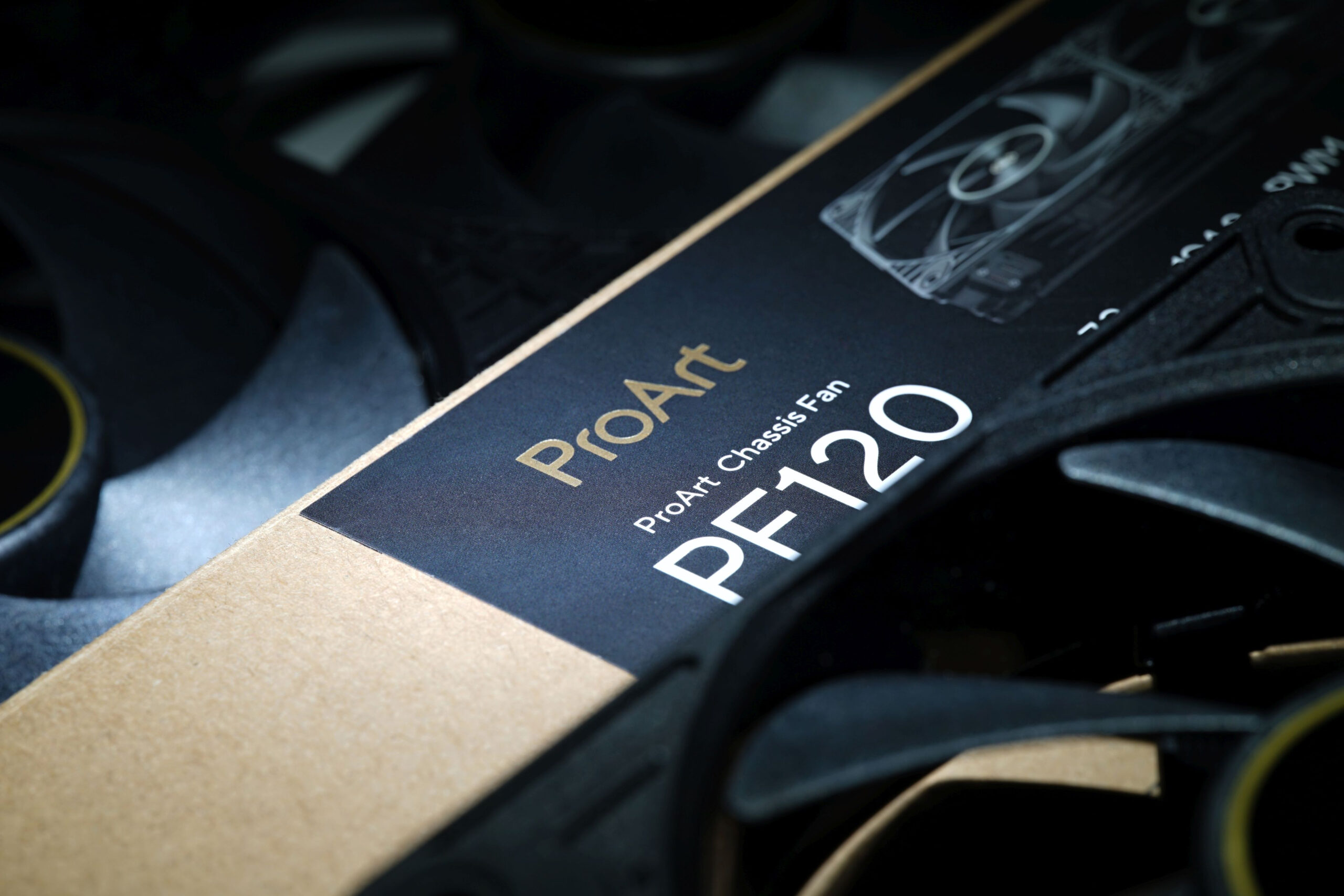
Asus ProArt PF120: The most efficient fan at low noise level

It wants to go head‑to‑head with the Phanteks T30-120 fan, while also having a slight edge in every respect. That’s Asus’s marketing—and now comes reality in HWCooling’s in‑depth analysis. The ProArt PF120 fans are truly something exceptional and worth paying attention to. High cooling efficiency and elegant daisy‑chaining are just the beginning. The overall design of Asus’s fans is impressive.

Static pressure per euro

Explanatory note: The following charts present static pressure output in relation to unit price. This cost-performance coefficient is calculated by dividing measured static pressure (in mm H2O) by the fan’s price (in EUR), then multiplying the result by 1000. This is specifically to prevent the resulting values from starting with unflattering zeros.


Why is a value sometimes missing for a fan? There can be several reasons. Most commonly, it’s because the fan couldn’t be regulated to the target noise level. Some fans have higher minimum RPM (or they spin slowly but have an excessively noisy motor), or they are simply slower models that can’t reach higher decibel thresholds. Results are also omitted from graphs if the impeller scrapes against the mesh of a nylon filter. In such cases, we classify the combination as incompatible. And of course, a zero in the graphs naturally appears in situations where we record an actual 0.00. This often occurs at extremely low speeds when obstacles are present or during vibration measurements.


Contents

The end, or just the beginning? 100 fans in HWCooling tests

Our database now includes one hundred fans—75 in the 120 mm format and 25 models with a physical size of 140 mm. In this article, we have compiled all data into unified charts. What was once separated for clarity is now brought together again, and the commentary will also include a… look ahead regarding fan testing. But we can already reveal that there is still a lot more to come. Read more “The end, or just the beginning? 100 fans in HWCooling tests” »

Contents

Prime GeForce RTX 5070 Deshroud With Arctic P12 Pro A-RGB

Asus cards such as the Prime GeForce RTX 5070 allow easy removal of the shroud with the fans, without removing the heatsink itself. This opens room for experimentation with cooling.We will find out how much you can gain by replacing stock fans with a pair of 120mm Arctic P12 Pro A-RGB fans. We will measure operating characteristics from 20 to 100% fan speed and see how much the card’s noise level drops at identical temperatures. Read more “Prime GeForce RTX 5070 Deshroud With Arctic P12 Pro A-RGB” »

Contents

Asus Prime GeForce RTX 5070 with 3× Arctic P9 PWM PST Deshroud

Alongside our previous tests of premium 92 mm Noctua fans, we’re adding something for value-focused users. For the more affordable Prime-series card, these are a better match. We’ll measure how much quieter the card gets after swapping the stock fans for budget 92 mm Arctic P9 PWM PST models with sleeve bearings, and compare the noise to the Arctic P9 PWM PST CO variant with dual ball bearings for continuous operation. Read more “Asus Prime GeForce RTX 5070 with 3× Arctic P9 PWM PST Deshroud” »

Contents

Leave a Reply

Your email address will not be published. Required fields are marked *