

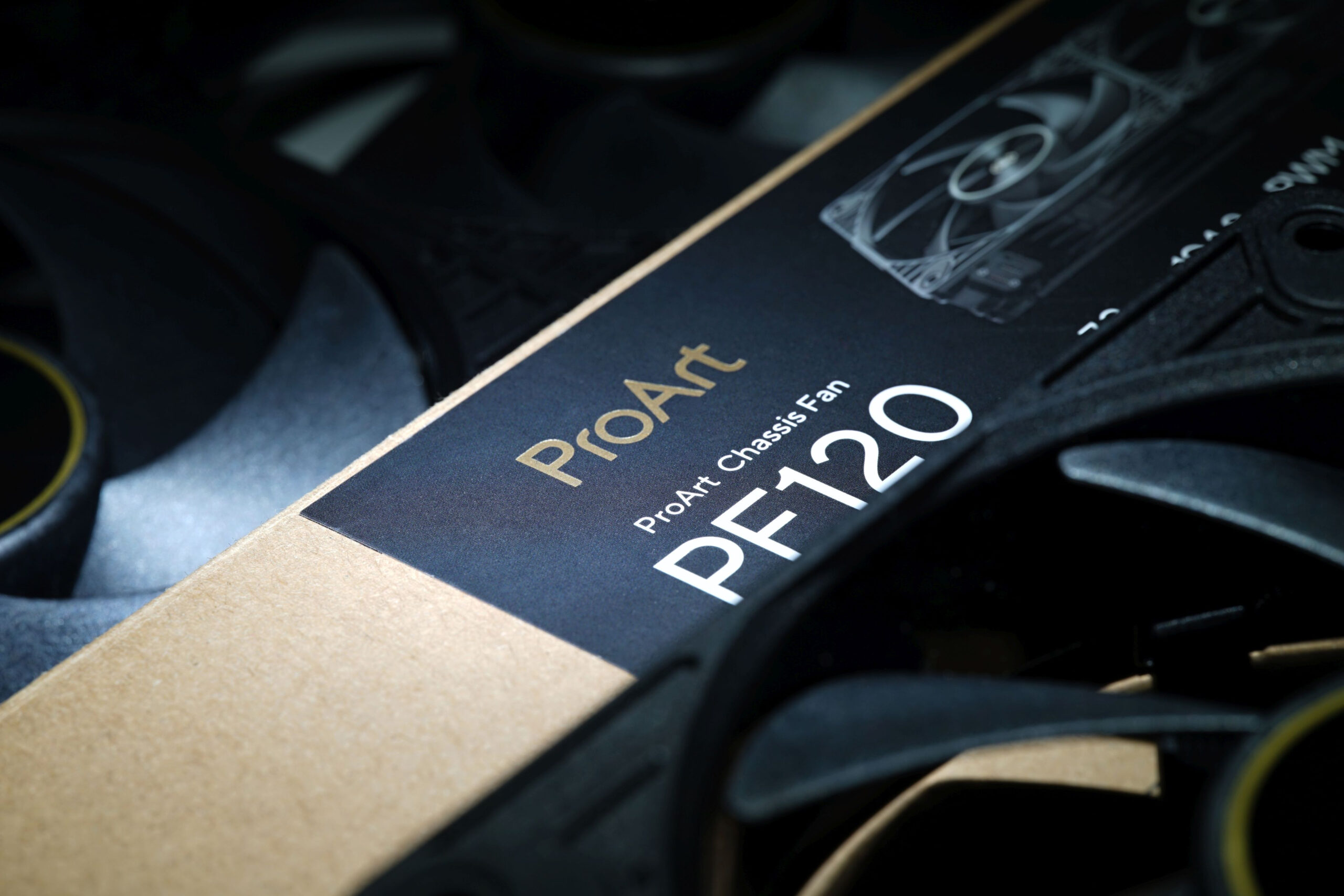
It wants to go head‑to‑head with the Phanteks T30-120 fan, while also having a slight edge in every respect. That’s Asus’s marketing—and now comes reality in HWCooling’s in‑depth analysis. The ProArt PF120 fans are truly something exceptional and worth paying attention to. High cooling efficiency and elegant daisy‑chaining are just the beginning. The overall design of Asus’s fans is impressive.
Evaluation
In many scenarios, the ProArt PF120 fans not only outperform the T30‑120 in airflow per unit of noise, but also other competing models. The lower the fan speed, the better the Asus models tend to perform.
One could note that wherever the Phanteks T30 loses a bit, the PF120 tends to pull ahead. The differences are always small, though, and calling “winners” here would be presumptuous. Even so, it must be said that the Asus ProArt PF120 are top‑tier fans that can outperform anything put in their way—referring to other fans, of course. This holds across all applications, whether with dust filters (nylon, plastic), on a grille (where resonant frequencies often result in relatively lower rankings), or through radiators (thin, thick).
The speed range is exceptionally wide. Even though on one end we recorded up to 3139 RPM, the minimum speeds are also very low, around 303 RPM. This is definitely a strong showing. It’s a fan capable of extremely high airflow (with high noise levels at the top end, naturally), yet one that can also be extremely quiet. And when we say it like that, we mean it literally.
The spectral analysis graphs show nothing acoustically disruptive, even at the lower end of the operating range. However, in combination with a hexagonal grille, tonal peaks appear at sound frequencies of roughly 538 Hz at higher speeds and 329 Hz at lower speeds. Put simply, this results in more pronounced “hum.”
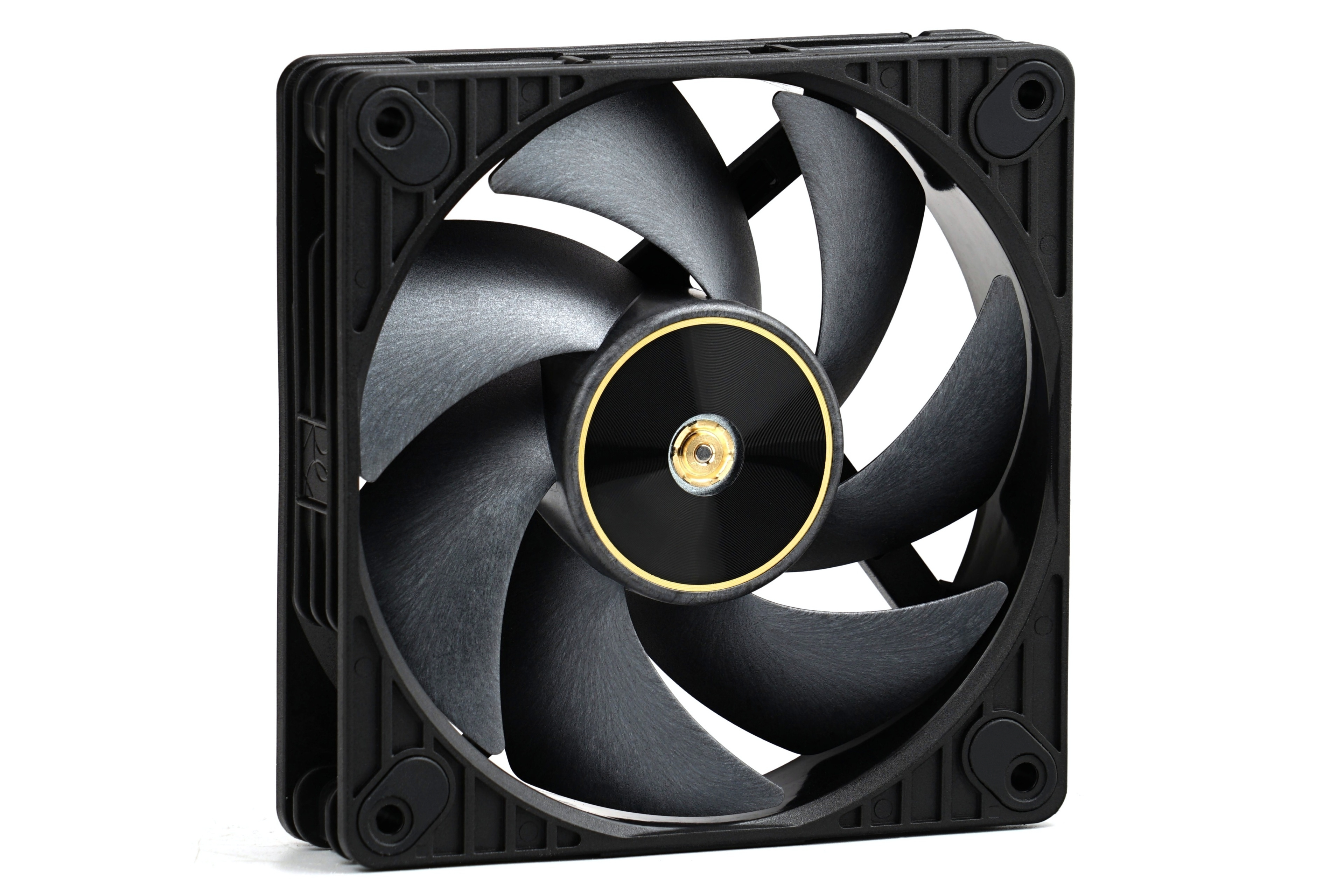
Vibration levels are also low, which is notable given the very high airflow even at maximum speed. This further reflects the unusually precise manufacturing quality that characterizes this fan.
Power consumption is average, and in relation to airflow, efficiency can be considered slightly above average. That is—except at the highest achievable speed, where the sharp rise in power draw significantly worsens this coefficient. The motor output is high, which prepares the fan well for deteriorating conditions it may encounter over time.
At its price (around 30 EUR per unit), a weaker price‑to‑performance ratio is natural, since that’s not the goal here—the Asus ProArt PF120 fans are meant to represent the most technically refined solution regardless of cost. And it’s not just about aerodynamic properties, but also about connection elegance (with fan‑to‑fan daisy‑chaining on a single header). Taking that into account, we can conclude with this: Asus has truly succeeded here, and with the PF120 it is firmly in the top league—and quite possibly winning it.
English translation and edit by Jozef Dudáš
| Asus ProArt PF120 |
| + Suitable for any use |
| + Cooling efficiency (airflow/pressure per unit of noise) at a very high level |
| + Uncompromising radiator‑cooling performance at any fan speed |
| + Consistently high airflow and static pressure even through restrictive obstacles |
| + Exceptionally wide speed range |
| + Possible low speeds (stable from approx. 303 RPM) |
| + Practically silent bearing and motor operation (no non‑aerodynamic noises) |
| + Very high manufacturing quality |
| + Extremely low, negligible vibrations (even at maximum speed) |
| + Extremely powerful motor (around 12.3 W) |
| + Clever method of daisy‑chaining multiple fans |
| - Can be noisier on a grille |
| Approximate retail price: 30 EUR |
PC fans are also available for purchase in the Datacomp e-store