When the RTX 5060 Ti launched, we tested one of Gigabyte’s cheaper Eagle models. Today we’re looking at the better-equipped RTX 5060 Ti Gaming OC from the same manufacturer. It uses a larger cooler and is quieter at the same temperatures. The price uplift over the base models is modest, and prices across brands are nearly identical. Even so, it faces stiff competition from Radeons, which are highly attractive alternatives.
Cyberpunk 2077, RT Medium, 2560 × 1440 (Silent)
For lower-priced graphics cards I use Cyberpunk 2077 with RT Medium settings at 2560 × 1440 resolution for testing operating characteristics. It consists of eight benchmark runs back to back.
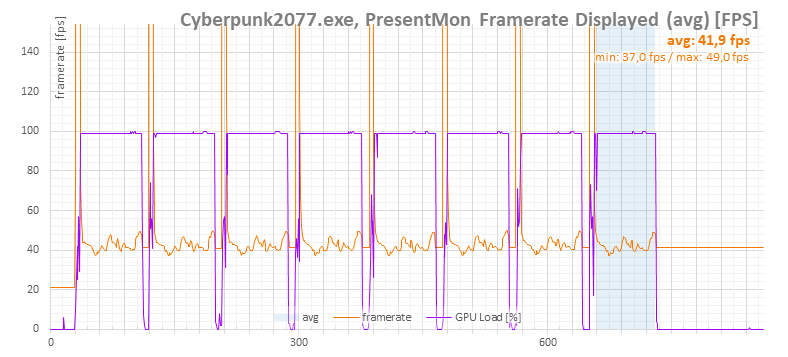
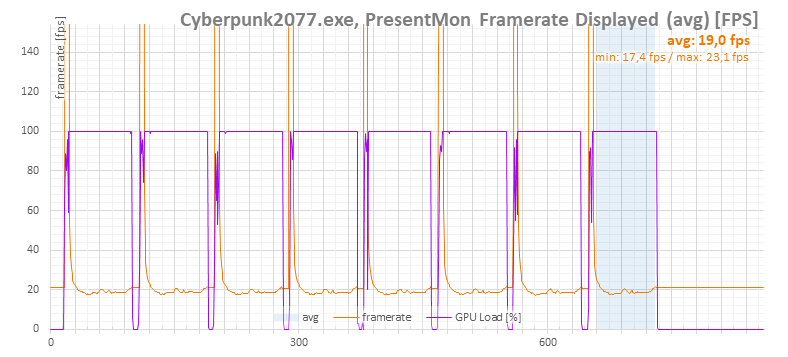
With the slightly lower GPU clock in Silent mode, the average performance differs only by tenths of a frame per second. The difference can be attributed more to normal measurement error than to the 10 MHz GPU clock drop.
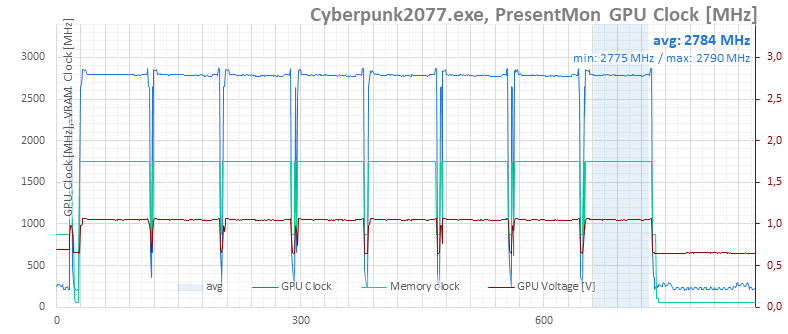
The average GPU clock dropped only slightly from 2794 to 2784 MHz. The minimum was 2775 MHz, the maximum 2790 MHz.
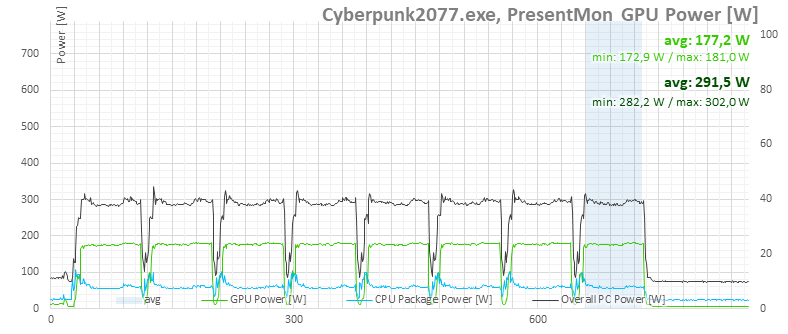
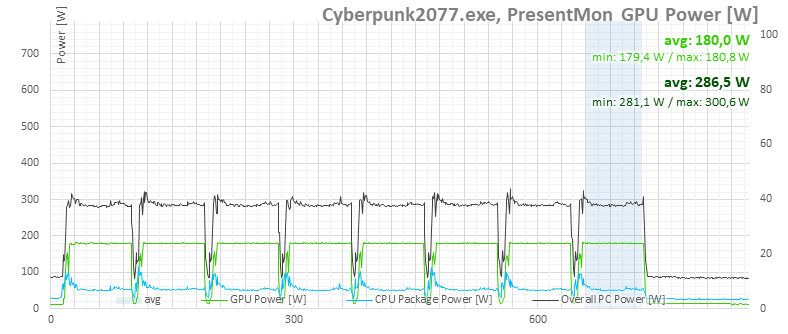
In the chart with power draw of the PC and of the card itself, no change is apparent, the monitored draw is again a few watts below the power limit.
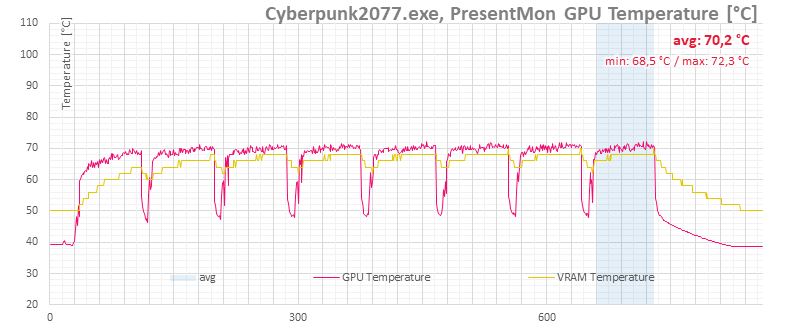
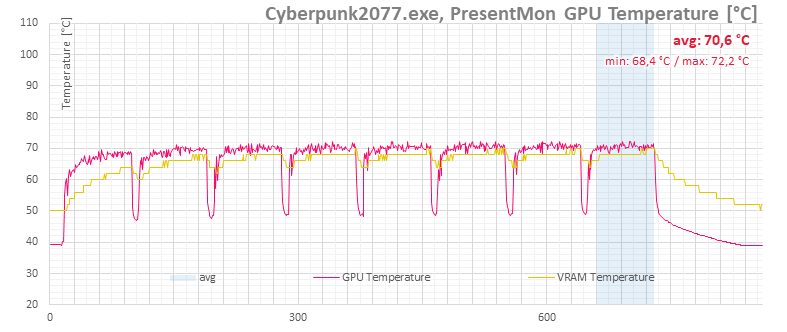
The warmed-up GPU temperature according to monitoring rose only a few degrees to a still low 72.3 °C, and the memory, peaking at 68 °C, is also doing very well.
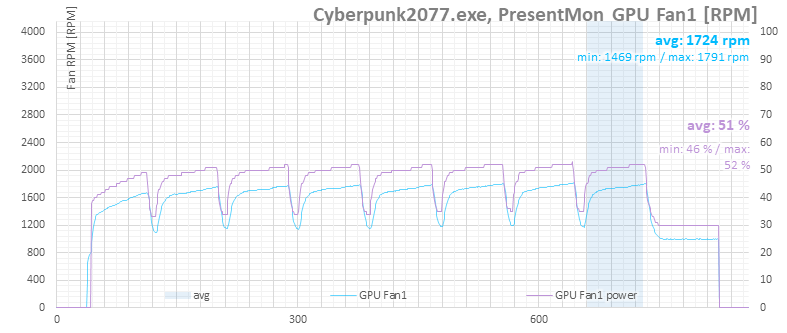
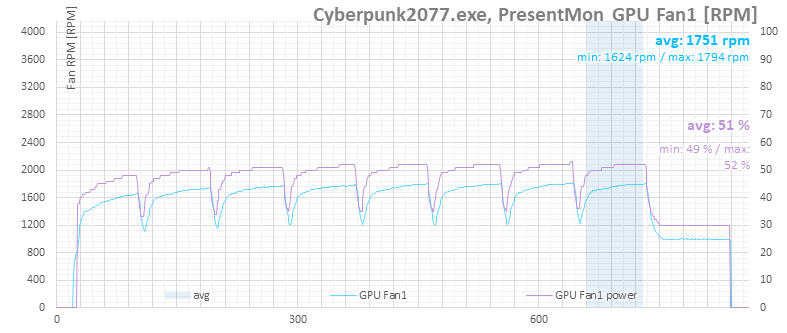
Fan speed dropped significantly, and with it card noise, with fans reaching 1790 RPM at peak.
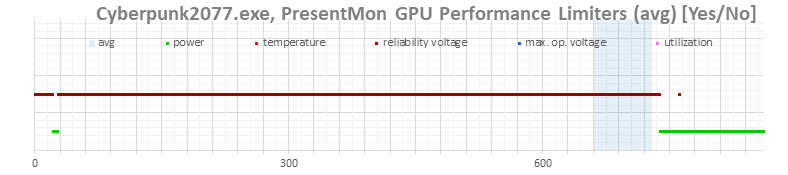
Again, the card lists reaching the set power limit as the reason for capping the clocks.
Cyberpunk 2077, RT Medium, 3840 × 2160 (Gaming)
or more powerful graphics cards I use Cyberpunk 2077 with RT Medium settings at 3840 × 2160 resolution for operating characteristic tests. For weaker cards it is not suitable, since with this setting they may not reach playable frame rates. For direct comparison though, I include results with the same setting at least in the form of graphs.


⠀