The ROG Strix GeForce RTX 5070 Ti 16GB OC Edition targets enthusiasts of premium products. It impresses with its refined design, significantly oversized cooling, and ARGB lighting that stands out in a glass case. Extras include headers for system fans and a fifth display output. It offers a Q mode for quiet cooling fans and gives tuners ample headroom for boosting performance and and fine-tune acoustics.
Fan behavior, noise level
Fan speeds can be set in the range of 30–100%. In Q mode, this corresponds to fan speeds ranging from approximately 500–3100 RPM (29.4–57.3 dBA). The fans likely weren’t perfectly quiet even at minimum speeds, probably due to the bearings, but this won’t be audible through the case.
At higher speeds, the noise level of the larger fans tends to fluctuate.

Cyberpunk 2077, RT Medium, 3840 × 2160 (P mode)
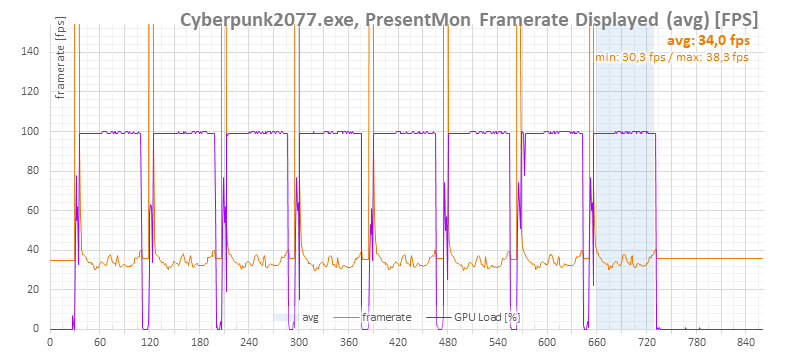
The first set of measurements is from the Cyberpunk 2077 benchmark with RT Medium settings at 3840 × 2160 resolution. This consists of eight consecutive benchmark runs. The graph always shows the last run, from which the average value for the warmed-up card is calculated.
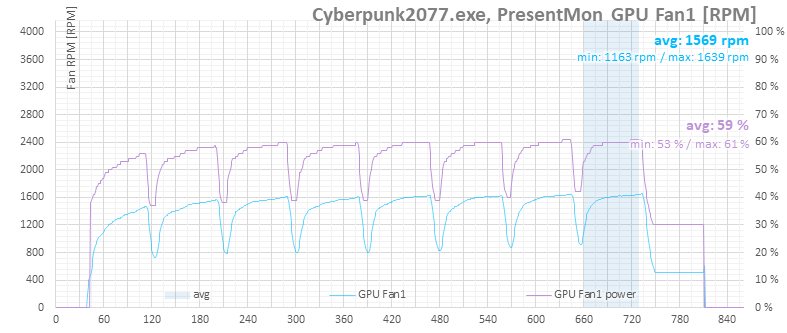
In Performance mode, after warming up, the fan speeds across tests ranged from 1640–1820 RPM, corresponding to a measured noise level of approx. 40–42.7 dBA. The card’s noise level is then only average, which is not what you want from a premium product.
In the quieter Q mode, the speeds ranged from 1280–1490 RPM, corresponding to 34–37.2 dBA. This also isn’t the result I would expect from the most expensive RTX 5070 Ti model—for example, the TUF RTX 5070 Ti had lower fan speeds and noise levels in the range of 32.8–34.7 dBA.
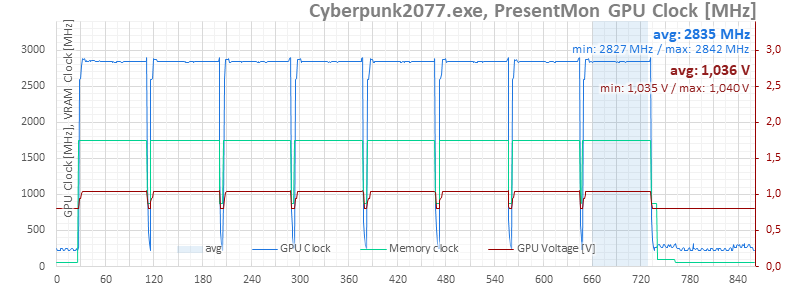
The chip is fully utilized in the test, but with the 320W BIOS, the clocks are limited more by voltage than by power.
The clock speed of the warmed-up GPU ranges between 2827 and 2842 MHz with an average of 2835 MHz.
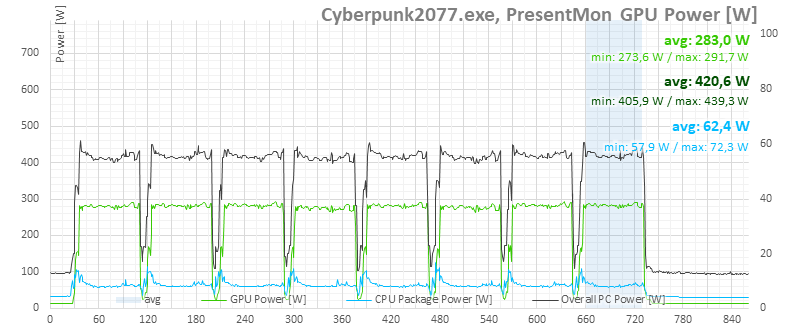
The card’s power draw according to monitoring (light green data series) ranged between 273.6 and 291.7 W with an average of 283 W. We’ve seen with many GeForce cards that even when the boost is power-limited, the power draw reported by monitoring can be lower. The total PC power draw averages 420.6 W.
Part of the power consumption evidently isn’t reflected in the monitoring, as the average value of 283 W is lower than that of the TUF RTX 5070 Ti, which averaged 295 W, yet the total PC power draw was lower at 416 W.
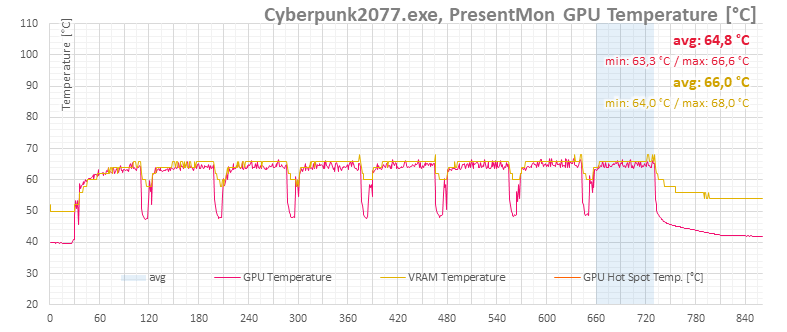
The average GPU temperature reached a maximum of 66.6 °C in the measured segment, with the memory at 68 °C. This is well below the thermal limits.
But this comes at the cost of higher noise level; with fans at 1640 RPM and 41.5 dBA, the card is only average.
The final graph, showing boost limit indicators, reveals why the clock speed difference isn’t that large even with a 20 W higher power limit—the card doesn’t hit the power limit as much, instead, the chip is hitting the long-term safe voltage limit.

⠀