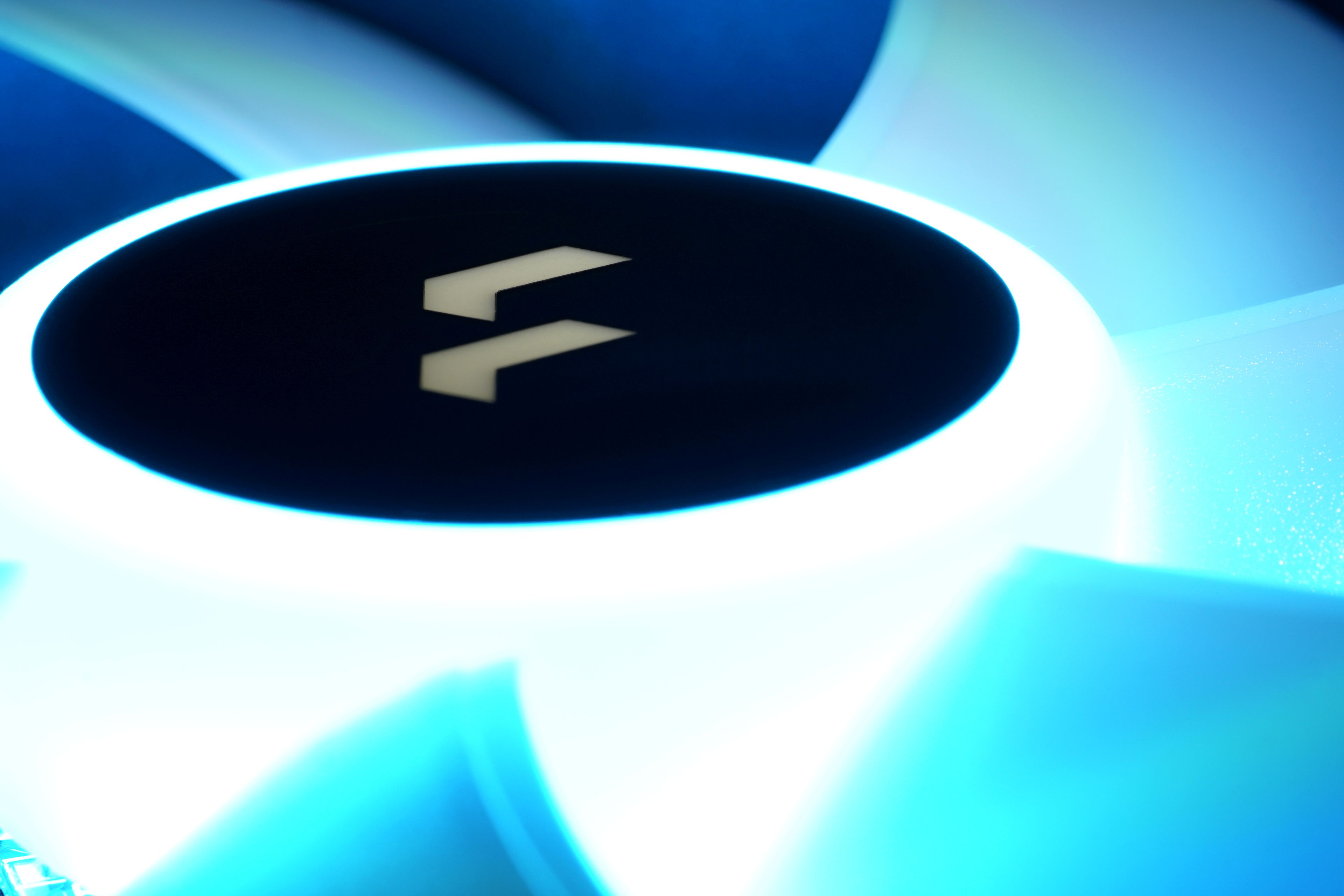
Sightly and efficient: the Fractal Design Aspect 12 RGB PWM test

An old-school rotor with one small aerodynamic tweak, the shortcomings of the Dynamic series of fans removed, and the addition of ARGB LED lighting. There are negatives too, but with the right application you can neatly avoid them. Overall, though, Fractal Design’s Aspects are functionally among the most feature-rich of what’s available in the current lineup of LED fans.

Results: Vibration, in total (3D vector length)

Explanatory note: We have already described how to measure the vibration intensity in the corresponding chapter within the testing methodology. However, it is worth emphasizing here what we mean by “cumulative vibration”. In order to be able to interpret the motion in the three axes (X, Y, Z) as simply as possible, with a single number, we consider the individual axes as vectors and calculate the so-called 3D vector from them. A more detailed account at the level of the individual axes is given in the next three chapters of this article.


Why is there a missing value sometimes? There may be more reasons. Usually it is because the fan could not be adjusted to the target noise level. Some have a higher minimum speed (or the speed is low, but the motor is too noisy) or it is a slower fan that will not reach the higher decibels. But the results in the graphs are also missing if the rotor is brushing against the nylon filter mesh. In that case, we evaluate this combination as incompatible. And zero in the graphs is naturally also in situations where we measure 0.00. This is a common occurrence at extremely low speeds with obstructions or within vibration measurements.

Contents

Arctic BioniX P12 A-RGB: Efficient, inexpensive, illuminated and…

And with very clever daisy‑chaining from one fan to the next. This is what can fill in the ellipsis in the headline. The aerodynamic efficiency remains top‑tier, built on a design that Arctic revised some time ago (with the P12 Pro fans), but which can still be considered “new.” The BioniX P12 A‑RGB fans certainly are (new), and in this in‑depth analysis we focus on how they work. Read more “Arctic BioniX P12 A-RGB: Efficient, inexpensive, illuminated and…” »

Contents

ID-Cooling AM-120-K: Bet on an Elegant Geometry

It has exactly the elements that make an inexpensive fan aerodynamically efficient and acoustically unobtrusive. Or rather, not too obtrusive—at least at lower, non‑high speeds. At higher speeds, every fan is “noisy,” but making a low‑cost fan that can still be described as pleasant to the ear is already something of a feat. We can, however, state that ID‑Cooling has achieved this with the AM‑120‑K model. Read more “ID-Cooling AM-120-K: Bet on an Elegant Geometry” »

Contents

BioniX (P) now with seven blades, smarter daisy-chaining

Arctic’s new BioniX fans, which adopt a seven-blade geometry, just like the “base” P1x A-RGB models, are nearing release. Based on the results of the older BioniX “P” fans, it can be assumed that aerodynamic efficiency will be higher this time. Alongside the fans, Arctic is also preparing a fan hub to which they can be connected. The method of daisy-chaining one fan to the next is innovative as well. Read more “BioniX (P) now with seven blades, smarter daisy-chaining” »

Contents

Leave a Reply

Your email address will not be published. Required fields are marked *