

The prices of the top-tier GeForce RTX 5090 cards are extremely high, so for most gamers, the GeForce RTX 5080 is likely the fastest graphics card they’re seriously considering. With no real alternatives nearby, the price range for the RTX 5080 varies widely. Premium models are pricey, and if you want more than a budget model, you’ll likely end up with a card like the TUF GeForce RTX 5080. Apparently, it should’ve been cheaper, but it’s still a safe bet.
A detailed description of the new technologies brought by Nvidia’s new graphics cards has been compiled by Jan Olšan in the article Blackwell: GeForce RTX 5000 architecture and innovations. It introduces the individual graphics chips Nvidia is using in the new cards, the new GDDR7 memory type, and also covers changes in cache memory, GPU compute units, updates to shaders and tensor cores, as well as improved compute units for ray tracing. The new generation of GeForce also brings support for new standards such as DisplayPort 2.1b and PCI Express 5.0.
With the new generation of cards, DLSS capabilities are evolving as well. It now supports Multi Frame Generation, which allows the generation of up to three intermediate frames, and introduces Nvidia Reflex 2, the second generation of its latency-reduction technology. This includes Frame Warp, which adjusts object and camera motion in rendered frames based on the player’s most recent input device movement data received just before the already rendered frame is displayed. A more detailed explanation can be found in the aforementioned article.
The GeForce RTX 5080 is not a new release – you may have already seen tests of several models on HWCooling:
- Nvidia GeForce RTX 5080 FE
- Asus ROG Astral GeForce RTX 5080 OC Ed.
- Gigabyte GeForce RTX 5080 Gaming OC
- MSI GeForce RTX 5080 Suprim SOC
Let me recap the basic specs – the RTX 5080 is the second most powerful model in the GeForce RTX 50 series. It uses the second-largest GB203 chip with a die size of 387 mm² and 45.6 billion transistors. The chip has 10,752 active stream processors, 336 texture units, and 112 raster units. For ray tracing calculations, there are 84 cores available, and for tensor operations, 336 cores. The chip’s base clock is 2295 MHz, with a boost clock of 2617 MHz, and the stated power limit for the card is 360 W. The RTX 5080 is equipped with 16 GB of GDDR7 memory running at 30 Gb/s, communicating with the chip over a 256-bit bus, offering a total bandwidth of 960 GB/s.
More detailed specifications will be added in a comparison table with the closest models.
| GeForce RTX 5090 | GeForce RTX 5080 | GeForce RTX 4090 | GeForce RTX 4080 Super | GeForce RTX 4080 | |
| Shader cores | Blackwell | Blackwell | Ada Lovelace | Ada Lovelace | Ada Lovelace |
| Nvidia CUDA cores (SP) | 21760 | 10752 | 16384 | 10240 | 9728 |
| Texture Mapping Units | 680 | 336 | 512 | 320 | 304 |
| Render Output Units | 176 | 128 | 176 | 112 | 112 |
| RT cores | 318 TFLOPS | 171 TFLOPS | 191 TFLOPS | 121 TFLOPS | 113 TFLOPS |
| Tensor Cores | 3352 AI TOPS | 1801 AI TOPS | 1321 AI TOPS | 836 AI TOPS | 780 AI TOPS |
| Boost Clock | 2.41 GHz | 2.62 GHz | 2.52 GHz | 2.55 GHz | 2.51 GHz |
| Base Clock | 2.10 GHz | 2.30 GHz | 2.23 GHz | 2.29 GHz | 2.21 GHz |
| Memory | 32 GB GDDR7 | 16 GB DDR7 | 24 GB GDDR6X | 16 GB GDDR6X | 16 GB GDDR6X |
| Memory Bus Width | 512-bit | 256-bit | 384-bit | 256-bit | 256-bit |
| Memory Bandwidth | 1792 GB/s | 960 GB/s | 1008 GB/s | 736 GB/s | 717 GB/s |
| Max. resolution | 4K at 480Hz or 8K at 120Hz with DSC | 4K at 480Hz or 8K at 120Hz with DSC | 4K at 240 Hz or 8K at 60 Hz with DSC, HDR | 4K at 240 Hz or 8K at 60 Hz with DSC, HDR | 4K at 240 Hz or 8K at 60 Hz with DSC, HDR |
| Standard Display Connectors | 3× DisplayPort, 1× HDMI | 3× DisplayPort, 1× HDMI | 3× DisplayPort, 1× HDMI | 3× DisplayPort, 1× HDMI | 3× DisplayPort, 1× HDMI |
| PCI Express | Gen 5 | Gen 5 | Gen 4 | Gen 4 | Gen 4 |
| Nvidia Encoder | 3× 9th gen | 2× 9th gen | 2× 8th gen | 2× 8th gen | 2× 8th gen |
| Nvidia Decoder | 2× 6th gen | 2× 6th gen | 1× 5th gen | 1× 5th gen | 1× 5th gen |
| length | 304 mm | 304 mm | 304 mm | 304 mm | 304 mm |
| width | 137 mm | 137 mm | 137 mm | 137 mm | 137 mm |
| height | 2-slot | 2-slot | 3-slot | 3-slot | 3-slot |
| Total Graphics Power | 575 W | 360 W | 450 W | 320 W | 320 W |
| Supplementary Power Connectores | 4× 8pin PCIe (adapter) or 1× 600 W PCIe Gen 5 | 3× 8pin PCIe (adapter) or 1× 450 W PCIe Gen 5 | 3× 8pin PCIe (adapter) or 1× 450 W PCIe Gen 5 | 3× 8pin PCIe (adapter) or 1× 450 W PCIe Gen 5 | 3× 8pin PCIe (adapter) or 1× 450 W PCIe Gen 5 |
Now let’s focus on the card from Asus.
Asus TUF Gaming GeForce RTX 5080 16GB GDDR7 OC Edition
(TUF-RTX5080-O16G-GAMING)
Asus offers the GeForce RTX 5080 in three product lines – Prime, TUF, and ROG Astral. Prime is the most affordable, TUF sits in the middle, and the ROG Astral models are premium-tier.

The card has two BIOS profiles. As usual, the base parameters such as GPU clock speeds or power limit are the same, differing only in the fan curve based on the card’s temperature. The power limit is set at the reference 360 W, and the stated boost gaming clock is factory-increased from 2617 to 2700 MHz. In practice, the actual gaming clocks are usually higher, with detailed tracking shown in the operating characteristics tests. We’ll start by examining the performance BIOS.

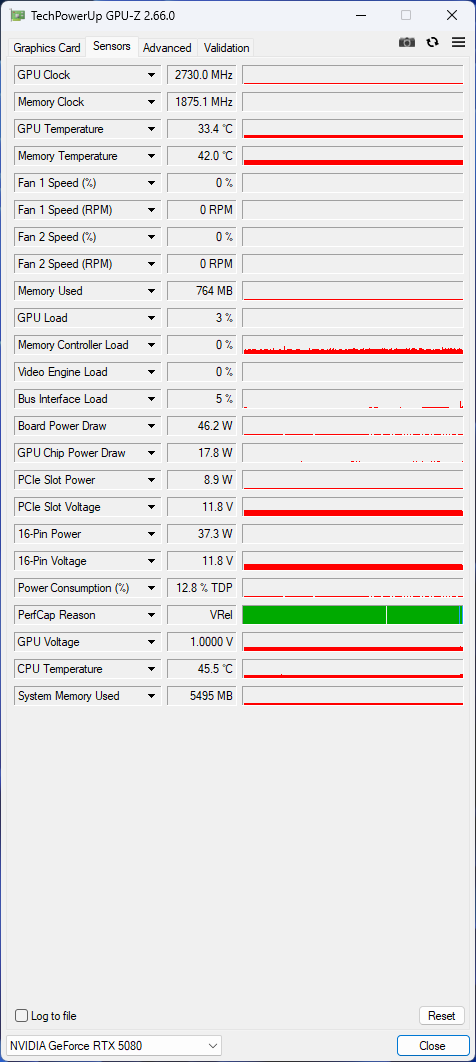
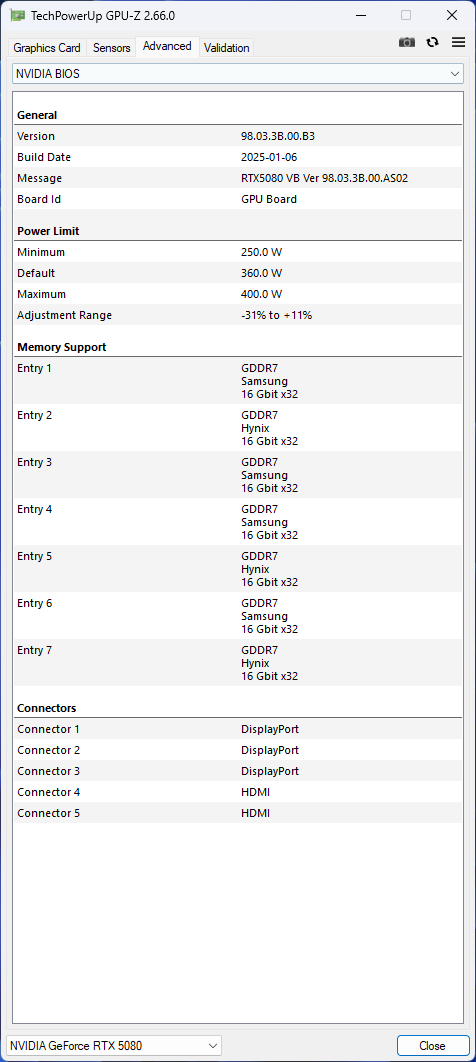
Monitoring lets you track basic parameters and sensors. Two connectors are available for the fans. These allow you to measure real-time RPMs and set performance. The fan near the bracket and the third fan at the rear are connected via a splitter to fan connector 1, while the middle fan is connected to fan connector 2. Their speeds are synchronized. The power limit can be adjusted in a range of -31% to +11%, which translates to 250 to 400 W.

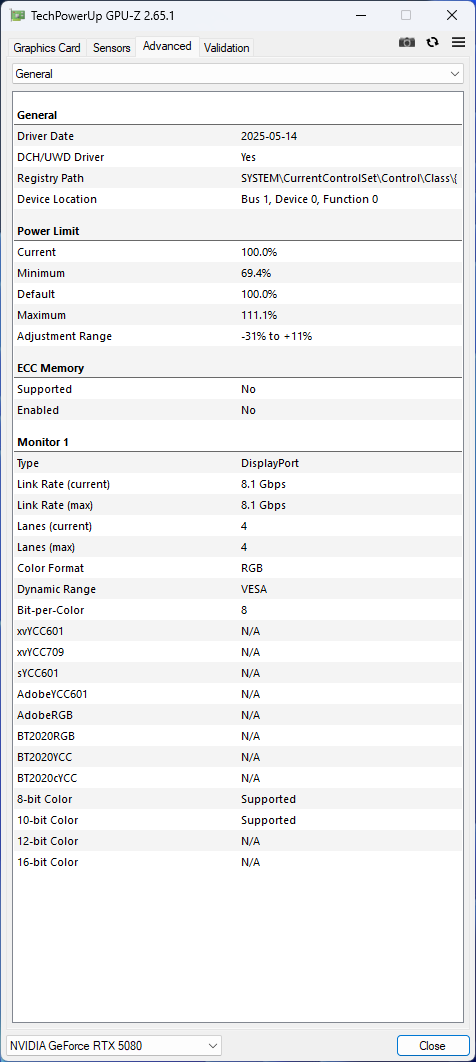
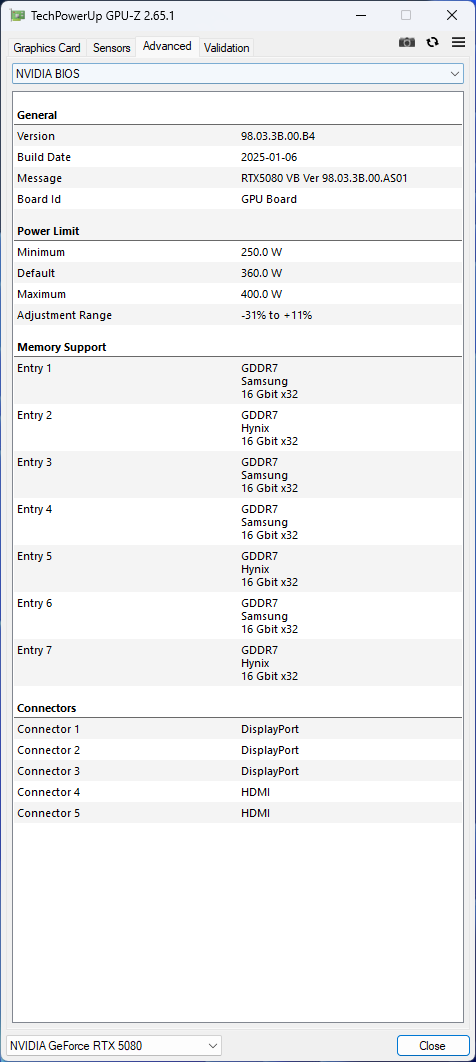
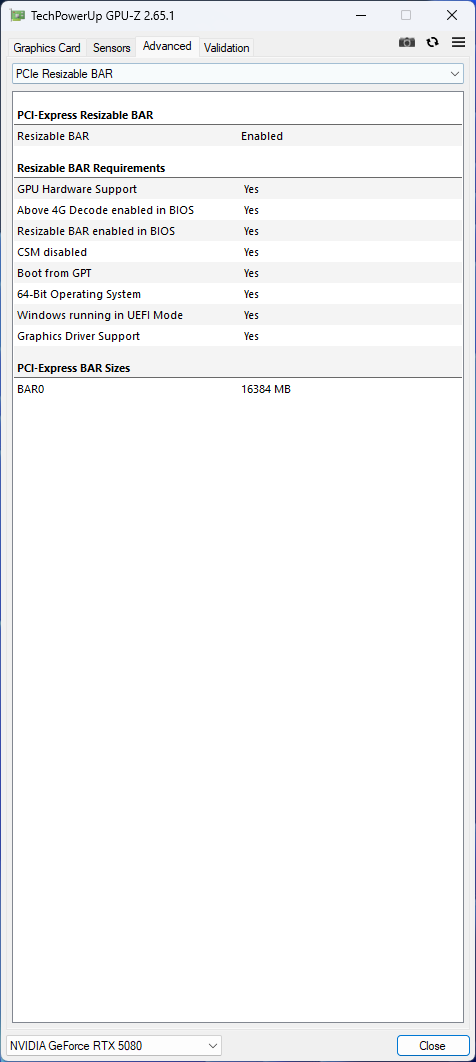
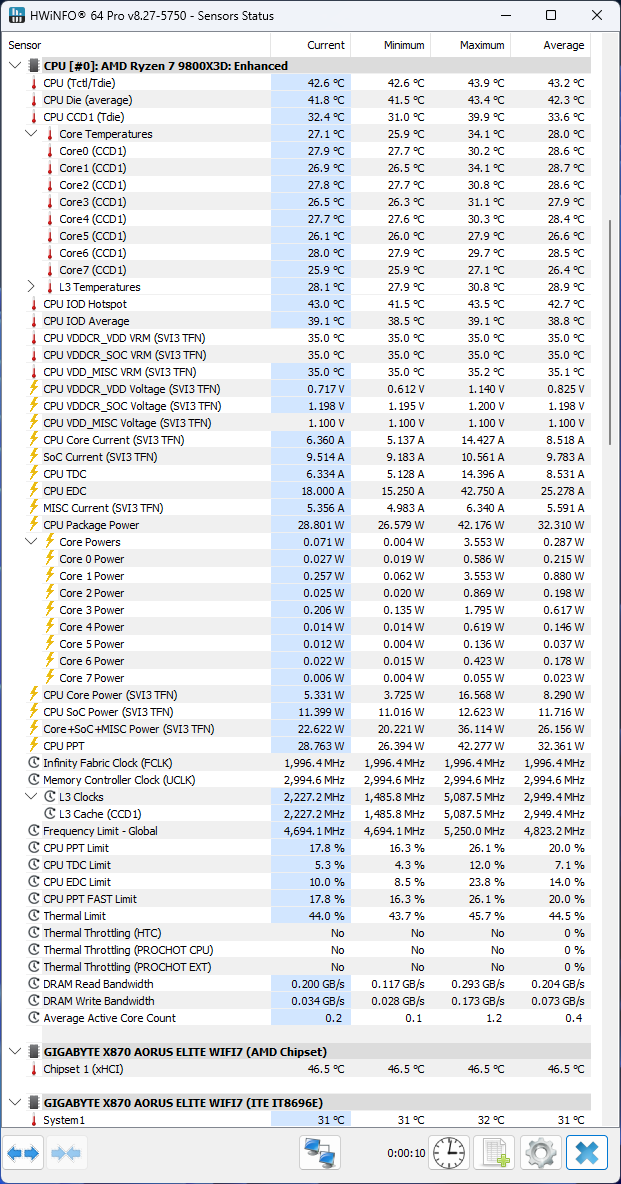
HWiNFO reads significantly more data from the card’s sensors than GPU-Z. The sensors available in the current version are shown in the screenshot below.
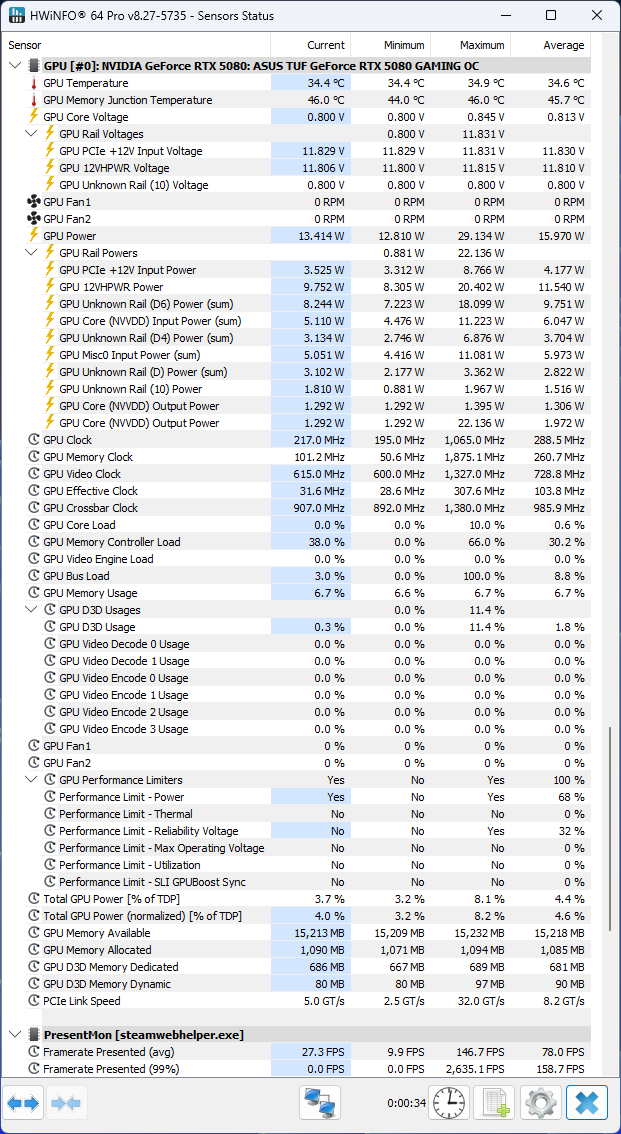
And below are also screenshots from the Quiet BIOS mode.



On the back of the packaging, the manufacturer presents the features and technologies used by the card. Components such as high-quality coils, MOSFETs, and capacitors, as well as proprietary Axial-tech fans with dual ball bearings, are aimed at improving the card’s lifespan. MaxContact is Asus’ designation for an ultra-flat base that improves contact with the chip and enhances heat dissipation. A metal frame reinforces the GPU and helps prevent cracking. A stainless steel bracket is also mentioned. Lastly, there’s Asus GPU Tweak III for adjustment of regulation settings, overclocking, and monitoring.


The accessories include a pile of manuals, leaflets, and cards. You’ll also find a Velcro cable tie, an adjustable GPU support bracket that doubles as a screwdriver, a magnetic TUF badge, and a power adapter.

⠀