




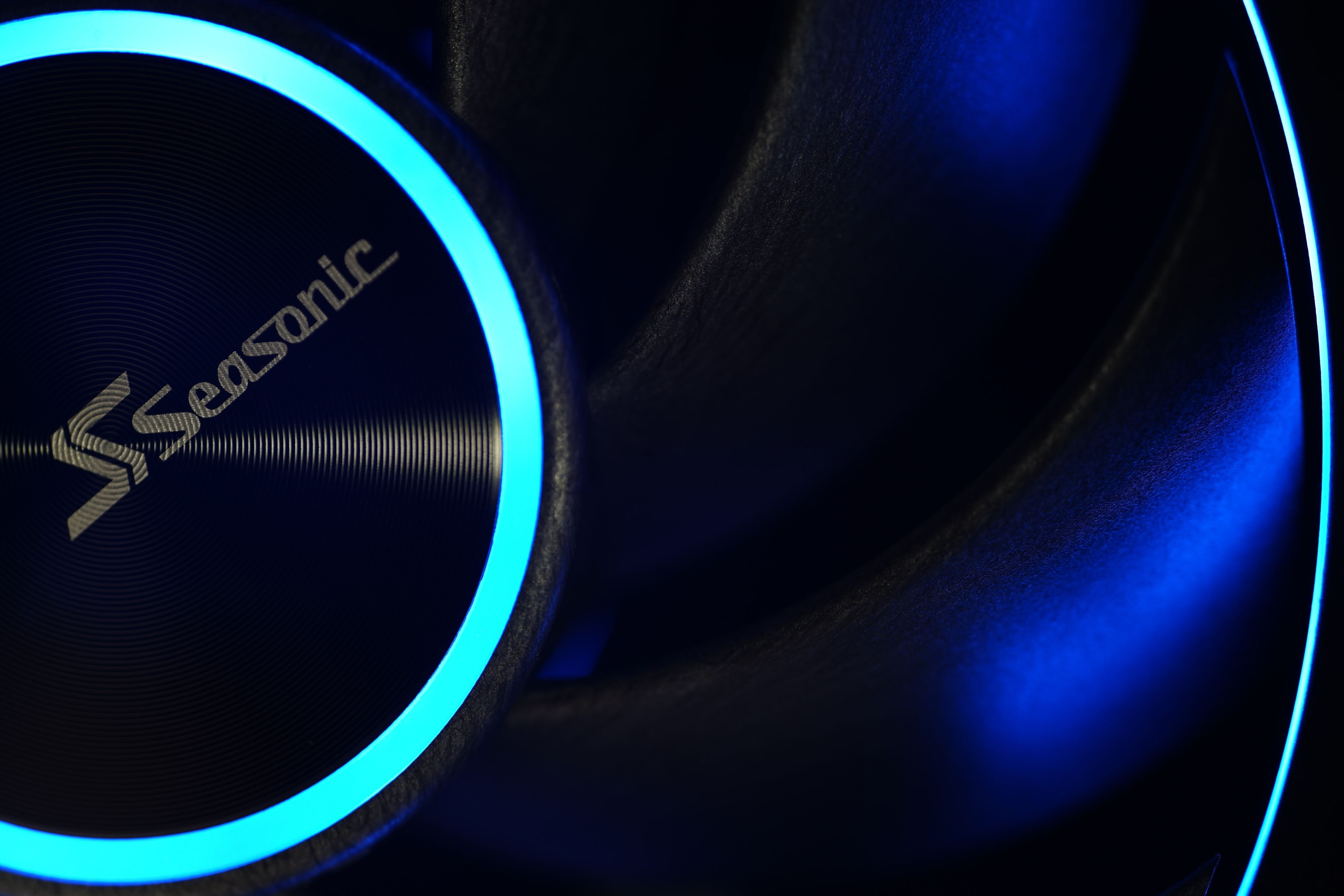
A concept in which an LCP impeller and ARGB LEDs meet is particularly rare. But it has enormous potential for achieving top-notch results. That is, as long as everything fits together optimally and there are no weak spots somewhere that increase the noise level. There are still a few things to tweak with the MagFlow ARGB fan, but already now, in its current form, it is a premium fan, and not only among lighted models.
The design of the MagFlow ARGB fan is truly rare considering it’s a lighted model. The unusualness lies in the combination of the very strong material (LCP) used to produce the impeller, with the LEDs. This is practically unheard of. The reasons for this include the inferior light-conducting properties compared to transparent polycarbonates. Seasonic has taken on this task – the implementation of ARGB LEDs in combination with LCP – quite elegantly and in an original way.
One lightguide lines the outside of the hub and the other extends along the inside of the stator tunnel. From there it softly lights the tips of the blades. Compared to conventional ring-light designs, in this case you do not perceive the light source points (individual LEDs) in the frontal view, but only a soft reflection. The luminosity is naturally lower to low even at maximum, don’t count on the case space being lit up too much, but some people may be comfortable with it just like this.
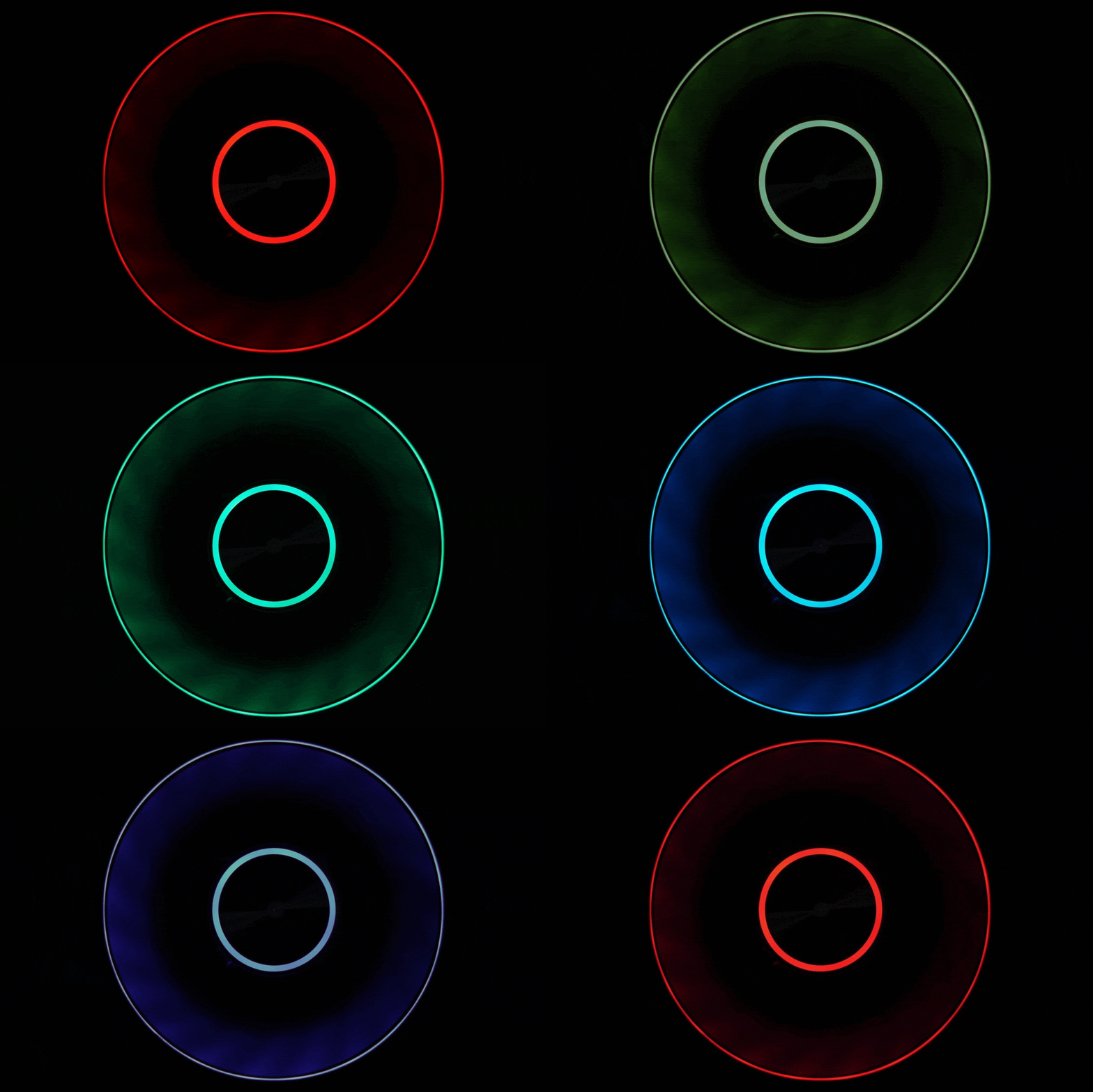
There’s also an ARGB LED fan with LCP blades from Thermaltake (Toughfan RGB), whose lightguides are across the entire surface of the frame. Who has done a better job, judge for yourself, that’s a subjective matter.
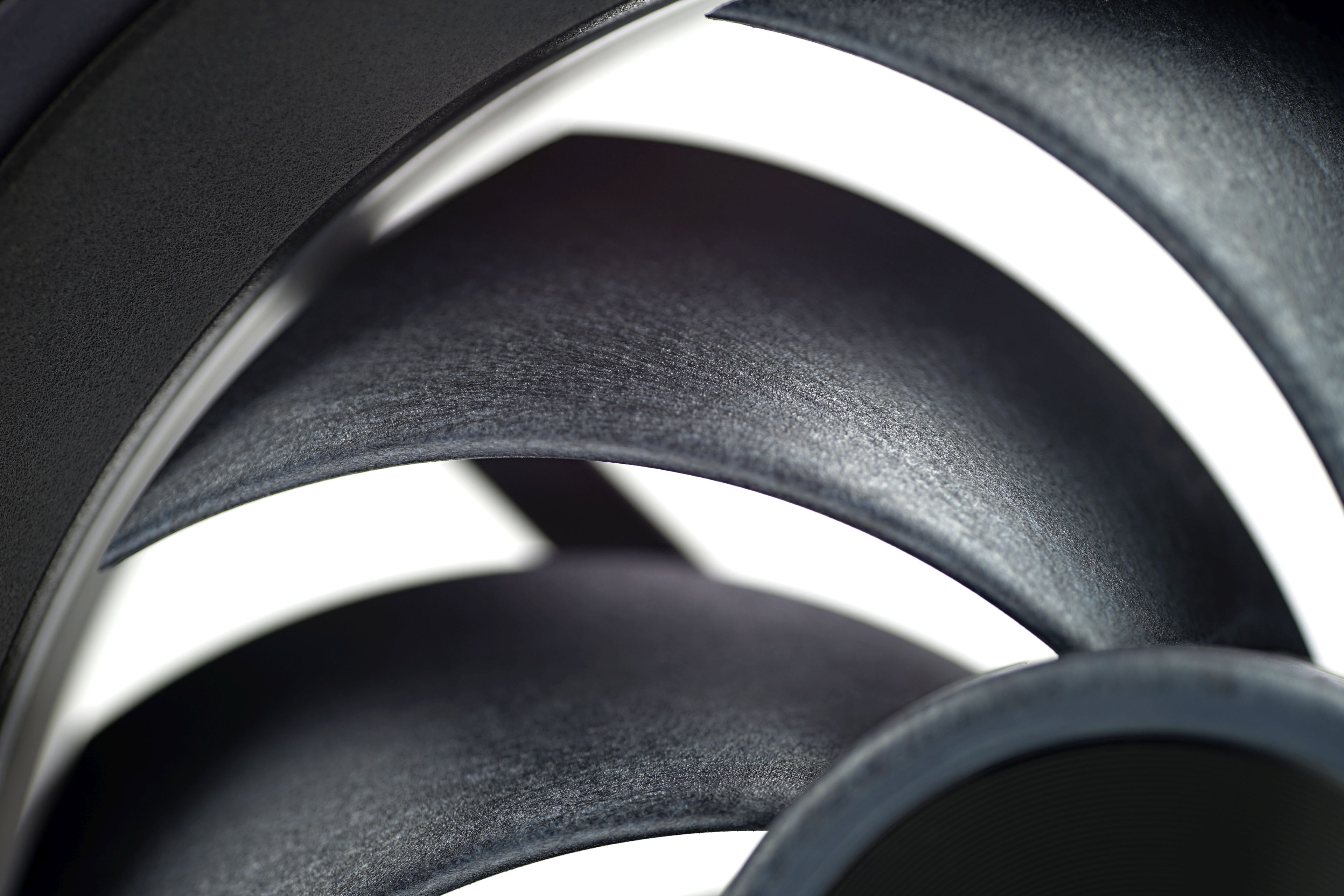
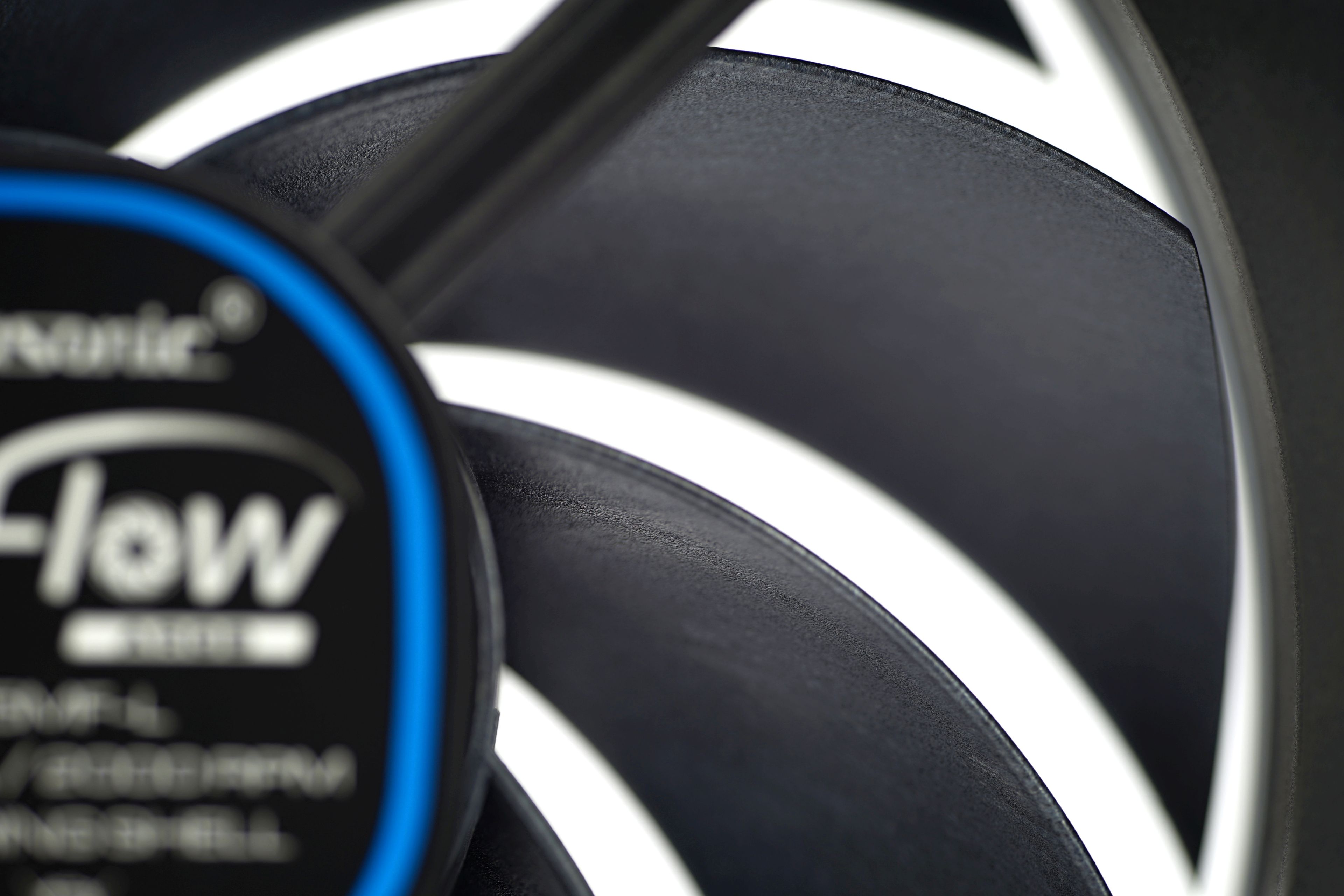
The advantage of LCP is its high rigidity and low thermal expansion. Even with relatively longer blades with more significantly curved leading edges, vibrations on the tips are minimal. This is also due to the extra thickness of the blades, which also increases the rigidity. The low vibration of the blades is also beneficial for acoustic reasons, avoiding secondary noise that results from unwanted resonant frequencies, whether from the fan itself or a case or a cooler that is affected by the fan.
A certain handicap of the MagFlow ARGB fan compared to designs with similar geometry is the smaller cross-section of the impeller. This is because of the relatively wide frames in which the LEDs are integrated. For comparison, the impeller footprint (approx. 8825 mm²) is approximately 13.5% smaller compared to, for example, the DeepCool FC120. And the MagFlow ARGB’s impeller even has a hair bigger hub (by the way, with a fancy metal cover grooved with concentric circles).
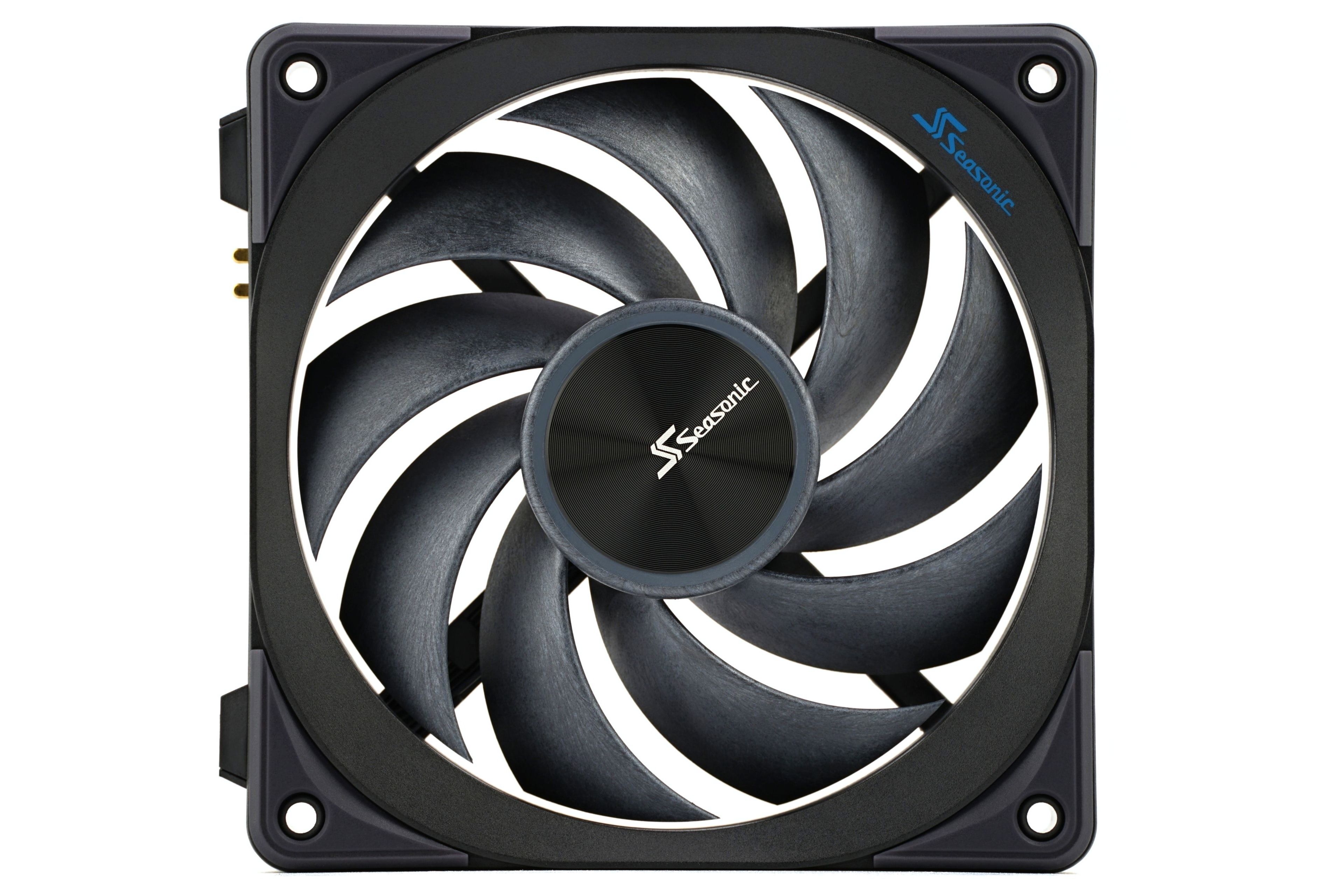
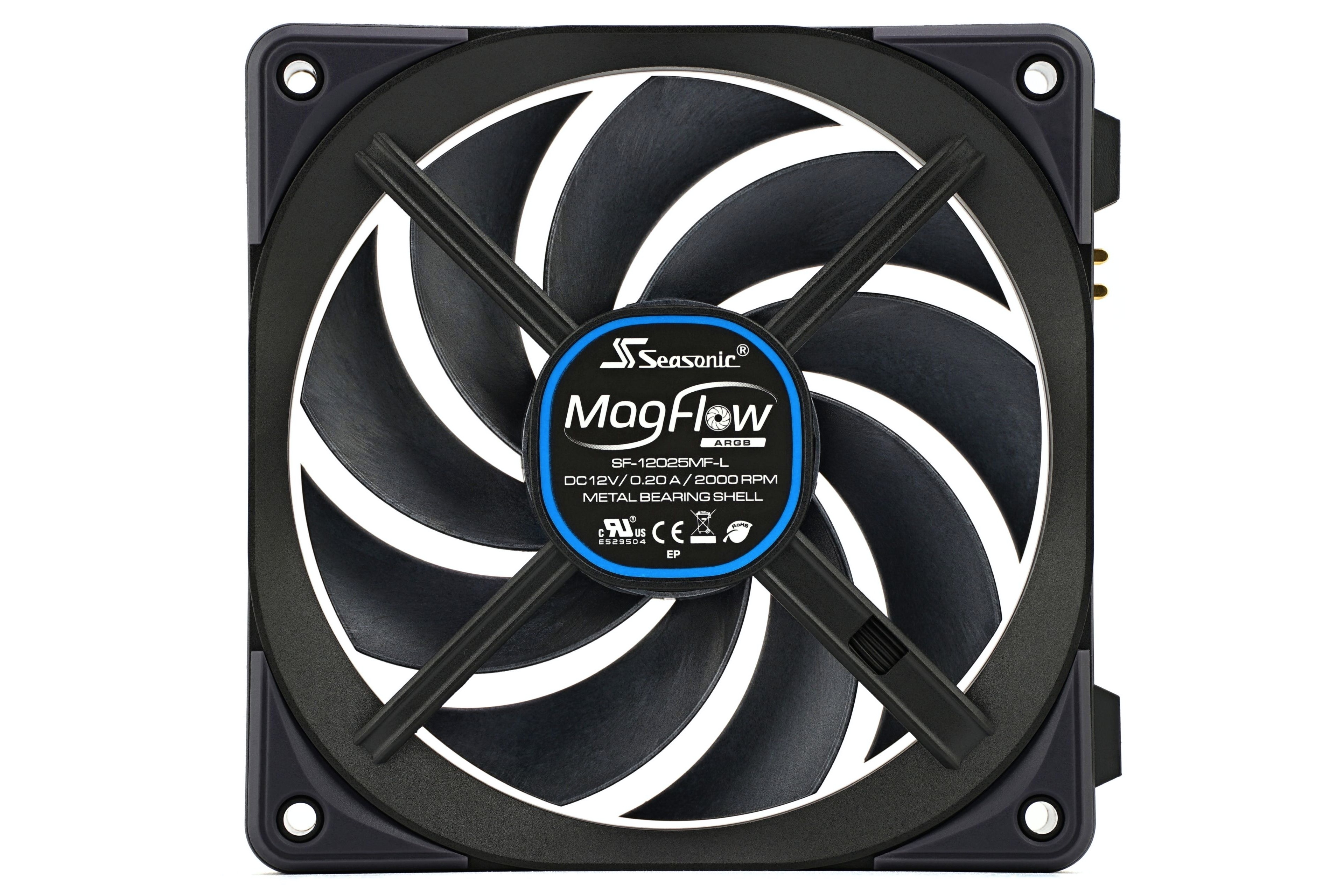
This doesn’t mean that the Seasonic fan can’t achieve comparable airflow, but it will require higher RPMs and higher noise levels in the aerodynamic noise band to do so.
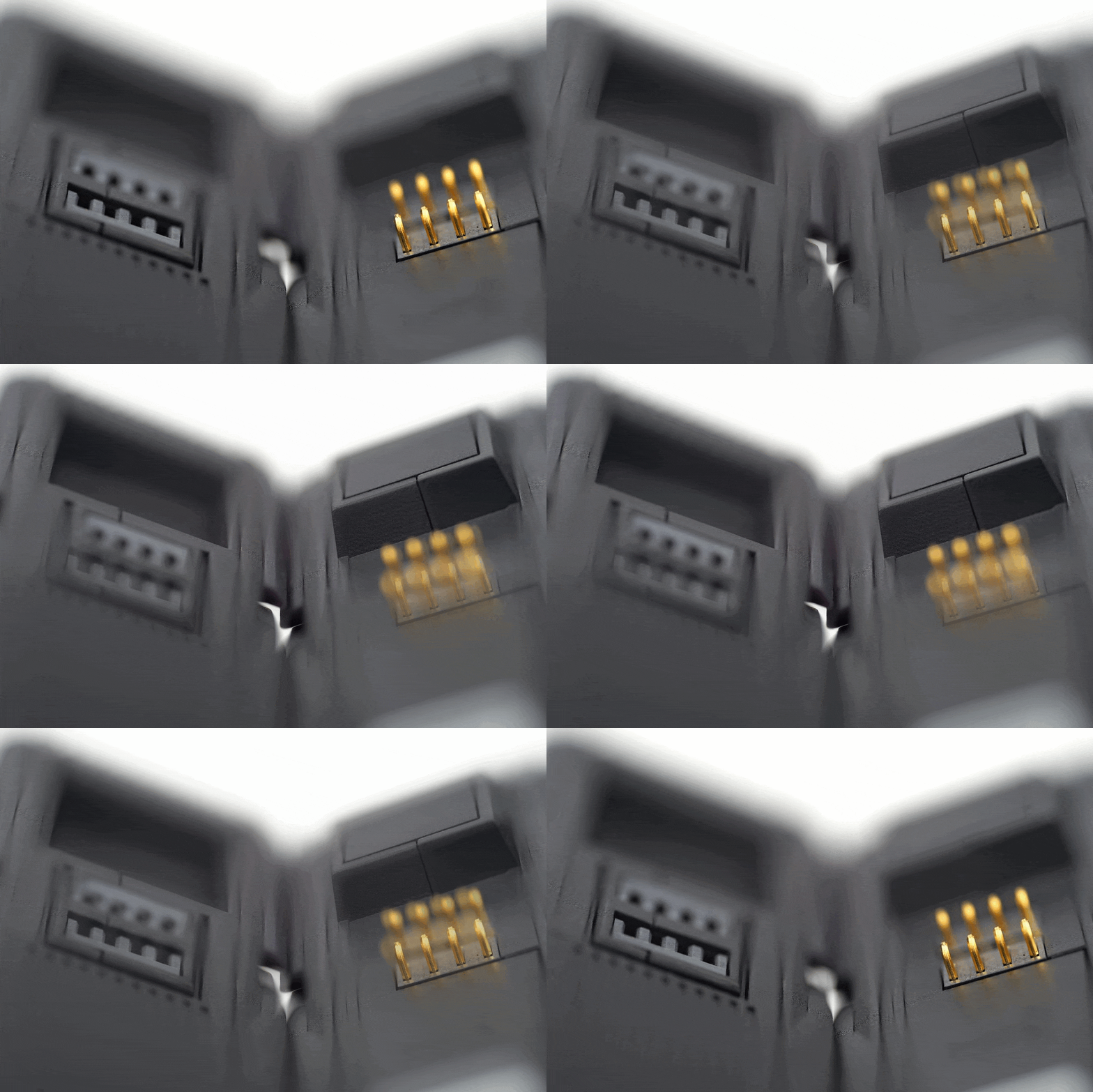
The advantage of the MagFlow ARGB is also its very easy daisy chaining in case you need multiple fans in a row (typically on radiators or in cases where one fan at the intake or exhaust is not enough). There are strong magnets protruding or recessed (depending on the side) in the corners of the frame to connect the fans. Mechanically. For electrical and data contact there are also contacts between magnets for the motor but also RGB. Then just connect one cable to the computer, from the outermost fan. This one is also modular.
Format-wise, the MagFlow is a 120-millimeter fan that Seasonic supplies in one piece (with an MSRP of 33.90 EUR), but also in 3-packs (99.90 EUR).
And one more thing: To navigate through the result graphs as easily as possible, you can sort the bars according to different criteria (via the button on the bottom left). By (non)presence of lighting, profile thickness, brand, bearings, price or value (with the option to change the sorting to descending or ascending). In the default settings, there is a preset “format” criterion that separates 120mm fans from 140mm fans.





Hmm, that’s worse than I thought for an LCP fan with Gentle Typhoon-like rotor, only trading blows with the much cheaper Arctic P12 ARGB. Perhaps the impeller footprint is the main culprit here, alongside the motor and bearing.
Comparison with the Grand Tornado would be interesting, as they represent two extremes of impeller footprint while having similar blade geometry.
Yes. Thank you for the heads-up, we have added one more negative to the +/- table, namely that the vibrations at some speeds are higher than they could be for the standards of LCP fans. There is probably some imperfection at the level of the bearings, for which this happens in combination with this impeller.
I have no doubt that the impeller itself will be well aligned and the fault will be elsewhere. At the same time, it won’t be some random thing, as these fans behave identically across different samples. It’s hard to say where exactly the weak point is, but maybe it could be suppressed or compensated for in some way. For example with balancing inserts, like the Phanteks T30. And maybe they wouldn’t help at all, there’s probably no point in speculating here and you just have to accept the fact that the vibrations can sometimes be higher for an LCP fan than one would expect.
Still, this is only Seasonic’s second fan and I have no doubt that with each new one more and more flaws will be removed and eventually the result will be very positive. We gave them a tip for an “Arctic P12 with an LCP impeller”. Personally, I would be very interested to see how such a design, with a very precise build, would stand up to, for example, the NF-A2x25 or the T30. I guess it might not be a bad thing, since even the P12, with its noisier low frequencies, which could be significantly suppressed after blade stiffening, ends up at the top of the performance charts. The question is whether with a significantly heavier impeller the small hub could be retained, as it could probably cause some instability.