




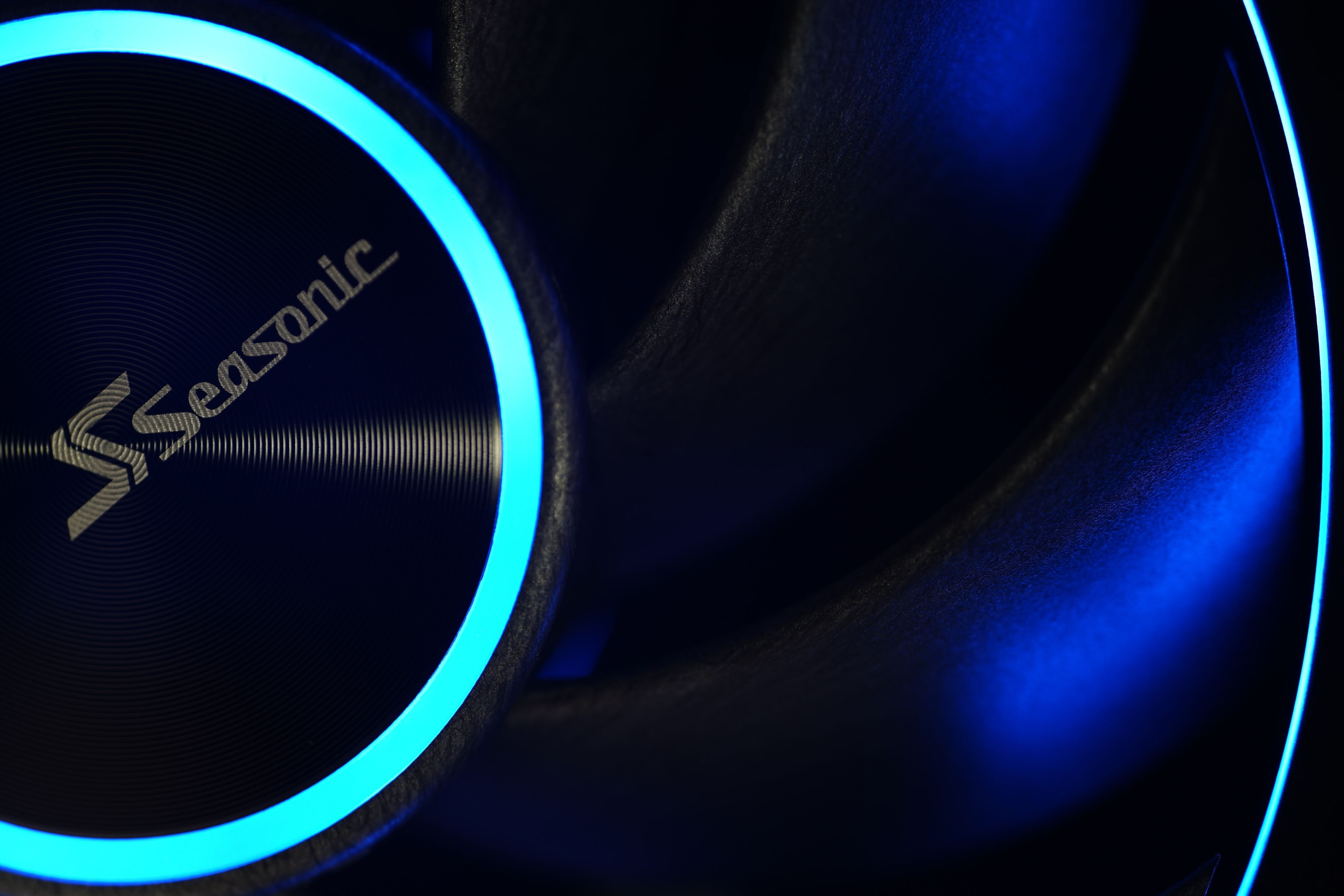
A concept in which an LCP impeller and ARGB LEDs meet is particularly rare. But it has enormous potential for achieving top-notch results. That is, as long as everything fits together optimally and there are no weak spots somewhere that increase the noise level. There are still a few things to tweak with the MagFlow ARGB fan, but already now, in its current form, it is a premium fan, and not only among lighted models.
| Brand and model of fan | Paper specicifations * | Price [EUR] | ||||||||
| Format (and thickness) in mm | Connecting | Speed [rpm] | Airflow [m3/h] | Static pressure [mm H2O] | Noise level [dBA] | Bearings | MTBF [h] | |||
| Motor | RGB LED | |||||||||
| Seasonic MagFlow ARGB | 120 (25) | 4-pin (PWM) | 3-pin (5 V) | 2000 | 84.05 | 2.28 | 30.2 | fluid | 100 000 | 34 |
| Noctua NF-A14 PWM | 140 (25) | 4-pin (PWM) | N/A | 1500 | 140.20 | 2.08 | 24.6 | SSO2 | 150 000 | 26 |
| BeQuiet! Pure Wings 3 (BL108) | 120 (25) | 4-pin (PWM) | N/A | 1200 | 97.50 | 0.96 | 21.9 | rifle | 80 000 | 15 |
| Endorfy Stratus 120 PWM | 120 (25) | 4-pin (PWM) | N/A | 200–1400 | N/A | N/A | N/A | fluid | 80 000 | 6 |
| Phanteks PH-F120T30 | 120 (30) | 4-pin (PWM) | N/A | 0–3000 | 171.40 | 7.11 | 39.7 | „dual vapo“ | 150 000 | 30 |
| BeQuiet! Light Wings White (BL101) | 120 (25) | 4-pin (PWM) | 3-pin (5 V) | 2500 | 88.86 | 2.60 | 31.0 | rifle | 60 000 | 23 ** |
| Scythe Kaze Flex II 120 | 120 (25) | 4-pin (PWM) | N/A | 300–2000 | 28.71–153.39 | 0.08–2.67 | 4.0–36.2 | fluid | 120 000 | 16 |
| Valkyrie X12 | 120 (25) | 4-pin (PWM) | 3-pin (5 V) | 800–2150 | 135.92 | 3.14 | 29.0 | fluid | 50 000 | 28 |
| Fractal Design Silent R3 140 mm | 140 (25) | 3-pin (DC) | N/A | 1000 | 95.31 | 0.87 | 21.6 | rifle | 40 000 | 12 |
| Arctic P12 PWM PST | 120 (25) | 4-pin (PWM) | N/A | 200–1800 | 95.65 | 2.20 | 10.6 | fluid | N/A | 6 |
| Cooler Master Mobius 120 OC | 120 (25) | 4-pin (PWM) | N/A | 0–3200 | 149.68 | 4.75 | 39.3 | ball | 200 000 | 32 |
| Corsair AF120 RGB Elite | 120 (25) | 4-pin (PWM) | 4-pin (5 V) iCUE | 550–2100 | 23.45–111.40 | 0.17–2.68 | 5.0–34.1 | fluid | N/A | 29 |
| Enermax SquA RGB White | 120 (25) | 4-pin (PWM) | 3-pin (5 V) | 300–1500 | 41,67–115,99 | 0.17–1.90 | 12.0–23.0 | N/A | 100 000 | 20 |
| Endorfy Fluctus 140 PWM | 140 (25) | 4-pin (PWM) | N/A | 250–1800 | N/A | N/A | N/A | fluid | 100 000 | 13 |
| Endorfy Fluctus 140 PWM ARGB | 140 (25) | 4-pin (PWM) | 3-pin (5 V) | 250–1800 | N/A | N/A | N/A | fluid | 100 000 | 17 |
| Arctic P12 PWM PST A-RGB | 120 (25) | 4-pin (PWM) | 3-pin (5 V) | 200–2000 | 82,91 | 1,85 | 10,6 | fluid | N/A | 14 |
| Scythe Kaze Flex II 120 Slim | 120 (25) | 4-pin (PWM) | N/A | 300–1800 | 13,86–81,55 | 0,05–1,36 | 2,6–27,8 | fluid | 120 000 | 17 |
| Seasonic MagFlow 1225 PWM | 120 (25) | 4-pin (PWM) | N/A | 600–2000 | 107.60 | 2.61 | 9.9–33.8 | fluid | 100 000 | 37 |
| Arctic P12 Slim PWM PST | 120 (15) | 4-pin (PWM) | N/A | 300–2100 | 71.53 | 1.45 | 10.6 | fluid | N/A | 7 |
| BeQuiet! Silent Wings Pro 4 (BL099) | 140 (25) | 4-pin (PWM) | N/A | 2400 | 165.50 | 3.64 | 36.8 | fluid | 300 000 | 33 |
| Fractal Design Prisma AL-14 PWM | 140 (25) | 4-pin (PWM) | 3-pin (5 V) | 500–1700 | 176.44 | 2.38 | 34.1 | sleeve | 100 000 | 21 |
| Gigabyte Aorus 140 ARGB | 140 (25) | 4-pin (PWM) | 3-pin (5 V) | 800–1700 | 51.48–103.03 | 0.59–2.18 | 8.9–35.8 | sleeve | 73 500 | 28 |
| BeQuiet! Light Wings (BL075) | 140 (25) | 4-pin (PWM) | 3-pin (5 V) | 2200 | 121.82 | 2.30 | 31.0 | rifle | 60 000 | 29 |
| Fractal Design Aspect 14 RGB PWM | 140 (25) | 4-pin (PWM) | 3-pin (5 V) | 500–1700 | 33.98–132.52 | 0.09–1.93 | 10.0–35.5 | rifle | 90 000 | 18 |
| DeepCool FK120 | 120 (25) | 4-pin (PWM) | N/A | 500–1850 | 117.21 | 2.19 | 28.0 | fluid | N/A | 11 |
| Asus TUF Gaming TF120 | 120 (25) | 4-pin (PWM) | 3-pin (5 V) | 1900 | 129.12 | 2.50 | 29.0 | fluid | 250 000 | 14 |
| BeQuiet! Light Wings (BL072) | 120 (25) | 4-pin (PWM) | 3-pin (5 V) | 1700 | 70.53 | 1.66 | 20.6 | rifle | 60 000 | 26 |
| DeepCool FC120 | 120 (25) | 6-pin (PWM) | 6-pin (5 V) | 500–1800 | 105.19 | 1.83 | 28.0 | hydrodynamic | N/A | 20 |
| Nidec Servo Gentle Typhoon D1225C (2150/12) | 120 (25) | 4-pin (PWM) | N/A | 2150 | 117.23 | 2.87 | 30.0 | ball | 100 000 | 20 |
| BeQuiet! Shadow Wings 2 (BL085) | 120 (25) | 4-pin (PWM) | N/A | 1100 | 65.41 | 0.82 | 15.9 | rifle | 80 000 | 15 |
| Noctua NF-A12x25 PWM | 120 (25) | 4-pin (PWM) | N/A | 450–2000 | 102.10 | 2.34 | 22.6 | SSO2 | 150 000 | 28 |
| Corsair AF120 Elite (black) | 120 (25) | 4-pin (PWM) | N/A | 400–1850 | 18.52–100.41 | 0.09–1.93 | 31.5 | fluid | N/A | 24 |
| Cooler Master MasterFan SF120M | 120 (25) | 4-pin (PWM) | N/A | 650–2000 | 105.33 | 2.40 | 5.5–22.0 | ball | 280 000 | 33 |
| Akasa Alucia SC12 | 120 (25) | 4-pin (PWM) | N/A | 500–2000 | 95.65 | 1.94 | 33.1 | hydrodynamic | N/A | 12 |
| BeQuiet! Silent Wings Pro 4 (BL098) | 120 (25) | 4-pin (PWM) | N/A | 3000 | 142.50 | 5.31 | 36.9 | fluid | 300 000 | 32 |
| Thermalright X-Silent 120 | 120 (25) | 3-pin (DC) | N/A | 1000 | 61.31 | N/A | 19.6 | fluid | 50 000 | 5 |
| Fractal Design Aspect 12 RGB PWM | 120 (25) | 4-pin (PWM) | 3-pin (5 V) | 500–2000 | 22.09–95.14 | 0.23–2.34 | 10.0–33.2 | rifle | 90 000 | 16 |
| BeQuiet! Silent Wings 3 (BL066) | 120 (25) | 4-pin (PWM) | N/A | 1450 | 85.80 | 1.79 | 16.4 | fluid | 300 000 | 21 |
| Gelid Zodiac | 120 (25) | 4-pin (PWM) | 3-pin (5 V) | 700–1600 | 111.29 | 1.47 | 35.0 | hydrodynamic | N/A | 10 |
| Fractal Design Dynamic X2 GP-12 PWM | 120 (25) | 4-pin (PWM) | N/A | 500–2000 | 148.83 | 0.51–2.30 | 10.0–32.2 | rifle | 100 000 | 12 |
| BeQuiet! Pure Wings 2 (BL039) | 120 (25) | 4-pin (PWM) | N/A | 1500 | 87.00 | 1.25 | 19.2 | rifle | 80 000 | 11 |
| Gigabyte Aorus 120 ARGB | 120 (25) | 4-pin (PWM) | 3-pin (5 V) | 800–1700 | 31.47–69.40 | 0.37–1.48 | 7.3–28.6 | sleeve | 73 500 | 25 |
| Arctic BioniX P120 A-RGB | 120 (30) | 4-pin (PWM) | 3-pin (5 V) | 400–2300 | 81.55 | 2.10 | 33.4 | fluid | N/A | 21 |
| Akasa OTTO SF12 | 120 (25) | 4-pin (PWM) | N/A | 0–2000 | 164.84 | 3.59 | 7.1–31.7 | ball | 80 000 | 22 |
| Cooler Master SickleFlow 120 ARGB | 120 (25) | 4-pin (PWM) | 3-pin (5 V) | 680–1800 | 105.34 | 2.50 | 8.0–27.0 | rifle | 160 000 | 15 |
| Alphacool SL-15 PWM | 120 (15) | 4-pin (PWM) | N/A | 600–1800 | 71.40 | 1.20 | 32.0 | ball | 50 000 | 11 |
| Arctic BioniX F120 | 120 (25) | 4-pin (PWM) | N/A | 200–1800 | 117.00 | 2.10 | 20.0 | fluid | N/A | 10 |
| SilverStone SST-AP123 | 120 (25) | 3-pin (DC) | N/A | 1500 | 96.84 | 1.46 | 23.8 | fluid | 50 000 | 25 |
| Noctua NF-P12 redux-1700 PWM | 120 (25) | 4-pin (PWM) | N/A | 400–1700 | 120.20 | 2.83 | 25.1 | SSO | 150 000 | 13 |
| SilentiumPC Fluctus 120 PWM | 120 (25) | 4-pin (PWM) | N/A | 300–1800 | N/A | N/A | N/A | fluid | 100 000 | 12 |
| MSI MEG Silent Gale P12 | 120 (25) | 4-pin (PWM) | N/A | 0–2000 | 95.48 | 2.21 | 22.7 | hydrodynamic | 50 000 | 31 |
| Asus ROG Strix XF120 | 120 (25) | 4-pin (PWM) | N/A | 1800 | 106.19 | 3.07 | 22.5 | „MagLev“ | 400 000 | 23 |
| Akasa Vegas X7 | 120 (25) | 4-pin (PWM) | 4-pin (12 V) | 1200 | 71.19 | N/A | 23.2 | fluid | 40 000 | 11 |
| Reeven Coldwing 12 | 120 (25) | 4-pin (PWM) | N/A | 300–1500 | 37.54–112.64 | 0.17–1.65 | 6.5–30.4 | sleeve | 30 000 | 12 |
| Asus ROG Strix XF120 | 120 (25) | 4-pin (PWM) | nemá | 1800 | 106,19 | 3,07 | 22,5 | „MagLev“ | 400 000 | 23 |
| Akasa Vegas X7 | 120 (25) | 4-pin (PWM) | 4-pin (12 V) | 1200 | 71,19 | N/A | 23,2 | fluidné | 40 000 | 11 |
| Reeven Coldwing 12 | 120 (25) | 4-pin (PWM) | nemá | 300–1500 | 37,54–112,64 | 0,17–1,65 | 6,5–30,4 | klzné | 30 000 | 12 |
| Reeven Kiran | 120 (25) | 4-pin (PWM) | zdieľané | 400–1500 | 110,10 | 2,95 | 33,6 | fluidné | 120 000 | 17 |
| SilentiumPC Sigma Pro 120 PWM | 120 (25) | 4-pin (PWM) | nemá | 500–1600 | 79,00 | N/A | 15,0 | hydraulické | 50 000 | 7 |
| SilentiumPC Sigma Pro Corona RGB 120 | 120 (25) | 4-pin (PWM) | 4-pin (12 V) | 1500 | 56,58 | N/A | N/A | hydraulické | 50 000 | 12 |
| SilverStone SST-AP121 | 120 (25) | 3-pin (DC) | nemá | 1500 | 60,08 | 1,71 | 22,4 | fluidné | 50 000 | 18 |
| SilverStone SST-FQ121 | 120 (25) | 7-pin (PWM) | nemá | 1000–1800 | 114,68 | 0,54–1,82 | 16,4–24,0 | fluidné | 150 000 | 20 |
| Xigmatek XLF-F1256 | 120 (25) | 3-pin (DC) | nemá | 1500 | 103,64 | N/A | 20,0 | rifle | 50 000 | 16 |
* When reading performance values, a certain amount of tolerance must always be taken into account. For maximum speeds, ±10 % is usually quoted, minimum speeds can vary considerably more from piece to piece, sometimes manufacturers will overlap by as much as ±50 %. This must then also be adequately taken into account for air flow, static pressure and noise levels. If only one value is given in a table entry, this means that it always refers to the situation at maximum speed, which is achieved at 12 V or 100 % PWM intensity. The manufacturer does not disclose the lower limit of the performance specifications in its materials in that case. The price in the last column is always approximate.
** Price calculated per unit, but the fan is not sold separately. It is only available as part of a three-pack that also includes an ARGB hub.




Hmm, that’s worse than I thought for an LCP fan with Gentle Typhoon-like rotor, only trading blows with the much cheaper Arctic P12 ARGB. Perhaps the impeller footprint is the main culprit here, alongside the motor and bearing.
Comparison with the Grand Tornado would be interesting, as they represent two extremes of impeller footprint while having similar blade geometry.
Yes. Thank you for the heads-up, we have added one more negative to the +/- table, namely that the vibrations at some speeds are higher than they could be for the standards of LCP fans. There is probably some imperfection at the level of the bearings, for which this happens in combination with this impeller.
I have no doubt that the impeller itself will be well aligned and the fault will be elsewhere. At the same time, it won’t be some random thing, as these fans behave identically across different samples. It’s hard to say where exactly the weak point is, but maybe it could be suppressed or compensated for in some way. For example with balancing inserts, like the Phanteks T30. And maybe they wouldn’t help at all, there’s probably no point in speculating here and you just have to accept the fact that the vibrations can sometimes be higher for an LCP fan than one would expect.
Still, this is only Seasonic’s second fan and I have no doubt that with each new one more and more flaws will be removed and eventually the result will be very positive. We gave them a tip for an “Arctic P12 with an LCP impeller”. Personally, I would be very interested to see how such a design, with a very precise build, would stand up to, for example, the NF-A2x25 or the T30. I guess it might not be a bad thing, since even the P12, with its noisier low frequencies, which could be significantly suppressed after blade stiffening, ends up at the top of the performance charts. The question is whether with a significantly heavier impeller the small hub could be retained, as it could probably cause some instability.