


The culmination of our trilogy of tests of Arctic’s 140mm fans is here. With the P14 Max, the designers have worked on improvements that change both the acoustic properties and performance of the fan. The main new feature, the hoop, allows for, among other things, a significant speed increase, due to which this fan can have a really high airflow. On the other hand, fans of extra low speeds will not be too pleased.
Initial warm-up…
Before we even start measuring anything, we let the fans run “idle” for a few minutes after plugging them in. This is because immediately after a cold start the fans reach different parameters than after a certain amount of short-term operation.
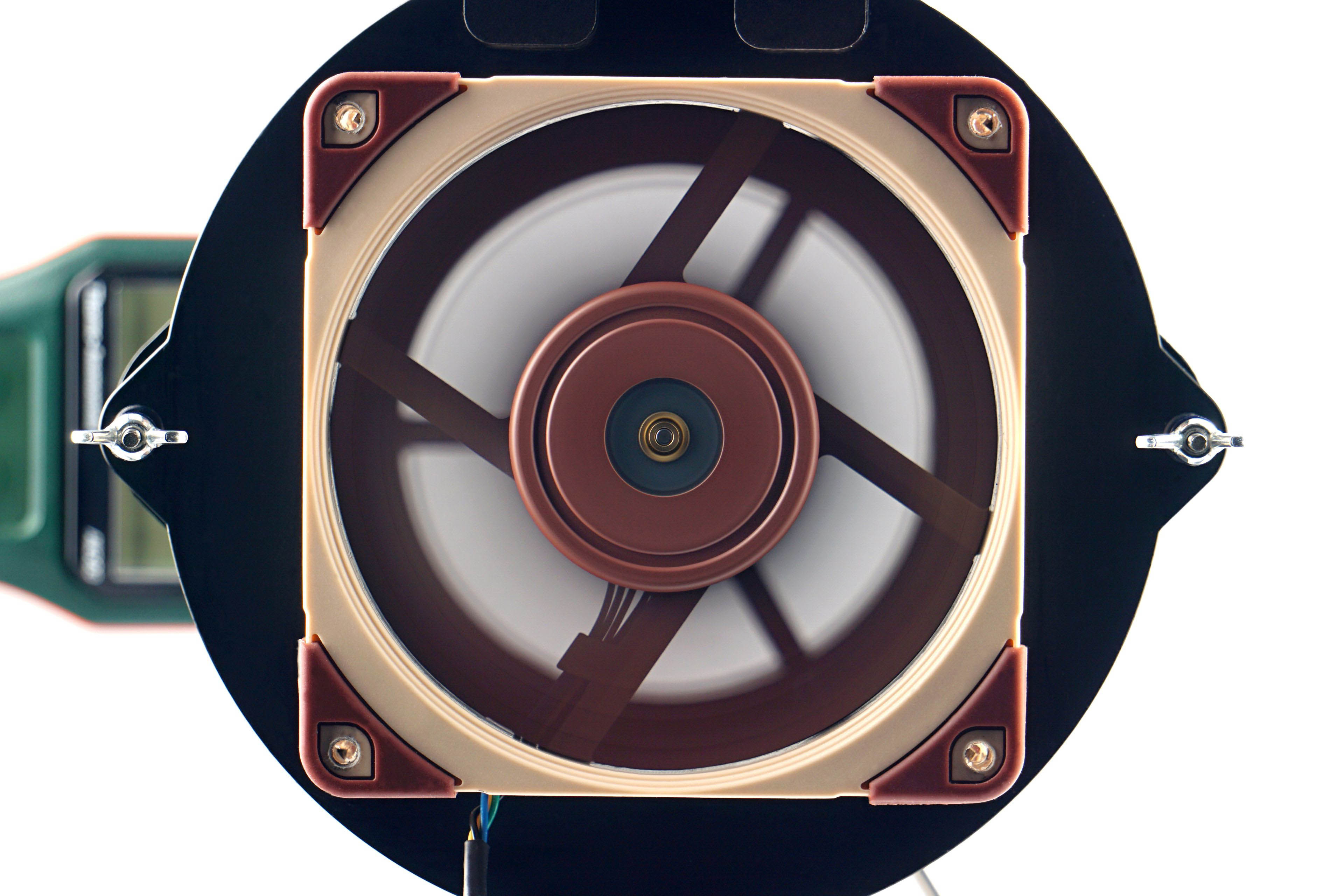
Until the operating temperature of the lubricant is stabilized, a typically lower maximum performance is achieved. This is because at lower temperatures the lubricant is denser, which is associated with higher friction. Therefore, the fans do not reach maximum speed immediately, but only after the first few seconds. Before the first measurements, we therefore leave the fans running for at least 300 seconds at 12 V, or 100 % PWM intensity.
…and speed recording
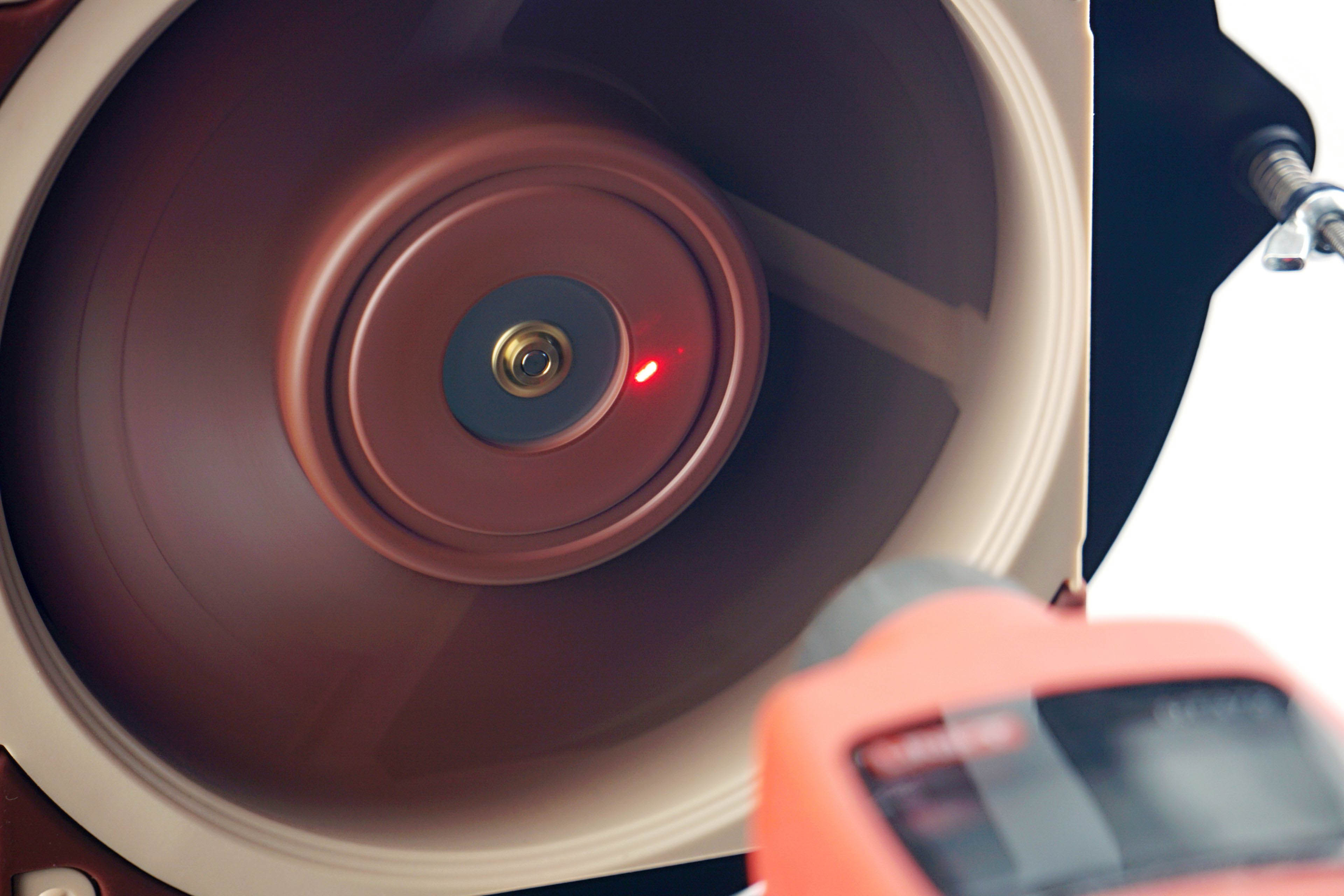
The speed of the fans is monitored using a laser tachometer, which reads the number of revolutions from a reflective sticker on the impeller. For this purpose, we use the UNI-T UT372 device, which also allows real-time averaging of samples. Thus, we do not record the peak value in the graphs, but the average speed value from a 30-second time period.
However, the speed itself is a relatively unimportant parameter that is often given more attention than is appropriate. This is the case even in many fan or cooler tests, where speed is used to normalize the different modes in which other variables are measured.
However, hyper-focusing on a specific speed is a rather unfortunate decision if only because the fans don’t gain any commonality. At the same speed all other variables are different, there is no intersection. It can be noted that a better normalization would have been by any other variable, whether it be static pressure, flow or noise level, which wins in our case. But more on that in the next chapter.
We only measure the speed so that you can associate a particular parameter (such as the amount of static pressure or some noise level) with something according to which you can adjust the fan yourself. Perhaps for that alone, the information about the achieved speed is useful. As part of the fan analysis, we will also indicate what the fans’ starting and minimum speeds are. Start-up speeds tend to be higher than minimum speeds because more force is required to get the impeller moving than once the fan impeller is spinning, and a minimum power intensity is sought at which the fan does not stall.




Really, really interesting results.
I have heard that the P14 max suffers from motor noises, but it’s clear now that it’s only at <900 RPM where it's unstable.
The outer ring having almost no impact on noise profile is very surprising. Well, at least in the no obstacles environment. The huge impact of the ring on noise profile on radiators, despite having no effect otherwise, is even more surprising. Perhaps the back pressure cause deformation of the blades or something like that?
P.S. The links to radiator frequency plots are broken in the English version.
Thanks, fixed! 🙂
From the measurements on the fan frame, we know that the P14 Max is not a source of significant vibrations even at medium speeds, and yet the tonal peaks at low sound frequencies are quite high. We can assume that the vibrations on the blades will also be very weak and in a situation on a radiator, due to its resistance, the character of the vibrations may change. And they may move out of the unpleasant resonant frequencies. I guess it could be like this, that is, unless someone comes up with a more realistic theory. 🙂
Anyway, the fact is that the color of the sound on radiators is quite pleasant. That is, on our testing ones. Of course, you can’t generalise this.
The unpleasant tones that occur at certain RPMs are primarily from blade and frame spar resonance, and the source of their excitation is essentially unrelated to aerodynamic factors, and is primarily from the torque ripple of the motor. You can test the frequency of the anomalous tone at a particular RPM, and the RPM at which it occurs and the frequency of the sound wave will form some sort of mathematical relationship to the number of poles/coils in the motor (i.e., the frequency of the motor’s torque ripple) and the RPM at which the anomalous tone occurs won’t change, regardless of whether you increase the impedance or create a pressure pulsation that interferes with the blade’s aero-dynamics work.
Distinguishing a resonant noise from a blade or frame can be accomplished by observing a significant increase in frame vibration at the onset of the anomalous tone, and by observing a diminution of the anomalous tone when the frame tabs are pressed down.
However, note that in high speed (e.g., 4000+ rpm for 120mm fans) plastic impeller fans, the frequency of blade resonance rises slightly at high rpm due to pre-stress from blade deformation. The intrinsic frequency depends mainly on mass distribution and rigidity, and it is not easy to balance mechanical reliability and aerodynamic performance.
https://noctua.at/en/custom-designed-pwm-ic-with-scd
It would seem like this technology is a (partial) solution to this problem. Are there other ways of mitigation?
That wind tunnel looks great!
Did you have a chance to check whether the p12 max has the same instability issues at low rpm?
I have heard from users that it’s also a problem for P12 Max. ThermalLeft’s tests collaborates with this, where the P12 Max has relatively strangely low airflow at the lowest and second lowest noise settings (corresponds to roughly <=1150 RPM).
That’s exactly what I was looking for. Thanks a lot.
Not yet. But I believe that sooner or later we will get to it. But it will be as M writes, referring to the ThermalLeft’s results database. Fans with an extremely wide speed range usually have higher minimum speeds, unfortunately. Especially when it comes to cheaper models, which include the Arctic P12 Max.
In several places, there are considerations about the P14 Max in the context of quiet operation… it’s worth being careful with those higher stable speeds in the lower RPM range. It isn’t necessarily completely silent. 🙂
In several places, there are considerations about the P14 Max in the context of quiet operation… it’s worth being careful with those higher stable speeds in the lower RPM range. It isn’t necessarily completely silent. 🙂