


The culmination of our trilogy of tests of Arctic’s 140mm fans is here. With the P14 Max, the designers have worked on improvements that change both the acoustic properties and performance of the fan. The main new feature, the hoop, allows for, among other things, a significant speed increase, due to which this fan can have a really high airflow. On the other hand, fans of extra low speeds will not be too pleased.
… and of airflow
With airflow measurements, we can well explain why the test tunnel is shaped the way it is. It doesn’t consist of two parts just so that the “exhaust” can be conveniently clogged for pressure measurements. The anemometer (i.e. the wind speed measuring instrument) is held together by two parts, two formations, through the flanges.
The front part, at the beginning of which the fan is mounted, becomes steadily narrower and from about two thirds of the way through the cross-section is smaller than that of a 120 mm fan. The reason for this is that the cross-section of the anemometer is always smaller than that of the fans tested. The taper towards the anemometer fan is as smooth as could be chosen and the tunnel walls are smooth. This has minimized the occurrence of unnatural turbulence.
The difference between the cross section at the intake (fan under test) and at the constriction point (anemometer) also means a difference in dynamic pressure, the principles of the Venturi effect apply here. In order to avoid distortion at this level and to ensure that the fan airflow is not different from what it actually is, the Bernoulli equation must be applied to the measured values (for maximum accuracy, the calculation also takes into account the internal cross-sectional area of the anemometer, i.e. its inactive part ). After all this, it is again possible to confront our results with the paper parameters.
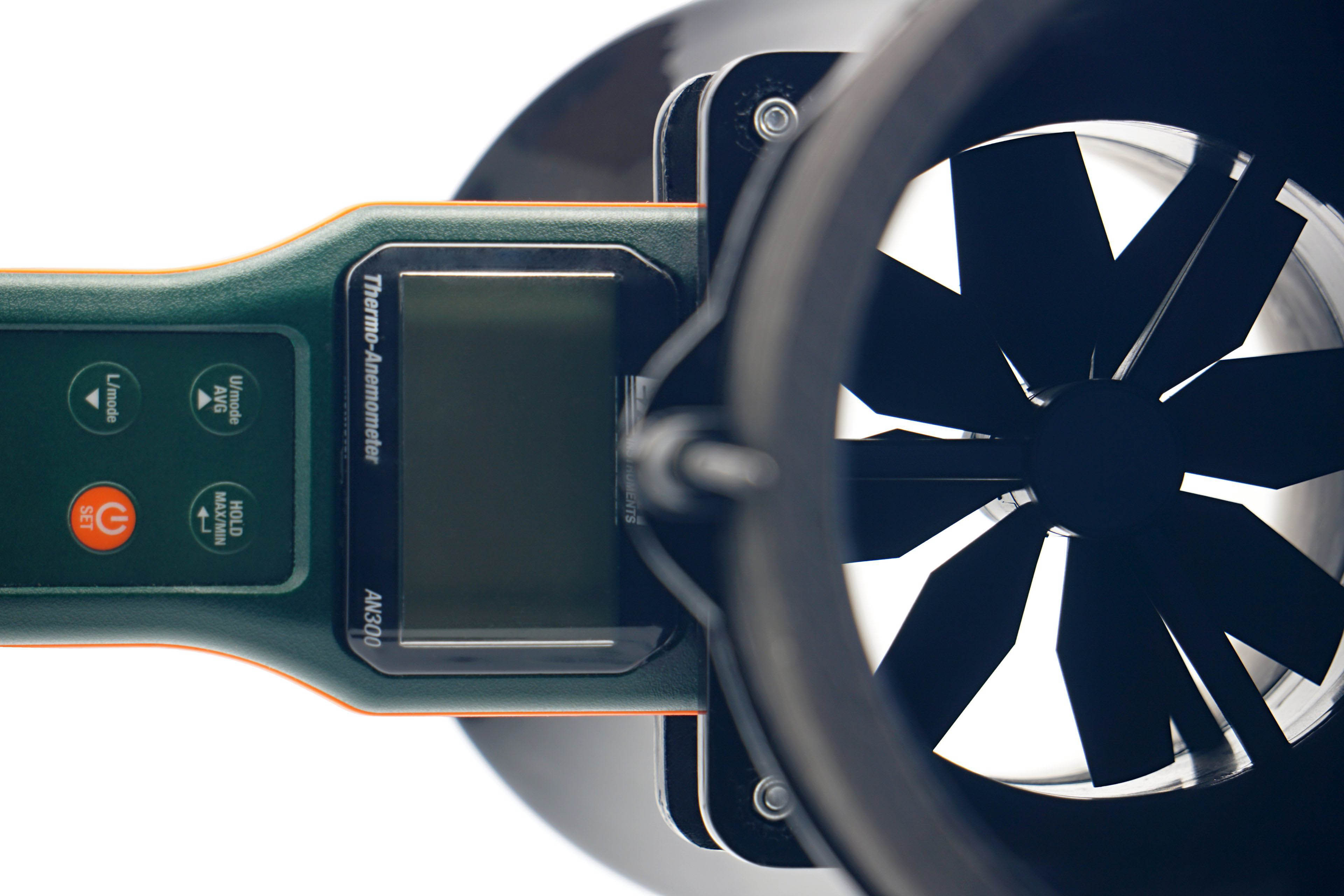
We use an Extech AN300 anemometer with a large 100 mm fan for the measurements. Its big advantage over other anemometers is that it is made for bidirectional sensing. This allows tests at different fan orientations. However, the “pull” position is more suitable or accurate for measurements, even though it may not seem so at first glance, but we’ll explain.
Here, we get to the second part of the tunnel, the part behind the anemometer. It is part of the whole device, mainly to allow a laminar flow of air to arrive at the impeller of the anemometer. Otherwise, uncontrolled side whirls would be reflected in the results, which are inconsistent with accurate measurements. Therefore, we will test the flow in the pull position. If anyone would like us to elaborate more on this topic, we can elaborate further at any time in the discussion below the article. Ask away. 🙂
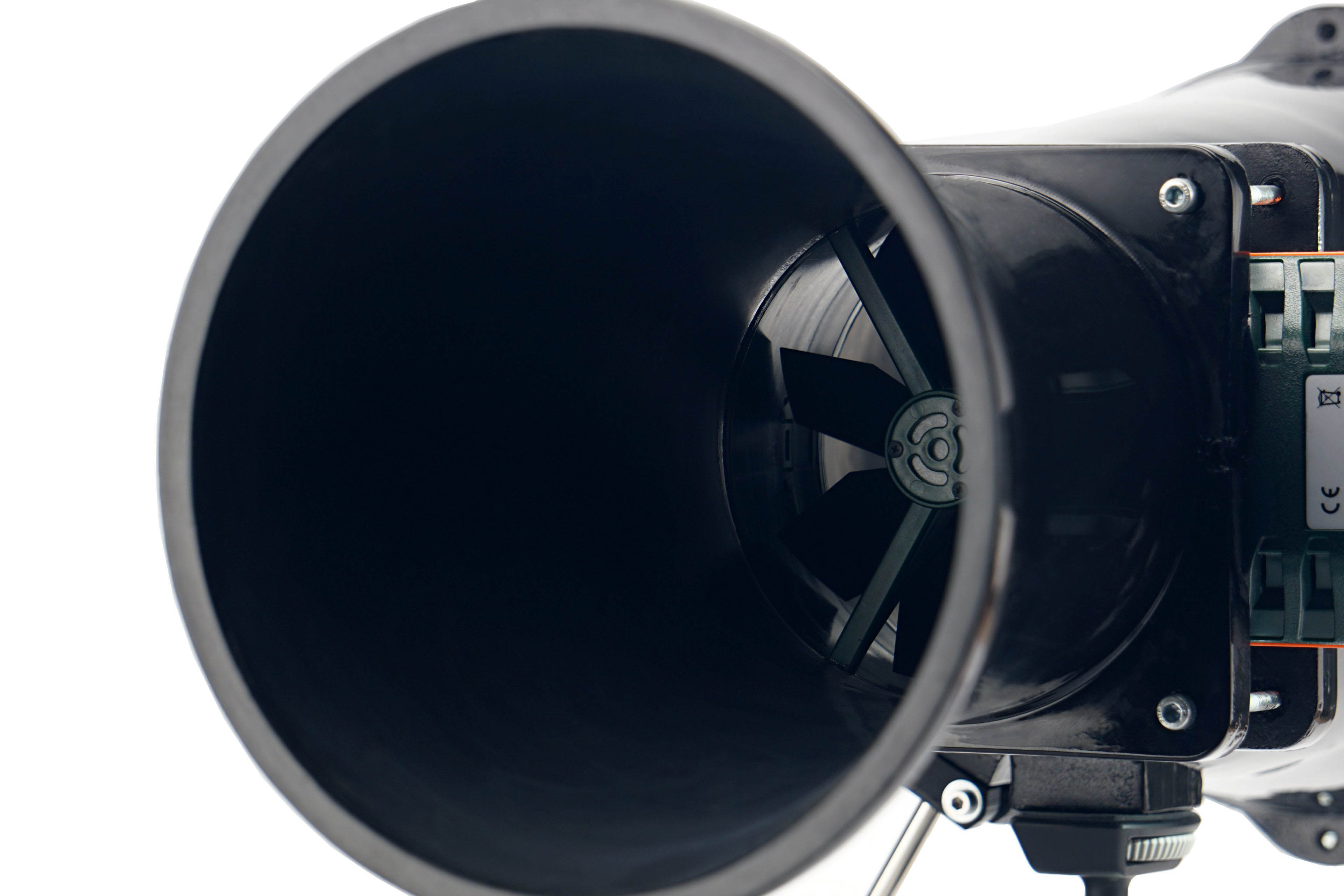
In regard to the anemometer, we shall return for a bit to noise measurements and to setting modes according to fixed noise levels. It may have occurred to you as you were reading that the anemometer fan is also a source of sound that needs to be filtered out when measuring fans. For this reason, we insert a securing pad between the frame and the anemometer fan before each measurement and mode setting according to the fixed noise level. This, by the way, also holds the anemometer fan during static pressure measurements.




Really, really interesting results.
I have heard that the P14 max suffers from motor noises, but it’s clear now that it’s only at <900 RPM where it's unstable.
The outer ring having almost no impact on noise profile is very surprising. Well, at least in the no obstacles environment. The huge impact of the ring on noise profile on radiators, despite having no effect otherwise, is even more surprising. Perhaps the back pressure cause deformation of the blades or something like that?
P.S. The links to radiator frequency plots are broken in the English version.
Thanks, fixed! 🙂
From the measurements on the fan frame, we know that the P14 Max is not a source of significant vibrations even at medium speeds, and yet the tonal peaks at low sound frequencies are quite high. We can assume that the vibrations on the blades will also be very weak and in a situation on a radiator, due to its resistance, the character of the vibrations may change. And they may move out of the unpleasant resonant frequencies. I guess it could be like this, that is, unless someone comes up with a more realistic theory. 🙂
Anyway, the fact is that the color of the sound on radiators is quite pleasant. That is, on our testing ones. Of course, you can’t generalise this.
The unpleasant tones that occur at certain RPMs are primarily from blade and frame spar resonance, and the source of their excitation is essentially unrelated to aerodynamic factors, and is primarily from the torque ripple of the motor. You can test the frequency of the anomalous tone at a particular RPM, and the RPM at which it occurs and the frequency of the sound wave will form some sort of mathematical relationship to the number of poles/coils in the motor (i.e., the frequency of the motor’s torque ripple) and the RPM at which the anomalous tone occurs won’t change, regardless of whether you increase the impedance or create a pressure pulsation that interferes with the blade’s aero-dynamics work.
Distinguishing a resonant noise from a blade or frame can be accomplished by observing a significant increase in frame vibration at the onset of the anomalous tone, and by observing a diminution of the anomalous tone when the frame tabs are pressed down.
However, note that in high speed (e.g., 4000+ rpm for 120mm fans) plastic impeller fans, the frequency of blade resonance rises slightly at high rpm due to pre-stress from blade deformation. The intrinsic frequency depends mainly on mass distribution and rigidity, and it is not easy to balance mechanical reliability and aerodynamic performance.
https://noctua.at/en/custom-designed-pwm-ic-with-scd
It would seem like this technology is a (partial) solution to this problem. Are there other ways of mitigation?
That wind tunnel looks great!
Did you have a chance to check whether the p12 max has the same instability issues at low rpm?
I have heard from users that it’s also a problem for P12 Max. ThermalLeft’s tests collaborates with this, where the P12 Max has relatively strangely low airflow at the lowest and second lowest noise settings (corresponds to roughly <=1150 RPM).
That’s exactly what I was looking for. Thanks a lot.
Not yet. But I believe that sooner or later we will get to it. But it will be as M writes, referring to the ThermalLeft’s results database. Fans with an extremely wide speed range usually have higher minimum speeds, unfortunately. Especially when it comes to cheaper models, which include the Arctic P12 Max.
In several places, there are considerations about the P14 Max in the context of quiet operation… it’s worth being careful with those higher stable speeds in the lower RPM range. It isn’t necessarily completely silent. 🙂
In several places, there are considerations about the P14 Max in the context of quiet operation… it’s worth being careful with those higher stable speeds in the lower RPM range. It isn’t necessarily completely silent. 🙂