


The culmination of our trilogy of tests of Arctic’s 140mm fans is here. With the P14 Max, the designers have worked on improvements that change both the acoustic properties and performance of the fan. The main new feature, the hoop, allows for, among other things, a significant speed increase, due to which this fan can have a really high airflow. On the other hand, fans of extra low speeds will not be too pleased.
Base 6 equal noise levels…
There are several options by which to normalize the test modes for fans. In the previous chapter, we wrote that perhaps the least appropriate option is equal speed.
Settings according to the same static pressure or flow are for consideration, but we find it most sensible in the long term to normalize the measurement modes according to the same noise levels. Firstly because decibels are a logarithmic unit and all others scale linearly, but mainly because you can orientate fastest by the same noise levels. The easiest way to compare the efficiency of fans is just by how they perform at the same sound pressure level. Of all the options, this is the one that most people can best imagine and bounce off of when considering other variables.
The individual noise level modes are adjusted from low levels continuously to higher levels. All users will find their results in the tests, regardless of whether they prefer very quiet operation at the limit of audibility or whether high performance is paramount.
The quietest mode corresponds to 31 dBA, followed by 33 dBA, and for each additional mode we add 3 dBA, which always doubles the noise level (36, 39, 42 and 45 dBA). Finally, we measure the fans at maximum power. Here, each one already has a slightly different noise level, which we also report. If there are missing measurements between the results for any of the fans, this means that it was not possible to set the target noise level. Either because its minimum speed exceeds the quietest mode of 31 dBA or vice versa because the fan is quieter than 45 dBA at maximum power.
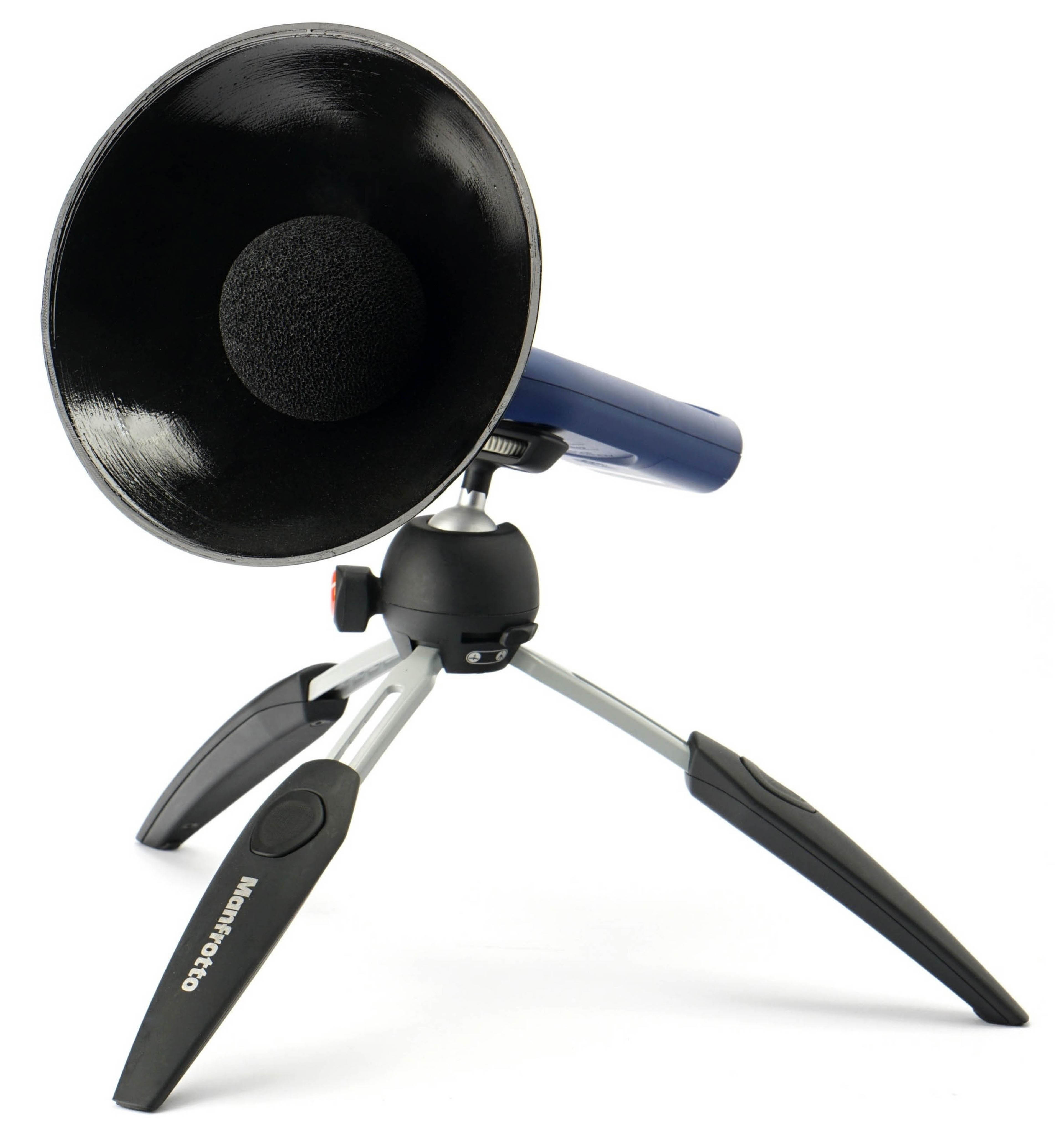
It is important to add that our noise level measurements are incomparable to the values quoted by the fan manufacturers in their specifications. One of the reasons is because we use a parabola-shaped collar around the sensor of the noise meter, which increases sensitivity. This is important in order to distinguish and set to the same noise level even modes at very low speeds, especially 31 dBA.
The noise meter next to the fan is quite close for sufficient resolution. The distance between the frame and the sensor is 15 centimeters. The sensor is positioned in such a way that there is no distortion or that the noise level measurements are not affected by airflow. Therefore, the noise meter is centered perpendicularly to the frame that defines the depth of the fan. Everything is always at the same angle and at the same distance. We use an inclinometer and markers to set the distances precisely and always the same.

We use a Reed R8080 noise meter to measure noise levels. This allows real-time averaging of samples, which is important for fine-tuning individual modes. We tune the fans until the specified noise level is reached to two decimal places, for example 31.50 dBA. The noise meter is the only instrument we calibrate inside our testlab. The other instruments have been calibrated by the relevant technical institutes. However, in the case of the noise meter, calibration is required before each test and we therefore have our own calibrator. This is already calibrated externally according to the standard.




Really, really interesting results.
I have heard that the P14 max suffers from motor noises, but it’s clear now that it’s only at <900 RPM where it's unstable.
The outer ring having almost no impact on noise profile is very surprising. Well, at least in the no obstacles environment. The huge impact of the ring on noise profile on radiators, despite having no effect otherwise, is even more surprising. Perhaps the back pressure cause deformation of the blades or something like that?
P.S. The links to radiator frequency plots are broken in the English version.
Thanks, fixed! 🙂
From the measurements on the fan frame, we know that the P14 Max is not a source of significant vibrations even at medium speeds, and yet the tonal peaks at low sound frequencies are quite high. We can assume that the vibrations on the blades will also be very weak and in a situation on a radiator, due to its resistance, the character of the vibrations may change. And they may move out of the unpleasant resonant frequencies. I guess it could be like this, that is, unless someone comes up with a more realistic theory. 🙂
Anyway, the fact is that the color of the sound on radiators is quite pleasant. That is, on our testing ones. Of course, you can’t generalise this.
The unpleasant tones that occur at certain RPMs are primarily from blade and frame spar resonance, and the source of their excitation is essentially unrelated to aerodynamic factors, and is primarily from the torque ripple of the motor. You can test the frequency of the anomalous tone at a particular RPM, and the RPM at which it occurs and the frequency of the sound wave will form some sort of mathematical relationship to the number of poles/coils in the motor (i.e., the frequency of the motor’s torque ripple) and the RPM at which the anomalous tone occurs won’t change, regardless of whether you increase the impedance or create a pressure pulsation that interferes with the blade’s aero-dynamics work.
Distinguishing a resonant noise from a blade or frame can be accomplished by observing a significant increase in frame vibration at the onset of the anomalous tone, and by observing a diminution of the anomalous tone when the frame tabs are pressed down.
However, note that in high speed (e.g., 4000+ rpm for 120mm fans) plastic impeller fans, the frequency of blade resonance rises slightly at high rpm due to pre-stress from blade deformation. The intrinsic frequency depends mainly on mass distribution and rigidity, and it is not easy to balance mechanical reliability and aerodynamic performance.
https://noctua.at/en/custom-designed-pwm-ic-with-scd
It would seem like this technology is a (partial) solution to this problem. Are there other ways of mitigation?
That wind tunnel looks great!
Did you have a chance to check whether the p12 max has the same instability issues at low rpm?
I have heard from users that it’s also a problem for P12 Max. ThermalLeft’s tests collaborates with this, where the P12 Max has relatively strangely low airflow at the lowest and second lowest noise settings (corresponds to roughly <=1150 RPM).
That’s exactly what I was looking for. Thanks a lot.
Not yet. But I believe that sooner or later we will get to it. But it will be as M writes, referring to the ThermalLeft’s results database. Fans with an extremely wide speed range usually have higher minimum speeds, unfortunately. Especially when it comes to cheaper models, which include the Arctic P12 Max.
In several places, there are considerations about the P14 Max in the context of quiet operation… it’s worth being careful with those higher stable speeds in the lower RPM range. It isn’t necessarily completely silent. 🙂
In several places, there are considerations about the P14 Max in the context of quiet operation… it’s worth being careful with those higher stable speeds in the lower RPM range. It isn’t necessarily completely silent. 🙂