


Longer life in exchange for more noise? These are also some of the agenda items we’ll cover in our comparison of the Arctic P14 CO fan with the fluid bearing variant. These are actually the main points. In any case, the ball bearings in the more expensive variant of these fans also have specific features that can be easily observed and distinguished even in normal, “home” use.
Everything changes with obstacles
So far, we have described how static pressure and airflow measurements are made under conditions where the fan has no obstacles in its path. In practice, however, fans do not usually blow into an empty space, but have a filter, grille or radiator in front of or behind them, the fins of which need to be pushed through as efficiently as possible.
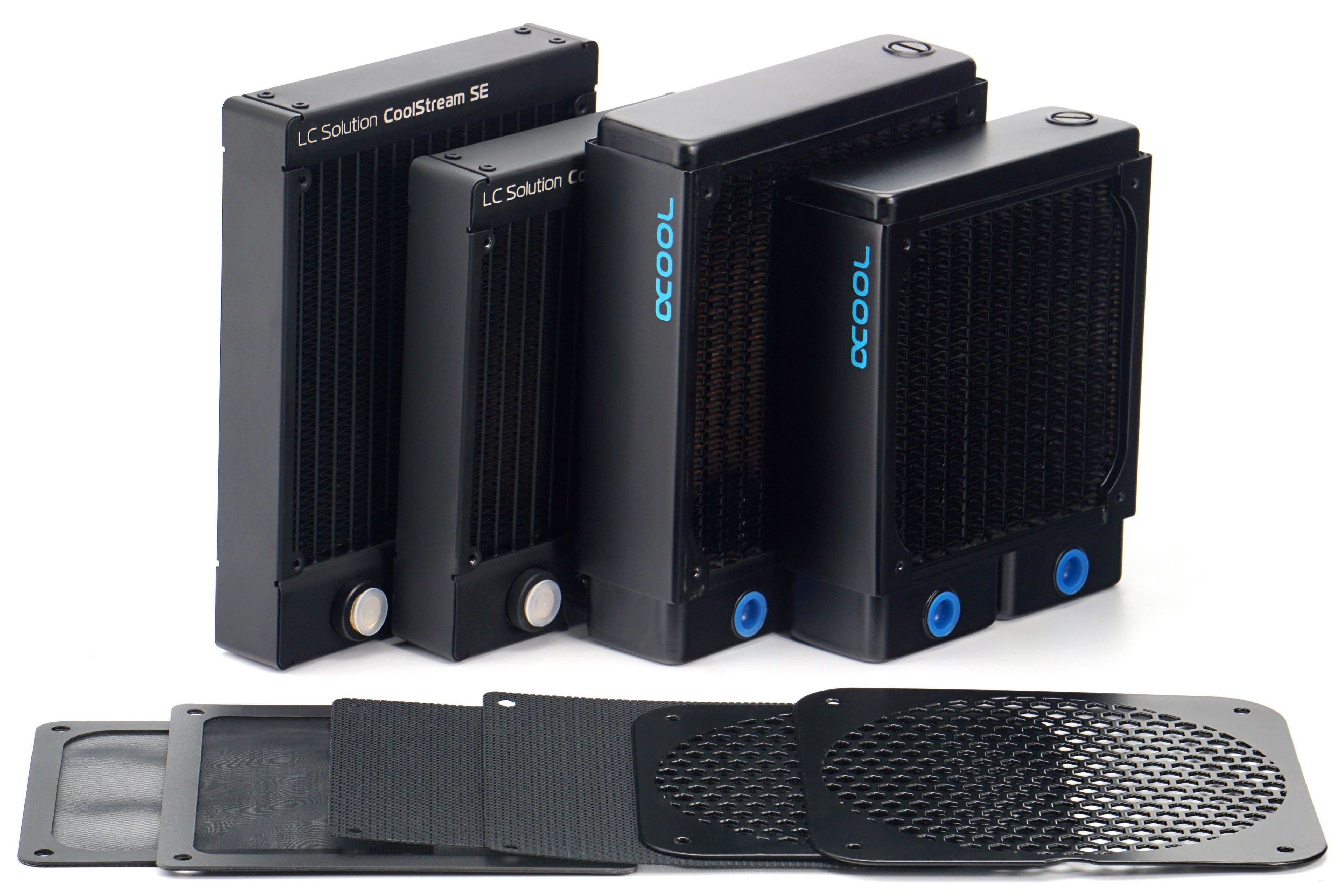
We will also measure both airflow and pressure through practical obstacles for the reasons stated above. These include two types of filters that are usually used in PC cases. One fine – nylon and the other plastic with a thinner mesh. One other obstacle is the hexagonal grille perforated at 50%, on which the vast majority of fans – intake and exhaust – are installed. In some cases, we measure the effect of the obstacles on the results at positions (behind or in front of the impeller) that are used in practice. All obstacles are both pushed through to detect pressure drops, but also pulled through, which in turn speaks to the impact on airflow.

We use two radiators that differ in thickness and fin density. The EK CoolStream SE120/140 is 28 mm thick and the FPI is 22, the Alphacool NexXxoS XT45 v2 is thicker (45 mm) but with less FPI. CoolStream’s fin disposition is also similar in parameters to AIOs. The results on the NexXxoS will again be attractive for those who build their own water cooling loops, where the fans should work well even at low speeds – hence the lower fin density.
These obstacles and especially the radiators, but also the grilles, increase the mechanical resistance in front of the fan, resulting in higher noise levels. However, we will still tune the fan speeds to the specified noise levels of 31 to 45 dBA. Naturally, the speeds will always be lower than when testing without obstructions, but we will maintain the noise levels for clarity. The different noise levels with and without obstacles will only be at maximum power. In this mode it will also be nice to see how the fan design works with the obstacle and in which case the noise level increases more and in which less.




Expected results, but still an interesting showcase of the effect of only changing the bearings.
So, the “hum” is still here all the same, despite some claims that the CO version fixes it. ThermalLeft has documented sound differences between revisions too (https://www.youtube.com/watch?v=nt8Ao4GDmzY), but even Arctic themselves doesn’t think revisions will have such an effect. I am starting to think it’s possibly a batch “issue” that may have introduced different properties to the rotor material.
I guess those claims of the CO rumbling less will never come from an official source (from Arctic)? They don’t seem to list among the changes across the revisions the modifications that address this. And personally, I don’t even see the technical reason behind the CO variant or the higher P14 revision (2 vs. 4) being quieter on lower frequencies. The impeller seems to have the same parameters in terms of geometry or material used. Nevertheless, there can certainly be a situation where different noise levels are measured across different fans. But it may not be due to different revisions, and perhaps it may be possible to observe this across different fan pieces of the same revision due to different manufacturing tolerances (which are high in the low-end after all)?
An analysis that tracks the tonal peaks of multiple pieces from the same revisions on each side would shed more light on this. From our experience, we note that the shape of the spectrograms of multiple pieces of the P14 PWM PST rev. 4 compared to P14 PWM PST CO rev. 3 in the low frequency band is identical at the same speed. The small differences in the spectrograms that you see in the tests are mainly just due to the fact that in modes normalized by the same noise levels, the speeds of the two variants (P14 and P14 CO fans) are slightly different. For the CO, the speeds are always set a little lower due to the noisier bearings.
Perhaps what is known as “resonance” is something else that’s not the frequency spike at ~100 Hz. Namely, the sudden increase in noise at specific RPM ranges. Or, perhaps the two issues are lumped together when people talk about it, when in fact the two (sound profile with pronounced low frequency peak, and some RPM ranges being suddenly louder) are different issues (that perhaps are related).
I am sure you would have noticed and mentioned it though, when you’re testing the fans and adjusting the fan speeds again and again.
Good day,
can the testers please answer this?
So P12 Max, P14 Max have both the better FDB, and only the CO versions have the ball bearing?
For both black and white version of the P12/14 Max?
Thanks
When the Max debuted (black color), it had a DBB. Later when the white version came, it had an FDB. Then they switched both models to FDB. The only Arctic fans that have a DBB nowadays are the “CO“ (continuous operation) and all server-grade fans (starting with the letter “S”)
DBB is optimal in harsh environments (higher temperature) and for continuous operation.
(I hope you don’t mind that I’m not a reviewer) 😉
It’s exactly as Bufo says. The P12 Max fan in its second revision already uses FDB. Ball bearings were only present in the first revision (P12 Max rev. 1). The unwanted whining noise that many users complained about no longer applies to the P12 Max rev. 2. Proof of this can also be seen in the sound spectrogram, where there are no significant tonal peaks at high frequencies. 🙂