


Longer life in exchange for more noise? These are also some of the agenda items we’ll cover in our comparison of the Arctic P14 CO fan with the fluid bearing variant. These are actually the main points. In any case, the ball bearings in the more expensive variant of these fans also have specific features that can be easily observed and distinguished even in normal, “home” use.
Initial warm-up…
Before we even start measuring anything, we let the fans run “idle” for a few minutes after plugging them in. This is because immediately after a cold start the fans reach different parameters than after a certain amount of short-term operation.
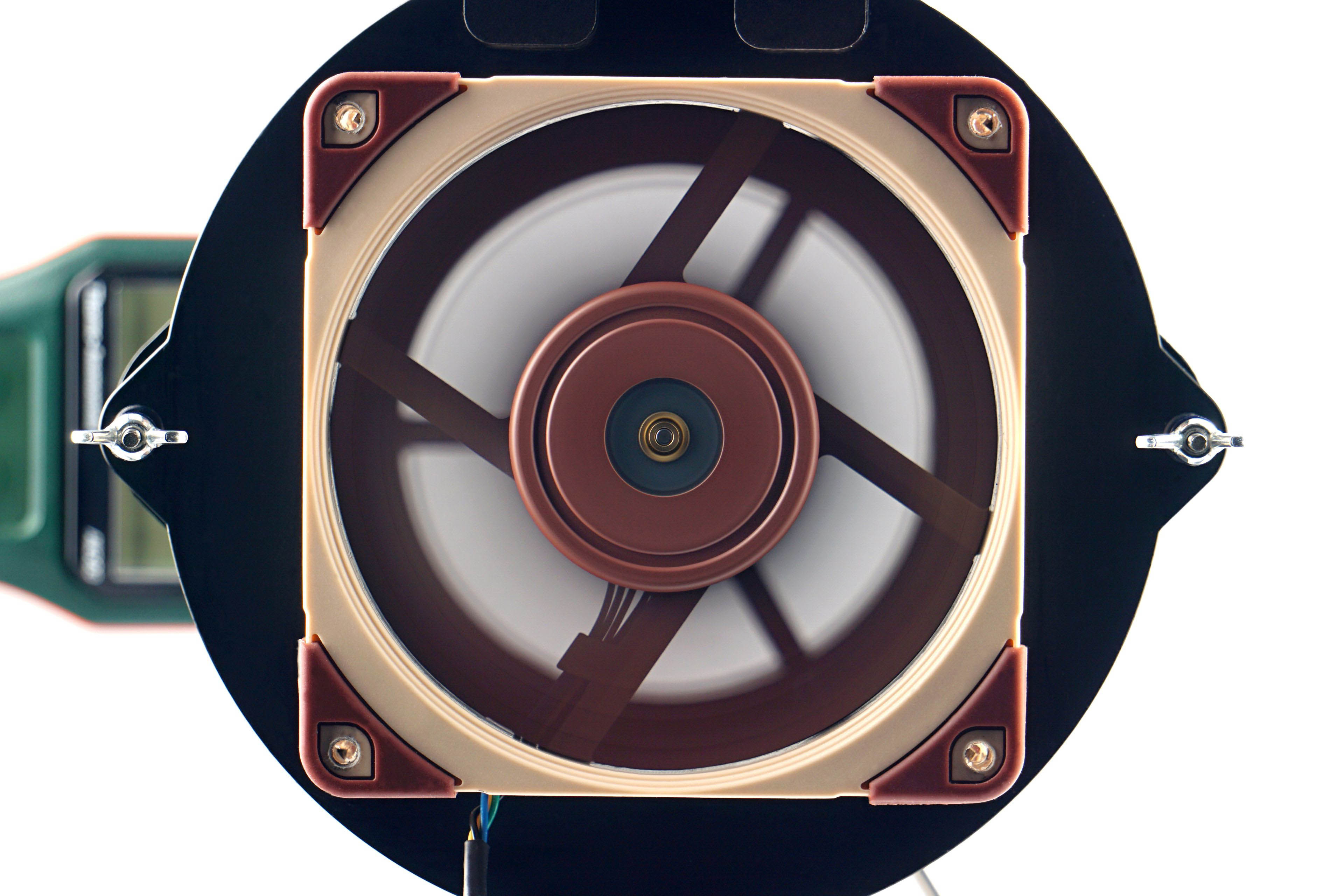
Until the operating temperature of the lubricant is stabilized, a typically lower maximum performance is achieved. This is because at lower temperatures the lubricant is denser, which is associated with higher friction. Therefore, the fans do not reach maximum speed immediately, but only after the first few seconds. Before the first measurements, we therefore leave the fans running for at least 300 seconds at 12 V, or 100 % PWM intensity.
…and speed recording
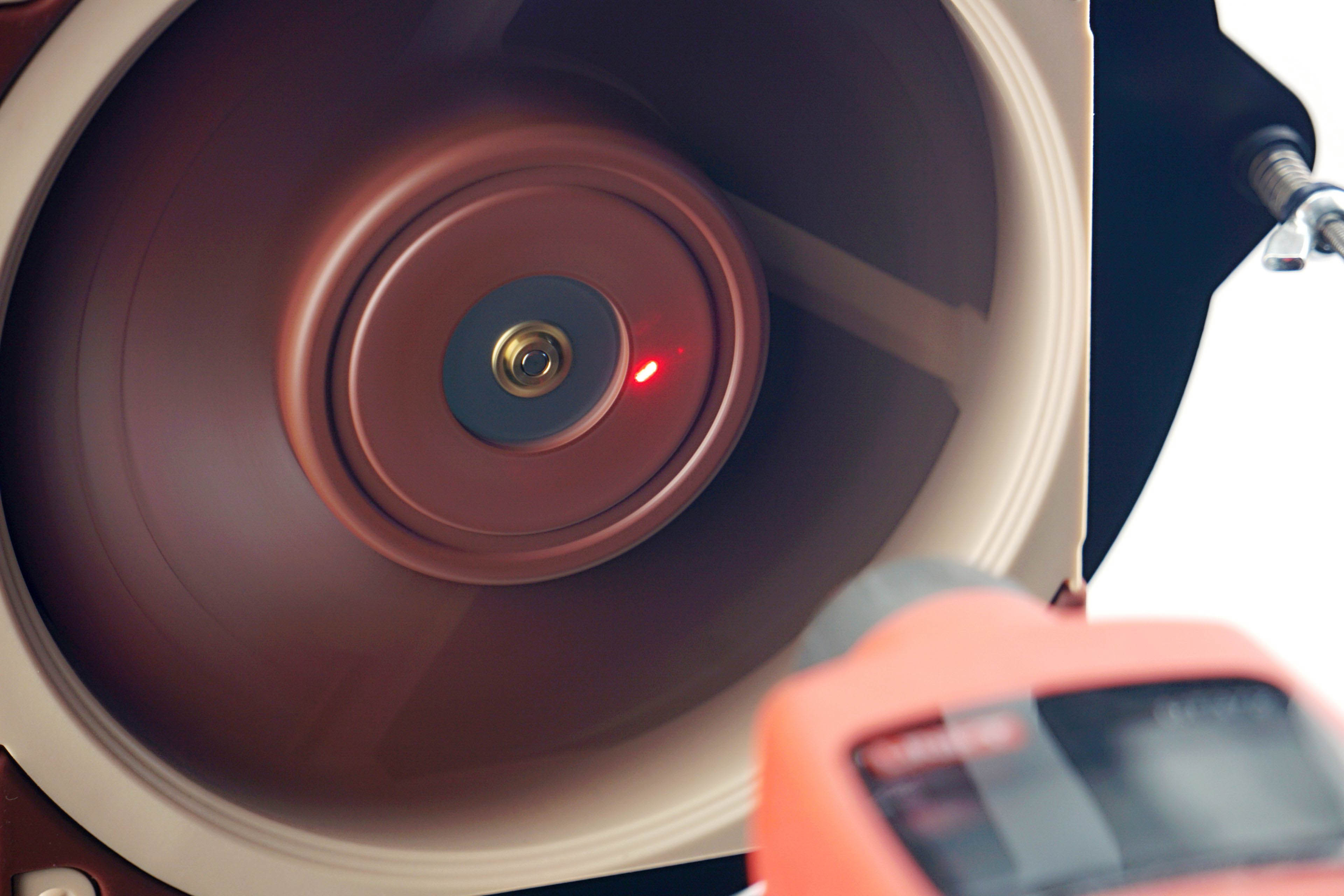
The speed of the fans is monitored using a laser tachometer, which reads the number of revolutions from a reflective sticker on the impeller. For this purpose, we use the UNI-T UT372 device, which also allows real-time averaging of samples. Thus, we do not record the peak value in the graphs, but the average speed value from a 30-second time period.
However, the speed itself is a relatively unimportant parameter that is often given more attention than is appropriate. This is the case even in many fan or cooler tests, where speed is used to normalize the different modes in which other variables are measured.
However, hyper-focusing on a specific speed is a rather unfortunate decision if only because the fans don’t gain any commonality. At the same speed all other variables are different, there is no intersection. It can be noted that a better normalization would have been by any other variable, whether it be static pressure, flow or noise level, which wins in our case. But more on that in the next chapter.
We only measure the speed so that you can associate a particular parameter (such as the amount of static pressure or some noise level) with something according to which you can adjust the fan yourself. Perhaps for that alone, the information about the achieved speed is useful. As part of the fan analysis, we will also indicate what the fans’ starting and minimum speeds are. Start-up speeds tend to be higher than minimum speeds because more force is required to get the impeller moving than once the fan impeller is spinning, and a minimum power intensity is sought at which the fan does not stall.




Expected results, but still an interesting showcase of the effect of only changing the bearings.
So, the “hum” is still here all the same, despite some claims that the CO version fixes it. ThermalLeft has documented sound differences between revisions too (https://www.youtube.com/watch?v=nt8Ao4GDmzY), but even Arctic themselves doesn’t think revisions will have such an effect. I am starting to think it’s possibly a batch “issue” that may have introduced different properties to the rotor material.
I guess those claims of the CO rumbling less will never come from an official source (from Arctic)? They don’t seem to list among the changes across the revisions the modifications that address this. And personally, I don’t even see the technical reason behind the CO variant or the higher P14 revision (2 vs. 4) being quieter on lower frequencies. The impeller seems to have the same parameters in terms of geometry or material used. Nevertheless, there can certainly be a situation where different noise levels are measured across different fans. But it may not be due to different revisions, and perhaps it may be possible to observe this across different fan pieces of the same revision due to different manufacturing tolerances (which are high in the low-end after all)?
An analysis that tracks the tonal peaks of multiple pieces from the same revisions on each side would shed more light on this. From our experience, we note that the shape of the spectrograms of multiple pieces of the P14 PWM PST rev. 4 compared to P14 PWM PST CO rev. 3 in the low frequency band is identical at the same speed. The small differences in the spectrograms that you see in the tests are mainly just due to the fact that in modes normalized by the same noise levels, the speeds of the two variants (P14 and P14 CO fans) are slightly different. For the CO, the speeds are always set a little lower due to the noisier bearings.
Perhaps what is known as “resonance” is something else that’s not the frequency spike at ~100 Hz. Namely, the sudden increase in noise at specific RPM ranges. Or, perhaps the two issues are lumped together when people talk about it, when in fact the two (sound profile with pronounced low frequency peak, and some RPM ranges being suddenly louder) are different issues (that perhaps are related).
I am sure you would have noticed and mentioned it though, when you’re testing the fans and adjusting the fan speeds again and again.
Good day,
can the testers please answer this?
So P12 Max, P14 Max have both the better FDB, and only the CO versions have the ball bearing?
For both black and white version of the P12/14 Max?
Thanks
When the Max debuted (black color), it had a DBB. Later when the white version came, it had an FDB. Then they switched both models to FDB. The only Arctic fans that have a DBB nowadays are the “CO“ (continuous operation) and all server-grade fans (starting with the letter “S”)
DBB is optimal in harsh environments (higher temperature) and for continuous operation.
(I hope you don’t mind that I’m not a reviewer) 😉
It’s exactly as Bufo says. The P12 Max fan in its second revision already uses FDB. Ball bearings were only present in the first revision (P12 Max rev. 1). The unwanted whining noise that many users complained about no longer applies to the P12 Max rev. 2. Proof of this can also be seen in the sound spectrogram, where there are no significant tonal peaks at high frequencies. 🙂