


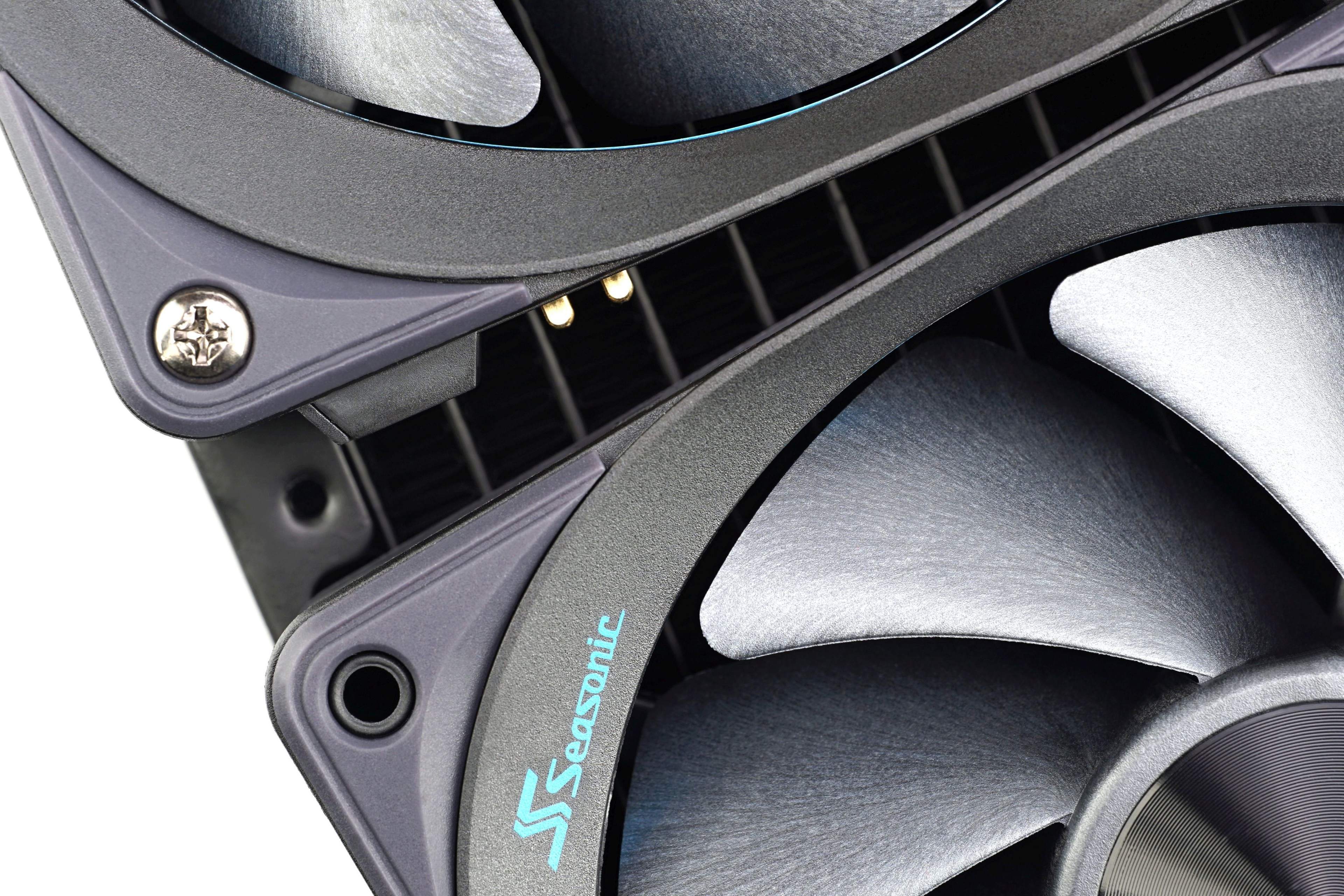
The design details here not only look fascinating, they really are. That is, except for one “little thing” that makes the MagFlow 1225 PWM unable to play an equal game with the top 120mm fans, even though it seemingly has all the prerequisites to do so. But at least the Seasonic fan has the added value of a very convenient installation: magnet here, magnet there, no cables in sight.
Results: Static pressure through a plastic filter
Note: “Higher is better” (the result of static pressure in the charts) is only valid for comparing fans of the same formats.
Why is there a missing value sometimes? There may be more reasons. Usually it is because the fan could not be adjusted to the target noise level. Some have a higher minimum speed (or the speed is low, but the motor is too noisy) or it is a slower fan that will not reach the higher decibels. But the results in the graphs are also missing if the rotor is brushing against the nylon filter mesh. In that case, we evaluate this combination as incompatible. And zero in the graphs is naturally also in situations where we measure 0.00. This is a common occurrence at extremely low speeds with obstructions or within vibration measurements.




It’s surprising to me that, despite having a small impeller and relatively large gaps between the blades and the frame, the fan doesn’t perform too badly. The large blade surface area likely helped. The performance relative to the price is really bad though…
The price is likely high due to both the LCP blades and fancy magnetic connections. The later of which seemed executed well, but the former is “wasted” due to Seasonic not using this advantage to make the gaps smaller. With the current impeller design, they might have been able to use reinforced PBT with little penalty while significantly lower the cost. Really puzzling why they go LCP without fully taking advantage of it.
I also wonder if the magnets are what leading to the frames being so thick. The diameter of the impeller is noticeably smaller than many other 120 mm fans, which is something commonly seen in other fans with similar magnetic connections. It is in my opinion a bad tradeoff.
Despite all its flaws, it’s a decent first fan from Seasonic. Hope they can fix the motor issue and improve the fan in other ways in their next iteration.
Very good point, about the smaller rotor of the MagFlow fan. But it is still significantly larger than on the Arctic BioniX P120 A-RGB. There is some compensation in the smaller area of the hub, but it is true that the efficiency is much lower in these places than at the other end of the blades.
It is also true that smaller gaps between the blades may not be such an advantage compared to traditional 7-blade fans, when you take into account that with a larger number of blades there are also larger gaps and the total area is decisive. Although it always depends on the geometry and inclination of the blades themselves. The number and length of the leading edges also play a role in the overall efficiency or airflow/noise ratio, so more blades may not always be a plus. Arctic probably knew very well that with fewer and larger blades, a lower noise level could be achieved at the same airflow. I mean, under certain circumstances, theoretically, when the noise level is not increased by the tonal peaks from vibration, that is… they figured that out later.
With a quieter motor, the MagFlow fan would show up in a completely different light, although it would probably not reach the peak at any of the noise levels. But we know that this geometry makes sense. Although less so in the high-end than in the low-end. It wasn’t that long ago that we were dealing with Genesis Oxal fans, whose basic outlines are similar to those of the MagFlow fan. Unfortunately, we don’t have its results publicly (it was an internal prototype test), but when Oxal fans come out (for now they can be bought only as part of cases) and we add them to the tests, you will see how they shuffle with the class of the cheapest fans. There the price/performance ratio will be a bit different… 🙂
MagFlow 1225 has very well-made appearance and decent ~ middle efficiency for some obstacles but.. the problem is that the price is as expensive as other high-end fans. I also found the same cons of MagFlow as your test.
In my test, Magflow shows especially worse result in radiator-pull test.
Some PSU manufacturers started to make their own PC cooling solution recently. And Seasonic’s product, which was the first runner among them, seems to fail in the competition. I would like to see if Super Flower’s Megacool can show good result. Challenges of various companies for PC cooling solutions makes the topic about it more interesting, isn’t it?
Thanks for the heads up about the Super Flower Megacool. I didn’t know about this fan and yet it looks like a capable challenger to the T30. Although personally I think one of the benefits of Phanteks is the smaller number of blades, which under certain circumstances (when there are no tonal peaks due to excessive vibration) can achieve higher airflow and static pressure at lower noise levels… by having fewer edges cutting the air. Arctic also seems to have worked with this thesis already with 5-blade designs. Though initially they underestimated the choice of material, or the need to reinforce the blades with a rotor frame, which was added later.
Heavily curved 9 blades, LCP impeller, 30T thickness. But not only that, Megacool has quite interesting feature.
https://img2.quasarzone.com/editor/2023/07/12/deac9fde48ba4aceebed595f2d8a9281.jpg
It has 12 pole motor! I never have seen this before in PC fans.
But one concern is that it uses 2 ball bearing. Megacool can have irritating noises. I can’t predict whether or not Megacool have tonal peaks due to aerodynamic interaction, but the bearing driving noise will seem clear to hear..
So even assuming there is no tonal peaks from Megacool, the lower normalized noise level of each fans, I think PH-F120T30 will make the better airflow/static pressure.
The Megacool also kinda sucks for its price,
Bearing noise isn’t even its problem, its the poor dynamic balance and motor noise. It especially makes funny motor whines when stopping at low speed or when it starts spinning. But it also makes weird noises when accelerating
But however, what is actually interesting is they for whatever reason, included a remote control to control fan speed profile