


Before Arctic transitions to its new, 7-blade fan design, let’s take a closer look at the one that has characterized the company for many years. And even though the 5-blade fans of the “P” series had certain shortcomings, they demonstrated just how efficient even low-cost designs can be. In the case of high-speed models, such as the tested P12 Max, they also show how far cooling performance can be pushed.
Evaluation
With the P12 Max fans, the era defined by Arctic’s long-standing aerodynamic design is slowly but surely coming to an end. Whether this is a good decision and a step forward is something we’ll find out relatively soon. What’s already clear, however, is that if you’re after a truly high-performance fan – with an exceptionally high airflow – then yes, the P12 Max is going to be a very solid choice. That is, unless you mind its very high noise output, which tends to come hand in hand with high-airflow systems. If maximum airflow is the priority, high noise is simply unavoidable.
At one end of the spectrum – at very high RPMs – the P12 Max excels in airflow across all types of airflow restrictions. Static pressure is also very high here, and while there’s some drop in airflow (such as on radiators), it’s nothing dramatic. You can still reach extremely high cooling performance. On the other hand, if you’re aiming for the quietest possible operation, this is where you need to be cautious. The P12 Max won’t be suitable here, because you simply can’t get it to run at very low speeds. It’s a similar story to the larger P14 Max model – the working RPM range is wide, but not wide enough to reach very low speeds that would deliver very quiet performance.
The P12 Max bottoms out at around 435 RPM with PWM control. It runs relatively stably there, meaning the following: at a certain PWM signal level, it doesn’t interpret the signal cleanly enough, resulting in RPM fluctuations of ±30 RPM, and the motor becomes noticeably noisier (this is, by the way, one reason for the greater airflow disparity at low speeds compared to the P12 A-RGB fan, whose motor is quieter at low speeds and thus contributes less to total noise). Still, we can conclude that, unlike the P14 Max, the P12 Max handles lower speeds better (making it potentially quieter), and its overall speed range is exceptionally broad.
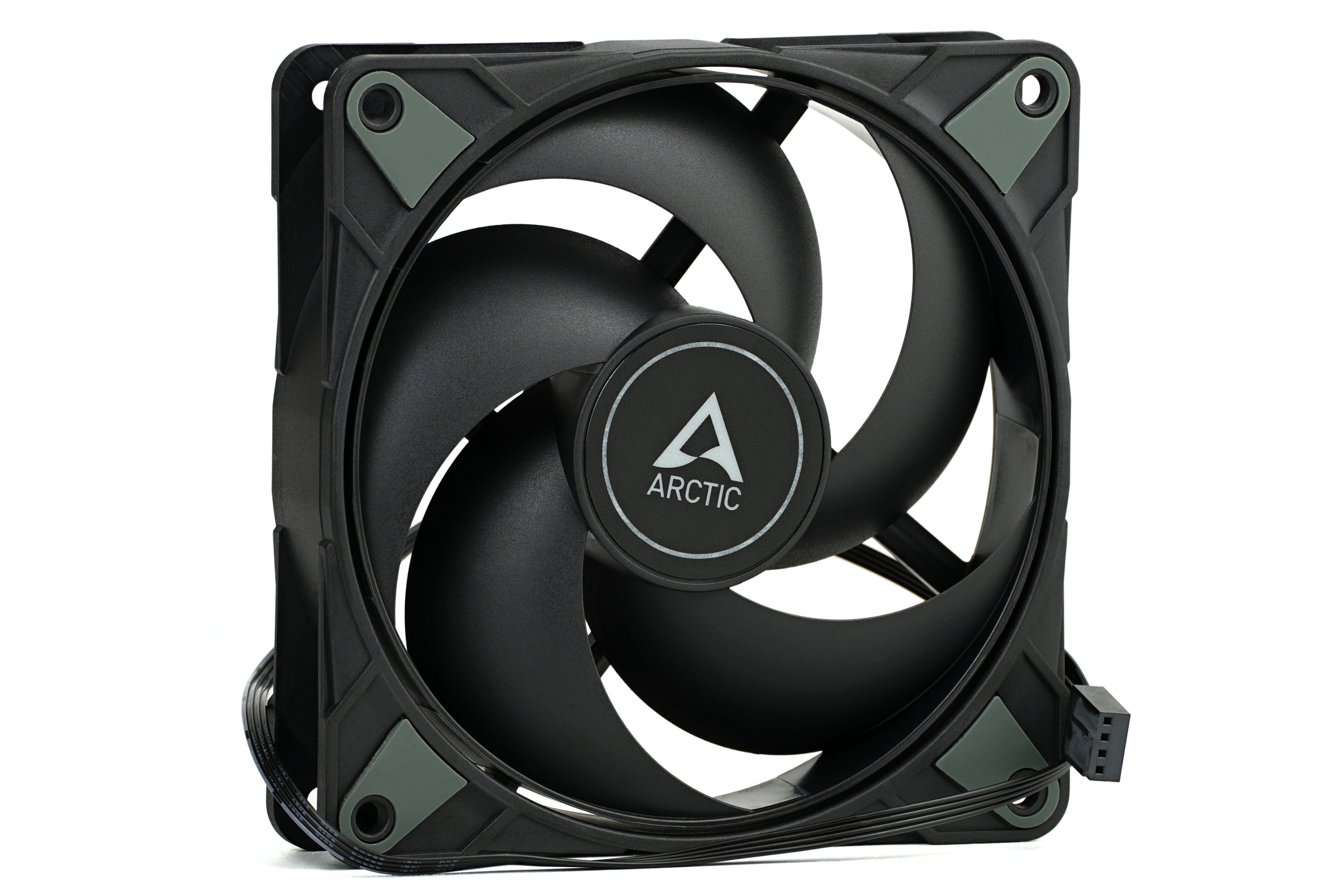
Due to a smaller impeller hub and thus larger blades, the cheaper P12 models often achieve higher airflow, even through obstacles. A good example of the P12 Max’s higher ranking is its performance with dust filters or a grille. However, at medium speeds, the P12 Max trails not only behind the P12s but also behind much cheaper fans like the Endorfy Stratus 120 PWM. And the list of fans the P12 Max loses to in this range is not short.
Of course, performance is not the only factor, but even so, we can comfortably say that at mid and low RPMs, the P12 Max often falls behind, with a weaker price-to-performance ratio. That said, this design is, as already mentioned, clearly intended for high-speed use – where not only the impeller hoop but also anti-vibration pads in the corners play a supporting role. Thanks to these elements, vibrations are kept in check even at very high speeds. Sure, at max RPMs, around 3300, vibrations are quite pronounced – but that’s true of virtually every fan as powerful as the P12 Max.
What more is there to say in farewell to the 5-blade design? Will it be a shame when Arctic stops selling these fans? Time will tell, as always. If what you need in your setup is maximum airflow and thus maximum cooling performance, then the P12 Max fans are still available. Order while you still can – sooner or later, they’ll be gone.
English translation and edit by Jozef Dudáš
| Arctic P12 Max (Black) rev. 2 |
| + Suitable for every usage |
| + Cooling efficiency (airflow/pressure per unit of noise) at a very high level |
| + Attractive price-to-airflow ratio... |
| + High airflow and static pressure even through restrictive obstacles |
| + Exceptionally wide speed range |
| + Quiet motor and bearing operation |
| + Very low, negligible vibrations at low to medium speeds |
| + Exceedingly powerful motor (over 10 W) |
| - Potential collision with nylon dust filters |
| - Medium to high vibrations at higher speeds |
| Approximate retail price: 8 EUR |


Overall quite similar behaviour (at same noise levels) vs the ARGB variant. Not too much compromise at lower speeds unlike the P14 Max, which is good to see.
One thing I just noticed is the different stator ribs compared to other fans in the Arctic P family. Now they’re thicker and straight (like many other fans) rather than thin and curved. This perhaps sacrifices a tiny amount of airflow but is needed for supporting the higher RPM and rotor weight.
Good point. The P12 Max fan is about 20 grams heavier than the P12 A-RGB. And it doesn’t even have any LEDs, which also add some weight. While we don’t know the exact difference in material density – since the P12 Max uses PBT for its rotor and the P12 A-RGB likely uses polycarbonate – there’s definitely some variation happening at that level too. 🙂
it seems the spam filter worked better with the older version… the Indonesian university bot seems pretty persistent (that’s the 3rd time I’ve noticed it) 😉
… I’m attaching the response to this thread so you don’t have a problem deleting it
so now, I’m really curious if there will be any answer 😀
…now you chose a different approach instead of deleting… we’ll see 😉
Are there more information regarding about this topic for us to research for? Thank you, Regard Telkom University
Is there any other information you’re interested in? Let us know, and we’ll do our best to provide whatever is within our capabilities. 🙂