


Before Arctic transitions to its new, 7-blade fan design, let’s take a closer look at the one that has characterized the company for many years. And even though the 5-blade fans of the “P” series had certain shortcomings, they demonstrated just how efficient even low-cost designs can be. In the case of high-speed models, such as the tested P12 Max, they also show how far cooling performance can be pushed.
Initial warm-up…
Before we even start measuring anything, we let the fans run “idle” for a few minutes after plugging them in. This is because immediately after a cold start the fans reach different parameters than after a certain amount of short-term operation.
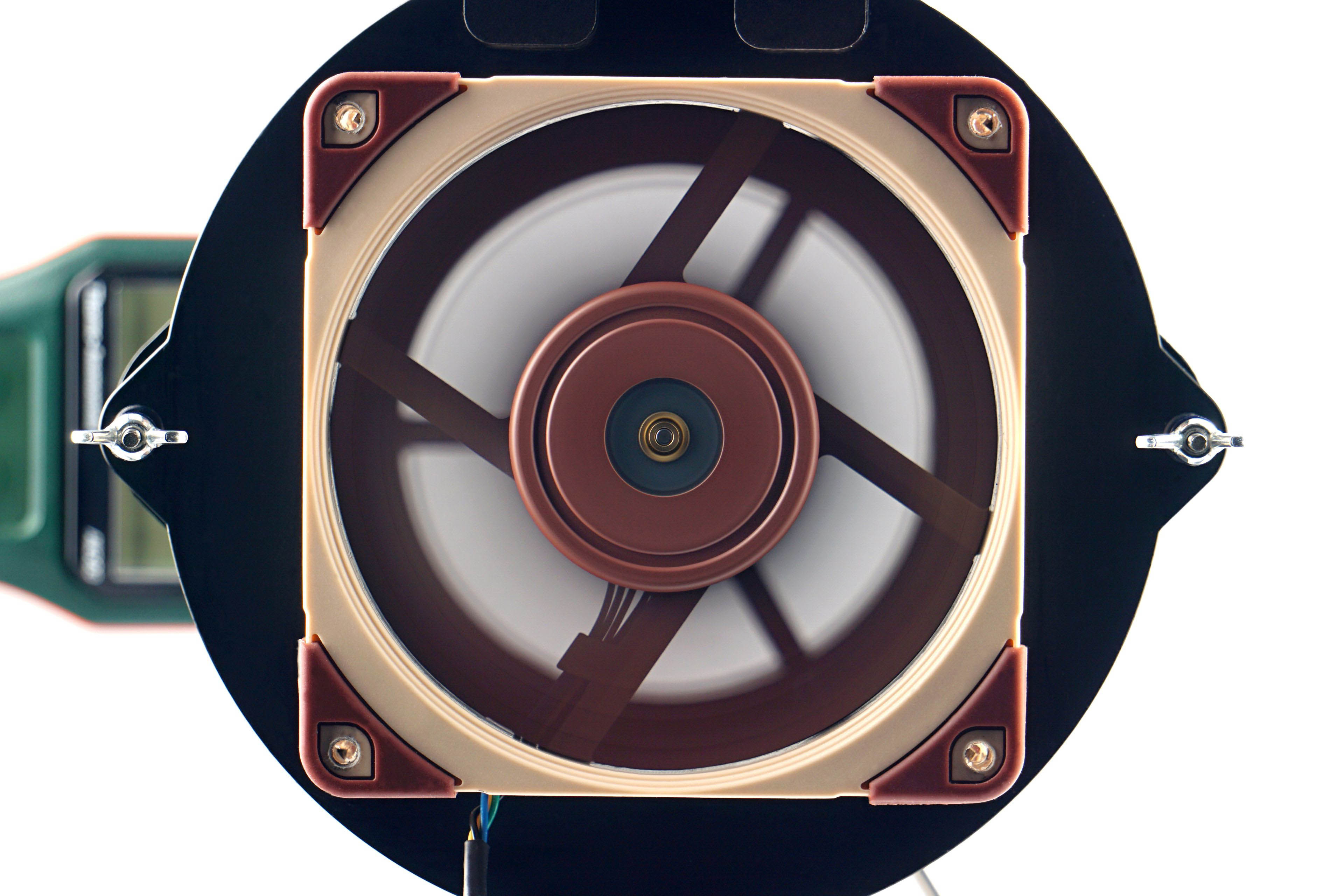
Until the operating temperature of the lubricant is stabilized, a typically lower maximum performance is achieved. This is because at lower temperatures the lubricant is denser, which is associated with higher friction. Therefore, the fans do not reach maximum speed immediately, but only after the first few seconds. Before the first measurements, we therefore leave the fans running for at least 300 seconds at 12 V, or 100 % PWM duty cycle.
… and speed recording
The speed of the fans is monitored using a laser tachometer, which reads the number of revolutions from a reflective sticker on the impeller. For this purpose, we use the UNI-T UT372 device, which also allows real-time averaging of samples. Thus, we do not record the peak value in the graphs, but the average speed value from a 30-second time period.
However, the speed itself is a relatively unimportant parameter that is often given more attention than is appropriate. This is the case even in many fan or cooler tests, where speed is used to normalize the different modes in which other variables are measured.
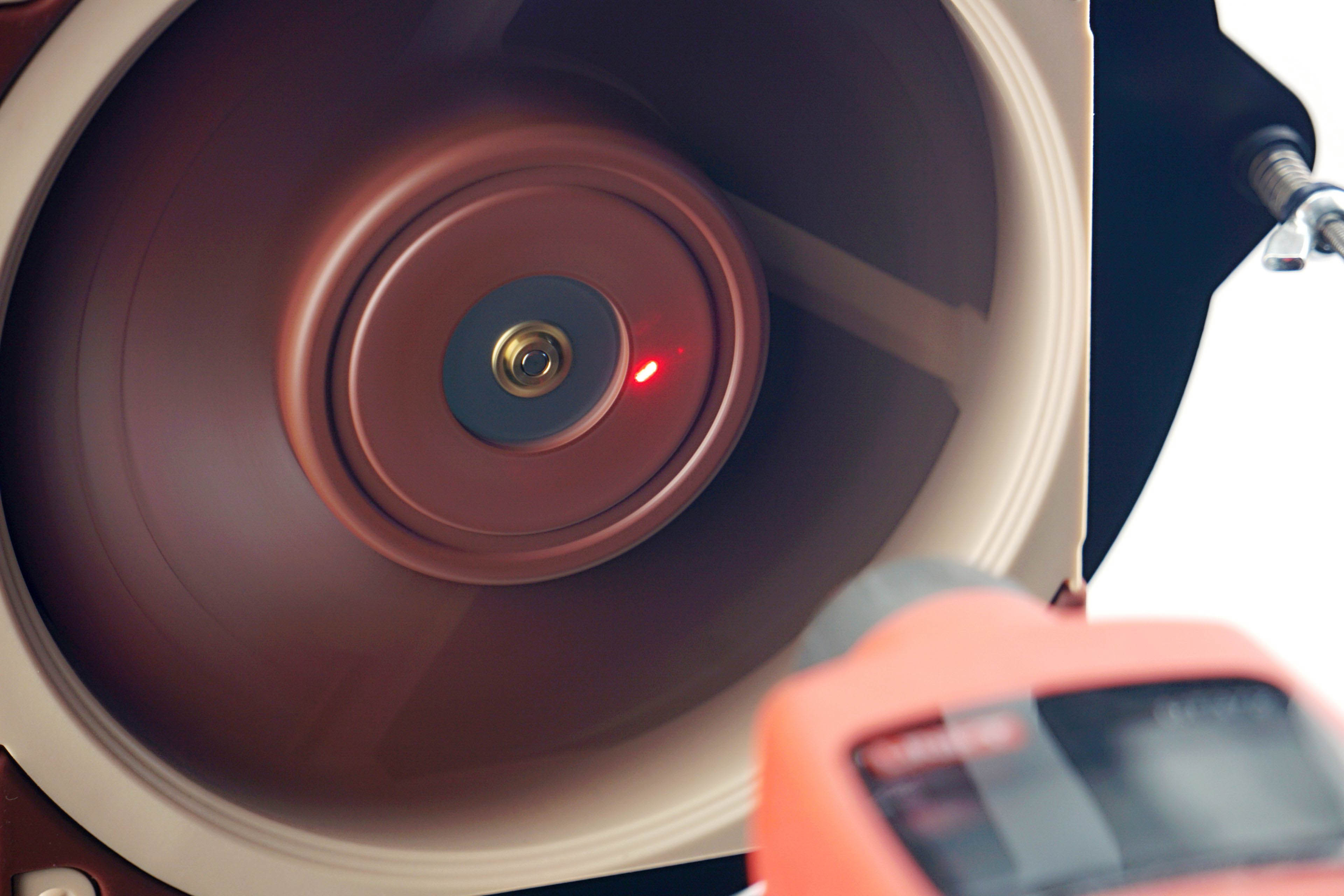
However, hyper-focusing on a specific speed is a rather unfortunate decision if only because the fans don’t gain any commonality. At the same speed all other variables are different, there is no intersection. It can be noted that a better normalization would have been by any other variable, whether it be static pressure, flow or noise level, which wins in our case. But more on that in the next chapter.
We only measure the speed so that you can associate a particular parameter (such as the amount of static pressure or some noise level) with something according to which you can adjust the fan yourself. Perhaps for that alone, the information about the achieved speed is useful. As part of the fan analysis, we will also indicate what the fans’ starting and minimum speeds are. Start-up speeds tend to be higher than minimum speeds because more force is required to get the impeller moving than once the fan impeller is spinning, and a minimum power intensity is sought at which the fan does not stall.



Overall quite similar behaviour (at same noise levels) vs the ARGB variant. Not too much compromise at lower speeds unlike the P14 Max, which is good to see.
One thing I just noticed is the different stator ribs compared to other fans in the Arctic P family. Now they’re thicker and straight (like many other fans) rather than thin and curved. This perhaps sacrifices a tiny amount of airflow but is needed for supporting the higher RPM and rotor weight.
Good point. The P12 Max fan is about 20 grams heavier than the P12 A-RGB. And it doesn’t even have any LEDs, which also add some weight. While we don’t know the exact difference in material density – since the P12 Max uses PBT for its rotor and the P12 A-RGB likely uses polycarbonate – there’s definitely some variation happening at that level too. 🙂
it seems the spam filter worked better with the older version… the Indonesian university bot seems pretty persistent (that’s the 3rd time I’ve noticed it) 😉
… I’m attaching the response to this thread so you don’t have a problem deleting it
so now, I’m really curious if there will be any answer 😀
…now you chose a different approach instead of deleting… we’ll see 😉
Are there more information regarding about this topic for us to research for? Thank you, Regard Telkom University
Is there any other information you’re interested in? Let us know, and we’ll do our best to provide whatever is within our capabilities. 🙂