


The biggest shortcoming of Arctic’s original P-series fans is the rumbling sound profile. The manufacturer realized this and decided to do something about it. Sensibly, by implementing a hoop to eliminate the critical vibrations that are the source of the annoying acoustic profile. The implementation turned out well, and already the P12 A-RGB shows how much quieter it is compared to the older P12 model. And the list of improvements doesn’t end there.
33 dBA or 33 dBA
The noise level, given as a single dBA value, is good for quick reference, but it doesn’t give you an idea of exactly what the sound sounds like. That’s because it averages a mix of noise levels of all frequencies of sound. One fan may disturb you more than the other, even though they both reach exactly the same dBA, yet each is characterized by different dominant (louder) frequencies. To analyze thoroughly with an idea of the “color” of the sound, it is essential to record and assess noise levels across the entire spectrum of frequencies that we perceive.

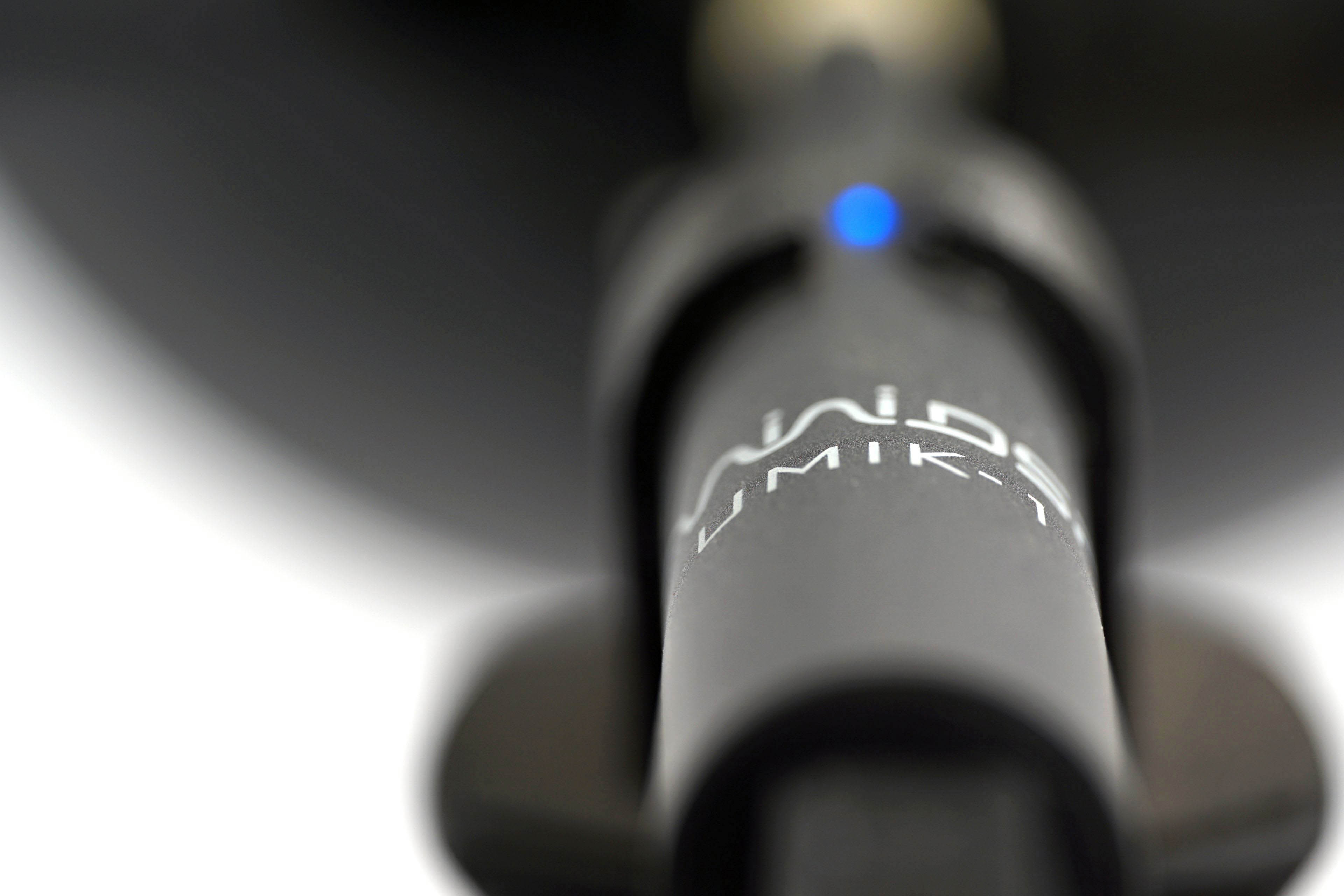
We already do this in graphics card tests, and we’ll do it for fans too, where it makes even more sense. Using the UMIK-1 miniDSP microphone and TrueRTA’s mode-specific, fixed dBA application, we also measure which frequencies contribute more and which contribute less to the sound. The monitored frequency range is 20-20,000 Hz, which we’ll work with at a fine resolution of 1/24 octave. In it, noise levels from 20 Hz to 20 000 Hz are captured at up to 240 frequencies.
The information captured in the spectrograph is a bit more than we will need for clear fan comparisons. While you’ll always find a complete spectrograph in the tests, we’ll only work with the dominant frequencies (and their noise intensities) in the low, mid, and high bands in the comparison tables and charts. The low frequency band is represented by 20–200 Hz, the medium by 201–2000 Hz and the high by 2001–20 000 Hz. From each of these three bands, we select the dominant frequency, i.e. the loudest one, which contributes most to the composition of the sound.
To the dominant frequency we also give the intensity of its noise. However, in this case it is in a different decibel scale than those you are used to from noise meter measurements. Instead of dBA, we have dBu. This is a finer scale, which is additionally expressed negatively. Be careful of this when studying the results – a noise intensity of -70 dBu is higher than -75 dBu. We discussed this in more detail in the article Get familiar with measuring the frequency response of sound.
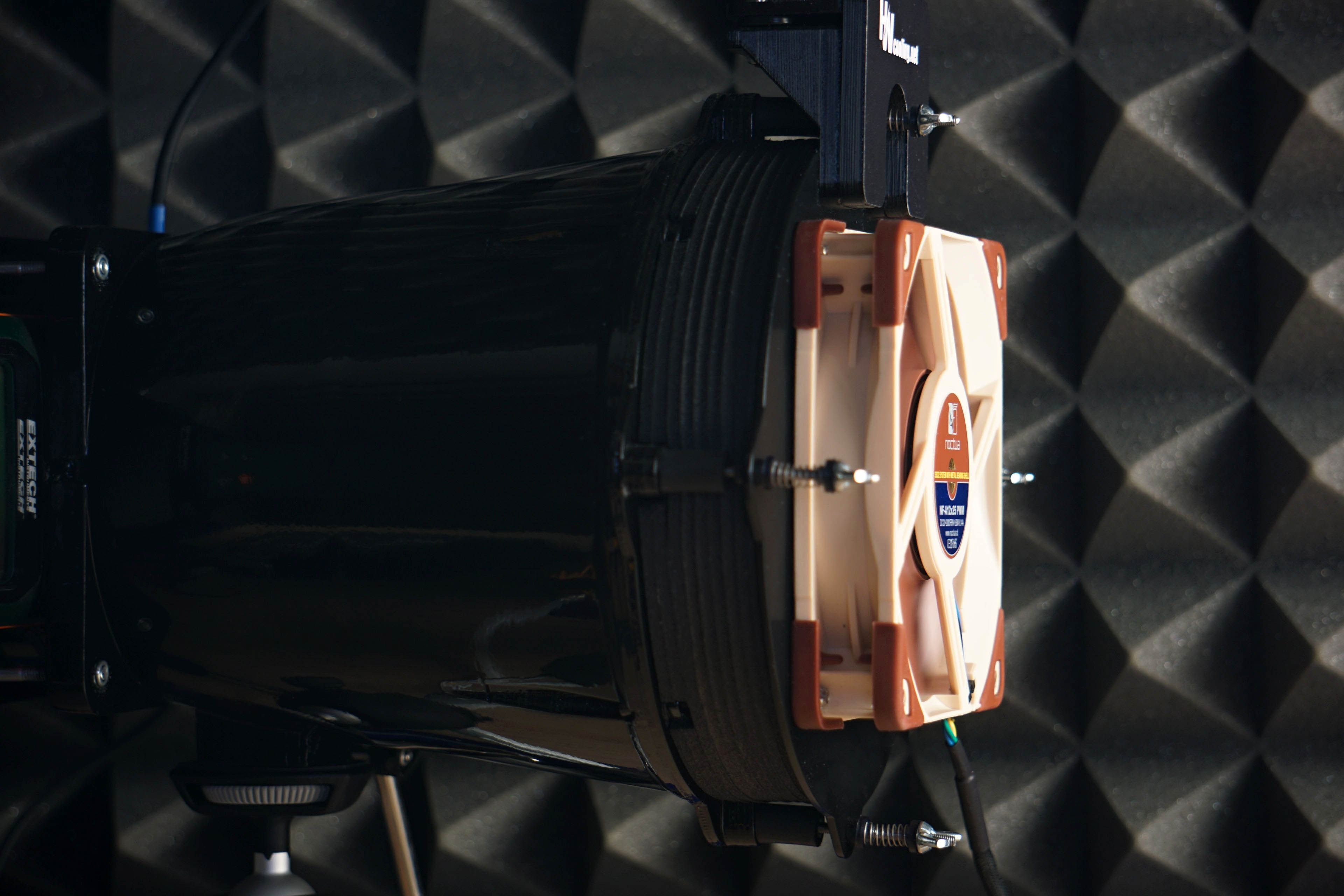
Strict acoustic safeguards are required to ensure that these measurements can be carried out with satisfactory repeatability at all. We use acoustic panels to measure the same values at all frequencies across repeated measurements. These ensure that the sound is always reflected equally to the microphone regardless of the distribution of other objects we have in the testlab. The baseline noise level before each measurement is also naturally the same. The room in which we measure is soundproofed.
Like the noise meter, the microphone has a parabolic collar to increase resolution. The latter is specially in this case not only to amplify but also to filter out the noises that occur whether we want them or not behind the microphone. We are talking about the physical activity of the user (tester). Without this addition, human breathing, for example, would also be picked up by the spectrograph. However, this is successfully reflected off the microphone sensor by the back (convex) side of the collar. As a result, the spectrogram only contains information about the sound emitted by the fan itself.



This is a good study of the effect of rings. The blades are a bit shorter so there’s less airflow at the same noise level (despite higher static pressure), but it suppresses blade vibrations very effectively, improving the noise profile for fans using flexible blades.
I am thinking that the increased static pressure may be partially be due to the increased hub size. It was mentioned by Noctua that the inner parts of the blades have less efficiency, and may even allow air to flow back, so an increased hub size may actually contribute to better static pressure. I think the Gentle Typhoon-like fans all have very similar, large motor hub size because of this.
It’s also interesting to see that the official static pressure spec vs. the one you measured varies by so much between the P12 and the P12 ARGB. The official spec has the P12 having higher static pressure being higher than the ARGB version, yet it is opposite here.
The rotor looks pretty much identical to that of the P12 Max, the other minor difference is the ribs in the stator. Are there any differences apart from blade material and the bearing (aside from RGB?) Perhaps this is the budget fan to get if you want to avoid the dual ball bearing noise of the P12 Max, even if you do not want or need RGB.
Well, the best study would be with P14 rev. 1 vs. rev. 2, if the same motor is used across revisions and the only difference is really in the (non)presence of the hoop.
As for the comparison of the paper specifications of the P12 and P12 A-RGB, I really don’t see the technical reason why the static pressure of the P12 at the same speed should be higher by… what, 25%, when at a speed lower by 200 rpm it should be +19%? It makes sense to me the other way round. Of course, a higher static pressure is indirectly caused by the larger hub, if only because it leaves a smaller empty area between the blades. The smaller the fan format, the higher the static pressure per unit of airflow. With the P12 A-RGB, the hoop itself also increases the overall pressure (i.e. static pressure as well) to a certain extent, as I mentioned in the article.
Anyway, I don’t like to dwell on these things about official parameters. The last thing we want is to have unnecessary back-and-forth with some manufacturer about what they state in their materials. That’s not really the goal, but in this case it couldn’t be completely avoided in the text. Things must always be as clear as possible, that’s what we pride ourselves on. And for the Arctic P12 to have a higher static pressure at the same speed compared to the NF-A12x25, well… 🙂
Noctua has now reduced the hub size for 140mm LCP fans. From internal communication with their representative we know that it is mainly for better optimization of the Centrifugal Turbulator with the unconventional curvature of the blades. Due to the smaller hub, the part of the blades before the curve (i.e. the typical critical part where aerodynamic efficiency decreases) should catch more air streams.
Would be nice to have the P12 CO variants in there as well as an additional reference.
I got some P12 Max’s but was disappointed with the overall noise distribution so I returned them (they definitely moved a lot of air but they were considerably noisier across the entire rpm range compared to the P12 CO’s I had, and one was particularly noisy when placed on a radiator – maybe I got a bad early batch).
I have had regular P12’s before with that hum in the 1000-1100rpm range, but not had a CO variant with that hum before, though obviously limited sample size.
We will add the CO variants, but the closest will be P14 (P14 CO vs. P14), to give a little kick to the building of the 140 mm fan database. We have very few of these in comparison and maybe less than half a year left until the release of Noctua 140mm LCP fans. And of course we want to be adequately prepared for them, i.e. with a sufficiently large reference sample of other fans. But the P12 Max with ball bearings will be added to the tests.
I was able to find the exactly same enhancement from P14s. Unlike the original P14, P14 ARGB has very weak resonant noise at some RPM points and no RPM range that generates a tonal peak. Also the overall noise profile is much better than P14.
As you mentioned, I also think Arctic’s solution is very cost-efficient way to resolve the unintended vibration of impeller. Everyone knows that the better way is using LCP material, but then the price and difficulties of manufacturing becomes the main problem.
Although there are some small downsides of this solution(i.e. Increased a moment of inertia of a rotor and slightly smaller area of blades.), I hope the company apply a rotor frame to other models such as P12/P14 PWM PST.