




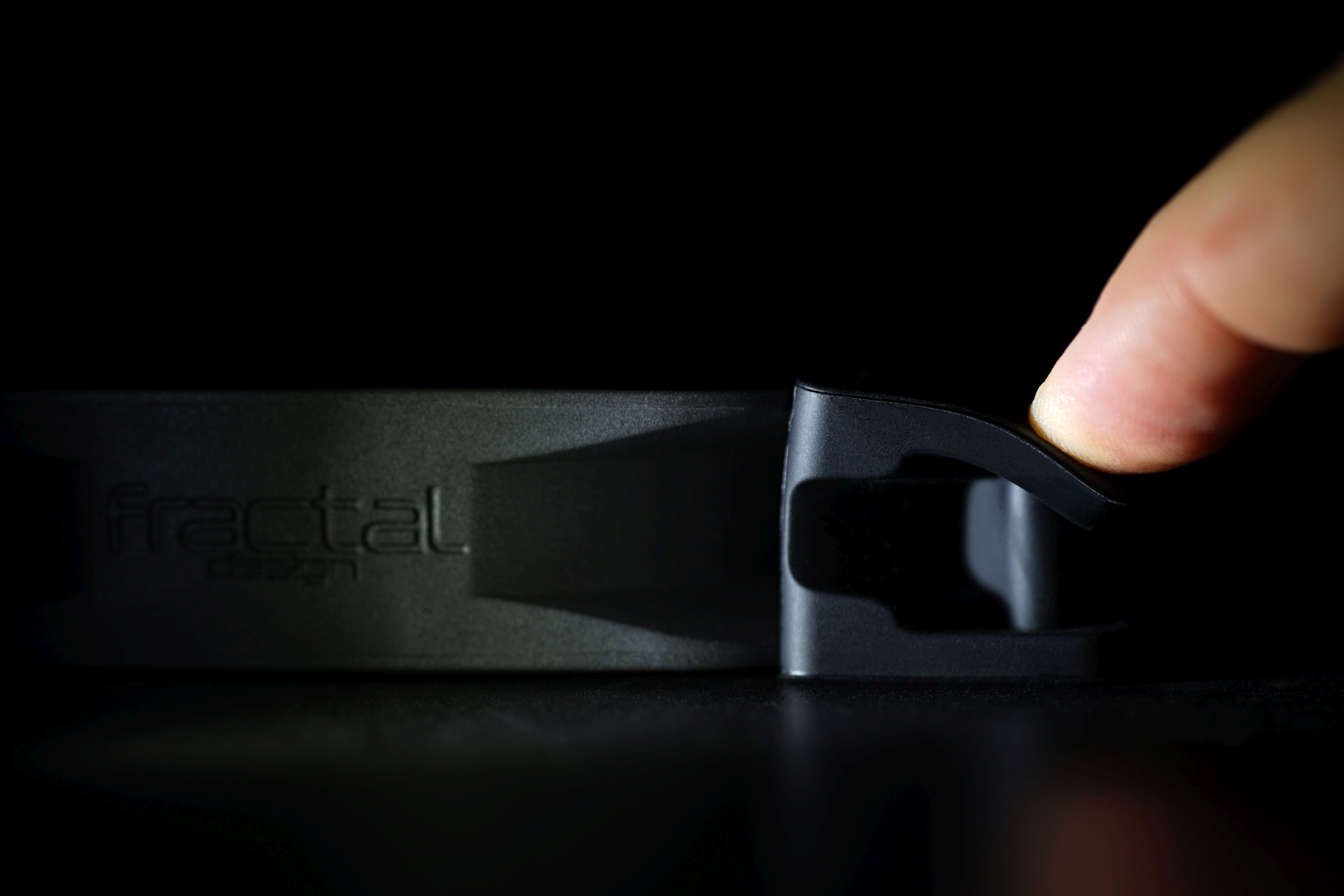
Venturi fans have some of the softest mounting corners. The transmission of vibrations from moving parts further away to anything (case plates, heatsink fins, …) is thus very significantly damped. Compared to other (even more modern Fractal Design models), these fans have more robust blades, which are both thicker and wider, and as a result, higher static pressure is also achieved at comparable speeds.
Results: Airflow through a thinner radiator
Why is there a missing value sometimes? There may be more reasons. Usually it is because the fan could not be adjusted to the target noise level. Some have a higher minimum speed (or the speed is low, but the motor is too noisy) or it is a slower fan that will not reach the higher decibels. But the results in the graphs are also missing if the impeller is brushing against the nylon filter mesh. In that case, we evaluate this combination as incompatible. And zero in the graphs is naturally also in situations where we measure 0.00. This is a common occurrence at extremely low speeds with obstructions or within vibration measurements.




I wonder the reason why these type of corners, despite being so effective, are uncommon. Is it a lack of necessity due to inherent low vibrations, rubber pads/mounts being good enough/better, or some kind of cost or mechanical concerns?
It’s hard to say anything for sure. But I will dare to speculate.
Let’s assume that higher vibrations characterize mainly the cheaper fans, where the goal was to make them as cheap as possible. All-rubber corners don’t fit into this scheme (lowest cost) (such Arctic P12 don’t even have rubber pads), so they are usually not used. And again, when there is a bigger budget for fans, the funds can be put into things that suppress vibrations more effectively than perfect anti-vibration corners. Whether it’s a stiffer material (just with a larger thickness or a different composition, for example LCP instead of PBT) or a less vibrating motor etc.